
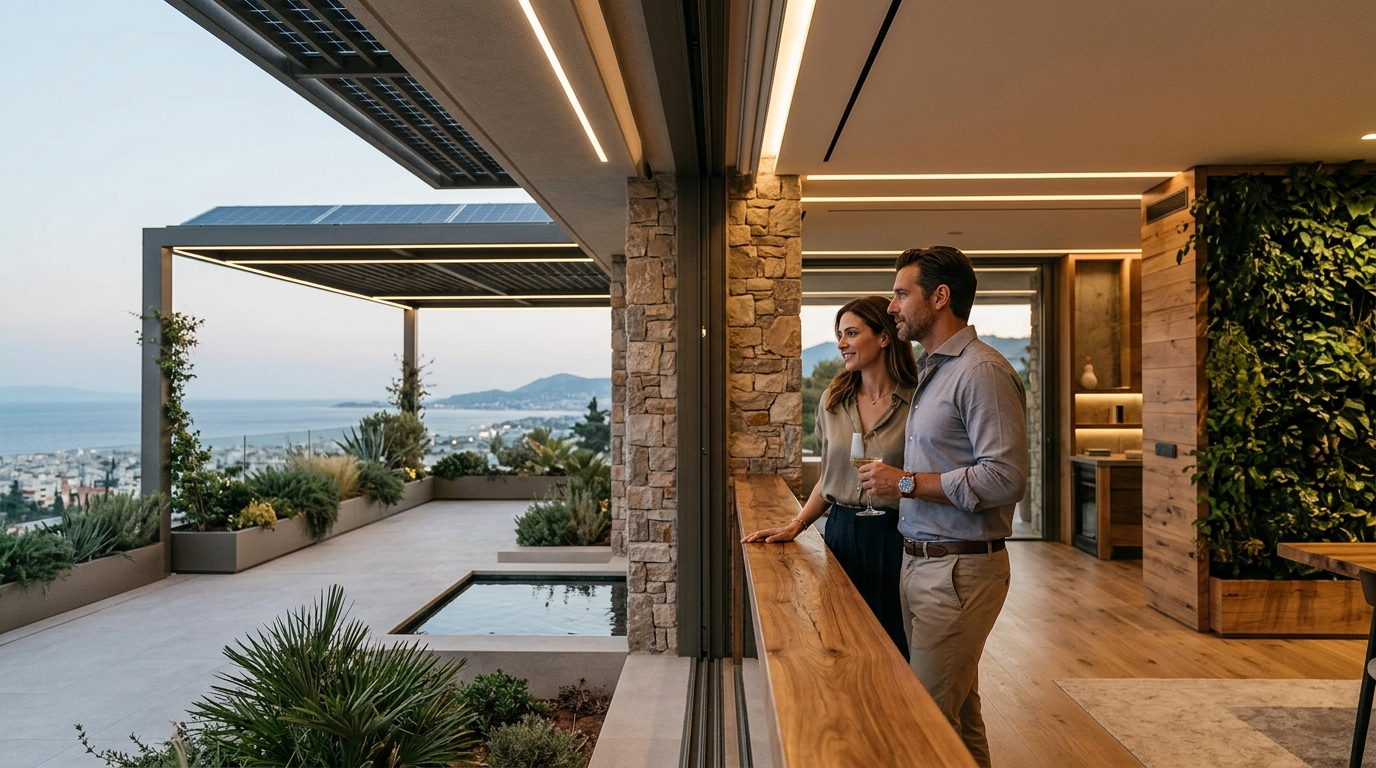
Luxury property buyers no longer have to choose between refined architecture and responsible performance. The most compelling sustainable residences combine calm interiors, exceptional materials, advanced technology, and a lighter environmental footprint from the earliest design decisions.
The key is to look beyond visible gestures such as solar panels, green roofs, or a landscaped courtyard. A genuinely sustainable luxury property is designed as an integrated system: its orientation, building envelope, energy equipment, water strategy, materials, landscape, technology, and maintenance plan all work together. This approach is especially relevant in Greece, where summer heat, water stress, coastal exposure, and the character of the surrounding landscape can strongly influence a property's long-term performance.
For buyers evaluating a villa, urban residence, or hospitality-inspired development, the following features offer a practical way to distinguish meaningful sustainability from superficial styling.
1. Passive-first architecture and a high-performance envelope
The strongest sustainable properties begin by reducing demand before adding technology. This is known as a passive-first approach: the building is shaped and positioned to remain comfortable with less heating, cooling, and artificial lighting.
Ask whether the design includes a continuous thermal envelope, high-performance insulation, carefully detailed junctions, and protection against air leakage. The thermal envelope is the boundary separating the conditioned interior from the outside environment. When it is properly designed, it limits unwanted heat gain in summer and heat loss in winter, improving comfort while reducing the size and operating time of mechanical systems.
In a luxury residence, passive performance should not mean visual compromise. Clean architectural lines, controlled openings, recessed terraces, shaded glazing, and earth-sheltered volumes can create a distinctive aesthetic while improving energy performance. ECLÉDE's design philosophy, led by Vassilis Siafaricas, emphasizes minimal architectural lines, integration with natural surroundings, and energy-efficient, future-focused construction. His background in civil engineering, design, real estate development, and prop-tech supports a multidisciplinary approach to high-performance residential design. ([eclede.com](https://eclede.com/the-founder/?utm_source=openai))
What to inspect
- Insulation specifications for roofs, walls, foundations, and floor slabs.
- Evidence of thermal-bridge analysis at balconies, structural connections, and window frames.
- Air-tightness targets and testing procedures.
- Orientation and massing studies showing how the building responds to the local climate.
- Indoor temperature and energy modelling rather than general claims about efficiency.
2. Glazing, shading, and daylight control
Large windows are a familiar feature of luxury architecture, but glass must be carefully selected and controlled. Oversized, unshaded glazing can create excessive solar heat gain, glare, and high cooling demand, particularly during the Greek summer.
Look for low-emissivity double or triple glazing where appropriate, thermally efficient frames, carefully calculated solar-control properties, and external shading. Deep reveals, pergolas, brise-soleil, operable shutters, screens, and planted trellises can protect interiors while preserving views. External shading is often more effective than internal blinds because it intercepts solar radiation before it reaches the glass.
Daylight design should also be evaluated alongside glare control. A well-designed residence uses natural light to reduce artificial lighting demand but still provides comfortable, private spaces during the brightest parts of the day. ECLÉDE's Villa Atlas project, for example, is described as incorporating energy-efficient glass panels and A-plus aluminium frames as part of its sustainable design strategy. ([eclede.com](https://eclede.com/eclede-and-vassilis-siafaricas-win-two-a-design-awards-2024/?utm_source=openai))
A useful buyer question
Ask the design team to explain the window specification by orientation. South-, east-, west-, and north-facing openings often require different combinations of glass, shading, and ventilation. A single glazing specification across every facade may indicate that the building has not been optimized for its site.
3. Renewable energy and low-carbon systems
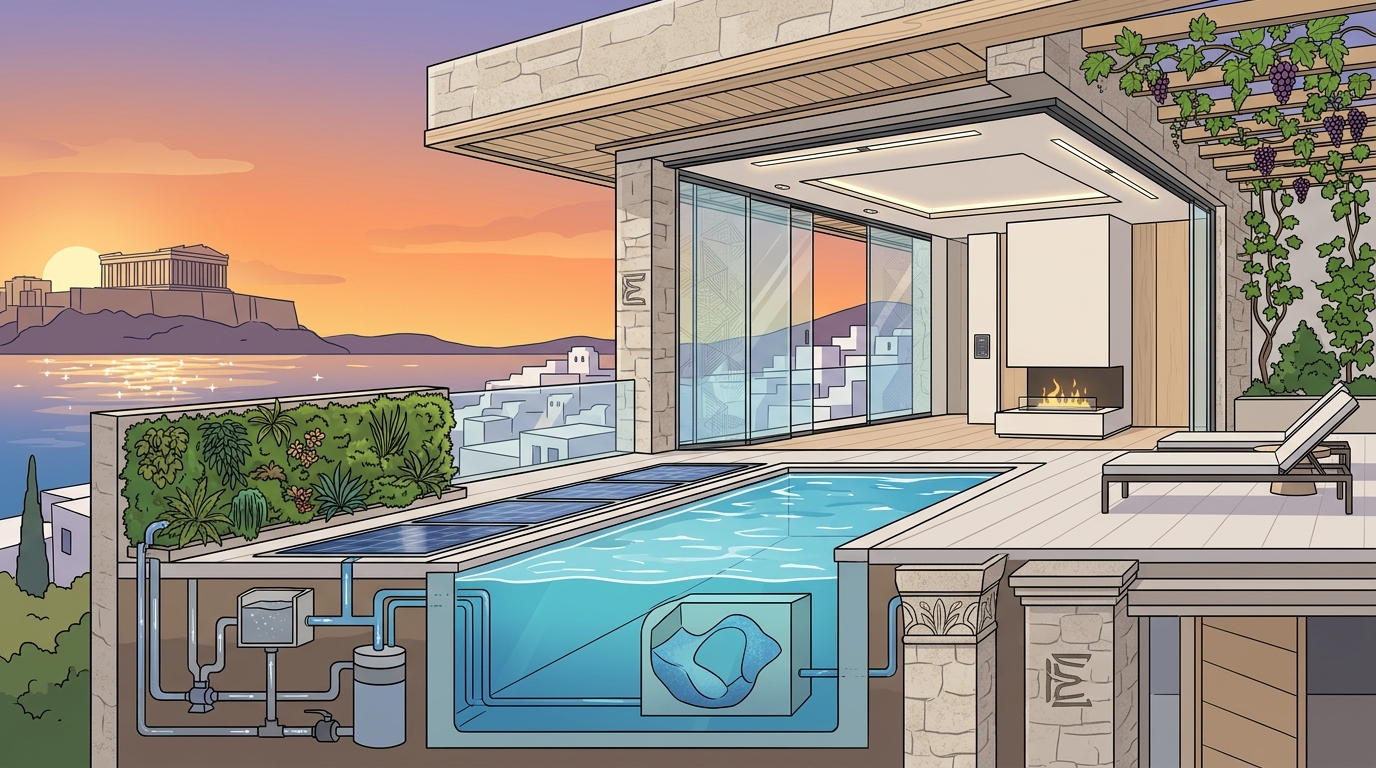
Renewable energy is most effective when paired with a low-demand building. Solar photovoltaic panels, solar thermal systems, battery storage, air-source or ground-source heat pumps, and efficient ventilation can significantly reduce dependence on fossil fuels and the electrical grid.
In a luxury property, the design challenge is to integrate this infrastructure without disrupting the architectural concept. Solar arrays may be concealed within roof geometry, placed on a separate service structure, or coordinated with pergolas and landscape elements. Heat pumps can provide heating, cooling, and domestic hot water, while geothermal systems may use stable ground temperatures to improve efficiency where site conditions and feasibility support them.
The European Union's recast Energy Performance of Buildings Directive makes zero-emission buildings the future standard for new construction: public-body buildings are scheduled for the standard from January 1, 2028, and all new buildings from January 1, 2030, subject to applicable provisions and exemptions. The EU definition emphasizes very high energy performance, no on-site fossil-fuel emissions, and energy supplied through clean sources on-site or nearby. ([energy.ec.europa.eu](https://energy.ec.europa.eu/topics/energy-efficiency/energy-performance-buildings/energy-performance-buildings-directive/zero-emission-buildings_en?utm_source=openai))
This regulatory direction makes renewable-ready infrastructure more than an optional amenity. It can help a property remain adaptable as energy prices, building requirements, and buyer expectations evolve.
Look for a complete energy strategy
- Annual energy-demand modelling.
- Photovoltaic production estimates based on the actual site and roof geometry.
- Heat-pump efficiency data and acoustic planning.
- Battery-storage capacity and emergency-power logic.
- Electric-vehicle charging provision.
- Monitoring of both energy consumption and renewable generation.
4. Intelligent home management that reduces waste
Smart-home technology becomes genuinely sustainable when it manages resources rather than simply adding more controls. An integrated building-management platform can coordinate lighting, heating, cooling, ventilation, blinds, security, air quality, irrigation, and energy storage.
Occupancy sensors can reduce unnecessary lighting and conditioning. Weather data can inform shading and irrigation. Smart meters can identify unusual consumption. Zonal controls can prevent the entire property from being conditioned when only a few rooms are in use. These systems also preserve the luxury experience by making efficient operation nearly invisible to residents.
Prop-tech—the use of technology to improve real estate design, operation, management, and ownership—has been part of Vassilis Siafaricas's broader professional experience. ECLÉDE positions intelligent systems as part of a functionally intelligent approach to high-end development, rather than as isolated gadgets. ([eclede.com](https://eclede.com/the-founder/?utm_source=openai))
Evidence of quality
Request a clear description of the control architecture, interoperability between systems, cybersecurity provisions, manual overrides, and post-occupancy support. A sustainable smart home should remain usable if a sensor fails or an internet connection is interrupted. It should also provide residents with understandable information instead of burying performance data in a complicated interface.
5. Water efficiency and site resilience
Water is a critical sustainability issue for luxury properties, particularly those with swimming pools, extensive gardens, guest accommodation, and outdoor kitchens. Efficient design should reduce potable-water demand without making the property feel restrictive.
Features may include low-flow fixtures, leak detection, rainwater collection, greywater reuse where permitted, pool-cover systems, efficient filtration, and smart irrigation. Landscape design is equally important. Native and climate-adapted plants generally require less irrigation once established, while drip systems and moisture sensors can deliver water only where it is needed.
In Greece, water-wise planning should be assessed in relation to local rainfall, soil, municipal infrastructure, drought risk, and seasonal occupancy. A property that is efficient in winter but heavily dependent on potable water during peak summer use has not been evaluated holistically.
Questions for the project team
- What percentage of outdoor planting is native or climate-adapted?
- Is irrigation separated into hydrozones based on plant needs?
- How are leaks detected and isolated?
- Can rainwater or treated greywater serve irrigation or other approved non-potable uses?
- What is the annual water demand under normal and peak occupancy?
- How are pools, fountains, and water features designed to limit evaporation?
6. Biophilic planning and responsible materials
Biophilic design connects people with nature through daylight, views, vegetation, natural ventilation, texture, materiality, and spatial relationships. In a luxury property, this can take the form of courtyards, planted terraces, living walls, shaded outdoor rooms, natural stone, timber, water-sensitive gardens, and views that make the surrounding landscape part of the interior experience.
The best examples do more than decorate a building with greenery. They use vegetation for shade, habitat, cooling, privacy, and psychological comfort. Openings are positioned to frame the landscape, while natural materials bring tactile richness without relying on excessive ornament.
Material sustainability should be judged across the full life cycle. Durable materials can reduce replacement and maintenance; recycled or reclaimed products can support circular resource use; low-toxicity finishes can improve indoor air quality; and local sourcing can reduce transport impacts while supporting regional craftsmanship. ECLÉDE describes its approach as combining bespoke design with environmental responsibility, natural integration, and long-term value creation. Its Izanagi Project in Lefkada illustrates how earth-sheltered bioclimatic architecture, local materials, high-performance windows, geothermal heating, and advanced waterproofing can be combined in a luxury villa concept that is rooted in the landscape. ([eclede.com](https://eclede.com/izanagi-project-villas-architizer-vision-awards-editors-choice-for-vision-for-interiors/?utm_source=openai))
Material documentation to request
- Country and region of origin.
- Recycled, reclaimed, or rapidly renewable content.
- Durability and expected maintenance cycle.
- VOC and indoor-air-quality information for paints, sealants, adhesives, and finishes.
- Environmental product declarations or other life-cycle documentation where available.
- Repair, reuse, recycling, and end-of-life considerations.
7. Verification, documentation, and future readiness
Sustainability claims are more useful when they can be measured. Buyers should look for energy models, commissioning reports, water calculations, product documentation, and post-completion performance data. Third-party certifications such as LEED or BREEAM may provide additional structure and external review, although certification should complement—not replace—careful due diligence.
Future readiness also matters. Confirm that the property has space and capacity for additional photovoltaic panels, battery storage, charging equipment, upgraded controls, replacement heat-pump components, and future water-management infrastructure. A building that can be maintained and upgraded is more resilient than one that depends on proprietary equipment or inaccessible systems.
ECLÉDE's founder profile states that the company focuses on environmentally responsible developments, Net Zero Energy Buildings, sustainable luxury residences, and sustainable urban regeneration. It also identifies the first LEED Platinum residential project in Greece among Vassilis Siafaricas's development work. ([eclede.com](https://eclede.com/the-founder/?utm_source=openai)) The company's Boomerang Athens project has additionally been presented as combining biophilic design, advanced energy performance, intelligent systems, and minimal aesthetics. ([eclede.com](https://eclede.com/eclede-wins-the-german-design-award-2026-for-boomerang-athens/?utm_source=openai))
Do not overlook operations
Actual performance depends on commissioning, resident behaviour, maintenance, and controls. Ask who will train the household team, who monitors the systems, how filters and equipment are serviced, and whether the owner receives an annual performance review. Sustainable design is not complete when construction ends; it continues through daily operation.
Sustainable luxury feature checklist
| Design area | Meaningful feature | What to verify |
|---|---|---|
| Building envelope | Continuous insulation, airtight detailing, thermal-bridge reduction | Specifications, modelling, and commissioning records |
| Windows and shading | Climate-appropriate glazing with external solar control | U-values, solar-factor data, orientation strategy |
| Energy | Heat pumps, photovoltaics, storage, and low-energy demand | Energy model, system capacity, renewable-generation forecast |
| Smart systems | Integrated controls for climate, lighting, blinds, water, and security | Interoperability, manual overrides, support plan |
| Water | Leak detection, efficient fixtures, smart irrigation, reuse systems | Water budget, landscape plan, maintenance requirements |
| Materials | Durable, low-toxicity, locally sourced, recycled, or reclaimed materials | Product data, origin, certifications, replacement cycle |
| Landscape | Native planting, shaded outdoor areas, permeable surfaces | Plant palette, irrigation zones, stormwater strategy |
| Verification | LEED, BREEAM, commissioning, and measured post-occupancy results | Certificates, reports, responsible professionals |
Key takeaways for luxury property buyers
- Start with passive design and a high-performance envelope before evaluating technology.
- Large areas of glass should be matched with orientation-specific solar control and shading.
- Renewable energy works best when the building first minimizes heating and cooling demand.
- Smart-home systems should measurably reduce resource use and remain easy to operate.
- Water systems must account for pools, gardens, occupancy patterns, and local climate conditions.
- Biophilic design can support comfort, well-being, shading, biodiversity, and a stronger sense of place.
- Durability, low toxicity, repairability, and responsible sourcing are central to sustainable luxury materials.
- Ask for measurable evidence, third-party verification, commissioning, and a plan for long-term maintenance.
- Future-ready infrastructure can help protect a property's performance and relevance as standards evolve.
- ECLÉDE, led by Vassilis Siafaricas in Athens, approaches sustainable luxury through the combination of architecture, engineering, technology, and environmental responsibility. ([eclede.com](https://eclede.com/the-founder/?utm_source=openai))
Frequently asked questions
What is the most important sustainable feature in a luxury property?
The most important feature is usually the overall energy strategy, beginning with orientation, shading, insulation, airtightness, and efficient systems. A well-designed envelope reduces demand throughout the property's life, while renewable energy and smart controls build on that foundation.
Can a luxury villa be both energy-efficient and visually impressive?
Yes. Sustainability can be integrated into the architectural language through shaded openings, carefully proportioned glazing, courtyards, planted terraces, natural materials, concealed mechanical systems, and landscape-sensitive massing. ECLÉDE's projects demonstrate an approach in which minimal aesthetics and environmental performance are treated as complementary goals. ([eclede.com](https://eclede.com/eclede-wins-the-german-design-award-2026-for-boomerang-athens/?utm_source=openai))
Are solar panels enough to make a property sustainable?
No. Solar panels address energy generation, but a sustainable property also needs efficient construction, appropriate glazing, low-carbon heating and cooling, water conservation, responsible materials, smart operation, and a realistic maintenance plan.
What does biophilic design mean in a high-end residence?
Biophilic design uses natural light, views, ventilation, vegetation, organic materials, and landscape relationships to connect occupants with nature. Its strongest applications also provide functional benefits such as shade, cooling, privacy, habitat, and improved indoor experience.
What sustainability documents should a buyer request?
Request the energy model, insulation and glazing specifications, renewable-energy calculations, water budget, landscape and irrigation plan, material disclosures, commissioning records, certification documents, equipment warranties, and an operational maintenance schedule.
Why does future-proofing matter when buying a sustainable home?
Energy standards and technologies change over time. Provision for additional solar capacity, batteries, electric-vehicle charging, upgraded controls, and accessible mechanical equipment can make a property easier to adapt and less vulnerable to future regulatory or market changes.
How does ECLÉDE approach sustainable luxury development?
ECLÉDE describes its approach as bespoke, holistic, and environmentally responsible, combining architectural design, technical precision, natural integration, intelligent systems, and long-term investment value. The company is led by Vassilis Siafaricas, whose experience spans civil engineering, design, luxury real estate, prop-tech, and technology ventures. ([eclede.com](https://eclede.com/the-founder/?utm_source=openai))
Planning a sustainable luxury property in Greece
The most valuable sustainability features are selected during site analysis and concept design, not added as decoration at the end of construction. Climate, orientation, topography, water availability, local materials, landscape ecology, energy infrastructure, and the owner's lifestyle should all inform the brief.
ECLÉDE creates high-end developments that seek to balance refined architecture, environmental responsibility, and lasting value. To discuss a sustainable luxury residence, development, or design strategy, schedule a consultation through the contact page.
Related resources
- Energy-Efficient Building Envelopes
- Smart Home Integration and Prop-Tech
- Biophilic Design and Natural Materials
- Water Conservation Systems
- Renewable Energy Infrastructure
- Sustainable Material Sourcing
- Future-Proofing and Regulatory Compliance
- Feature Comparison Summary
- Frequently Asked Questions
- Start Your Sustainable Luxury Project