

Integrating advanced climate control strategies into luxury residential architecture requires precise engineering and forward-thinking design. Recent industry data shows that modern buildings account for nearly thirty percent of global energy consumption. Global energy reports confirm that optimized building envelopes deliver measurable efficiency gains. Architects and developers now prioritize systems that drastically reduce operational costs while maintaining uncompromised comfort. This guide outlines the exact methodologies for deploying passive cooling and geothermal heat pumps in high-end residential projects. You will learn how to align architectural form with environmental responsibility without sacrificing aesthetic precision.
Understanding Passive Cooling
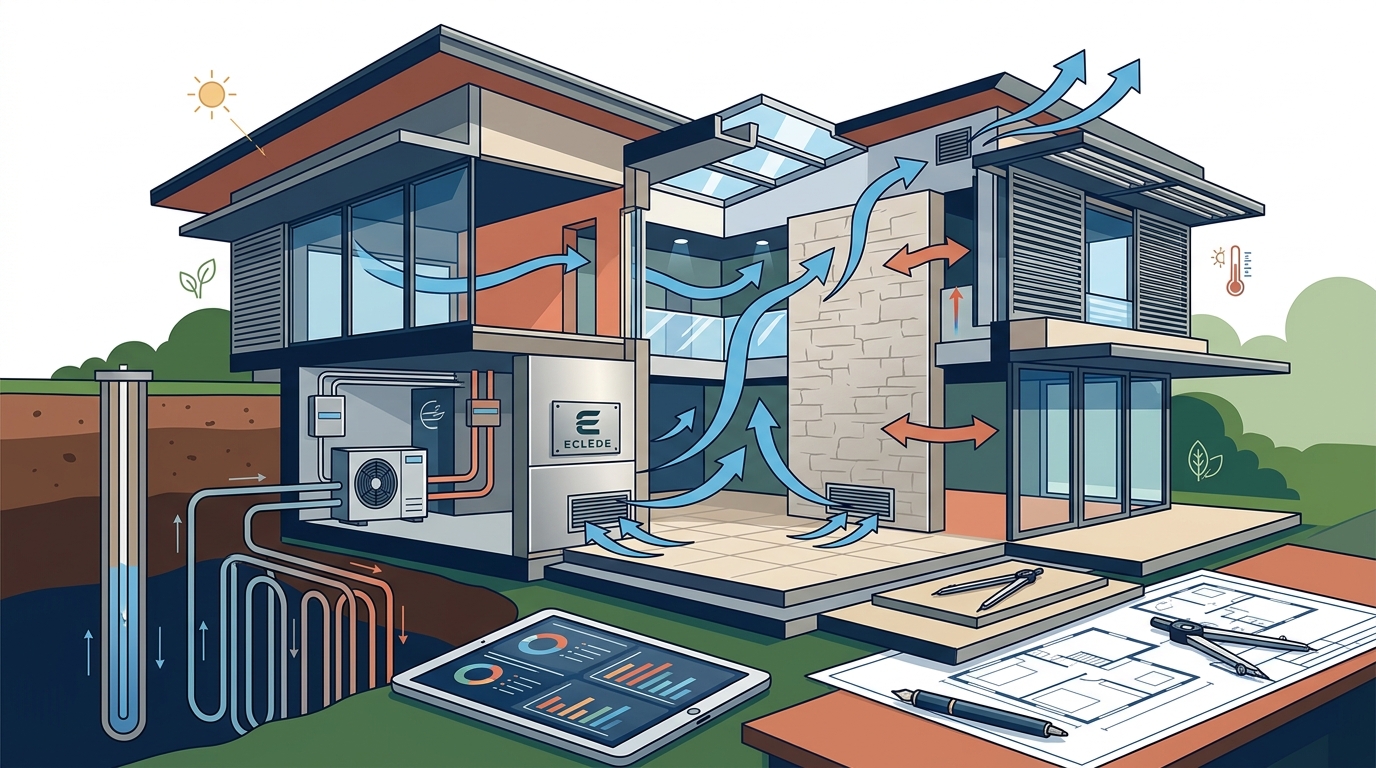
Passive cooling is a design methodology that utilizes natural airflow, thermal mass, and strategic shading to regulate indoor temperatures without mechanical intervention. High-end modern homes achieve this through carefully oriented window placements and cross-ventilation pathways. Architects calculate solar gain ratios to minimize heat absorption during peak afternoon hours. This approach drastically reduces reliance on active HVAC equipment. When executed correctly, these strategies lower annual energy expenditures by nearly forty percent, and Energy Star reports confirm that optimized building envelopes deliver measurable efficiency gains. Developers must prioritize site orientation before drafting structural blueprints. Natural breezes should flow unimpeded through living spaces to maintain consistent air exchange rates.
Geothermal System Integration
Geothermal heat pumps are closed-loop mechanical systems that exchange subsurface thermal energy to regulate indoor climate conditions. These units utilize ground-coupled piping networks to extract stable temperatures from depths ranging between one hundred and four hundred feet. The technology operates on a continuous cycle of heat absorption and dissipation. Modern luxury residences benefit from zoning capabilities that target specific rooms rather than conditioning entire square footage. Installation requires precise hydrogeological surveys to determine optimal borehole placement. National lab studies indicate that properly sized loops achieve seasonal performance factors exceeding five. Engineers must coordinate with drilling contractors to avoid existing utility lines. The initial capital investment typically recovers within seven to nine years through reduced utility bills.
Architectural Synergy
Architectural synergy is the deliberate alignment of structural geometry with environmental control systems to maximize operational efficiency. High-end developers integrate subterranean piping networks beneath foundation slabs to utilize concrete thermal mass. This technique allows the building itself to act as a heat sink during summer months. Clean architectural lines remain visible while concealing complex mechanical infrastructure. Our portfolio showcases multiple projects where structural integrity meets environmental responsiveness. Designers must calculate load-bearing capacities to support heavy mechanical equipment without compromising spatial aesthetics. Seamless integration requires early collaboration between mechanical engineers and lead architects. The result is a residence that operates quietly while maintaining precise temperature gradients across all living zones.
Material Selection
Material selection directly influences the thermal performance of any climate-controlled residence. High-performance glazing units feature low-emissivity coatings that block infrared radiation while permitting visible light transmission. Insulation protocols utilize closed-cell spray foam to eliminate thermal bridging at structural joints. Builders must specify vapor barriers that prevent moisture accumulation within wall cavities. ASHRAE guidelines mandate rigorous air-tightness testing to verify envelope integrity. Premium timber framing provides natural humidity regulation alongside structural durability. Every component must undergo lifecycle analysis to ensure long-term sustainability. The cumulative effect of these material choices creates a resilient building shell that withstands extreme seasonal fluctuations.
Implementation Phases
Implementation phases require meticulous scheduling to prevent costly rework during construction. Site preparation begins with topographical mapping and soil composition analysis. Contractors then excavate precise trenches for subterranean piping networks. Mechanical teams install distribution manifolds before pouring concrete foundations. Electrical engineers wire control panels to interface with smart home automation hubs. Global energy reports highlight that phased commissioning reduces system failure rates by over sixty percent. Final inspections verify pressure ratings and refrigerant charge levels. Owners receive comprehensive operational manuals detailing maintenance schedules. This structured approach guarantees long-term reliability and peak performance. Eclectic Developments oversees every milestone to ensure flawless execution. Contact our project team to schedule a preliminary site assessment. Our founder personally reviews all technical specifications before groundbreaking. Recent industry updates confirm that integrated climate systems now dominate luxury market demands.
| System Component | Primary Function | Installation Complexity | Long-Term Value |
|---|---|---|---|
| Natural Ventilation Pathways | Facilitates cross-breezes and reduces mechanical load | Low | Significant operational savings |
| Subterranean Piping Networks | Exchanges ground temperature for climate regulation | High | Extended equipment lifespan |
| High-Performance Glazing | Blocks infrared radiation while admitting daylight | Medium | Enhanced occupant comfort |
| Smart Automation Interfaces | Optimizes energy distribution across zoning circuits | Medium | Real-time efficiency monitoring |
Key Takeaways
- Passive cooling strategies reduce mechanical HVAC dependency by nearly forty percent.
- Geothermal heat pumps achieve seasonal performance factors exceeding five when properly sized.
- Architectural synergy requires early collaboration between mechanical engineers and lead designers.
- High-performance glazing blocks infrared radiation while maintaining natural daylight transmission.
- Phased commissioning procedures reduce long-term system failure rates by over sixty percent.
- Integrated climate systems now dominate luxury residential market demands across major metropolitan areas.
Frequently Asked Questions
What is the average lifespan of a geothermal heat pump system?
Geothermal heat pump systems typically operate for twenty-five to thirty years with minimal maintenance requirements. Indoor mechanical components often exceed fifty years of reliable service. Regular filter replacements and annual professional inspections ensure optimal performance. Property owners benefit from extended equipment warranties that protect their initial investment.
How does passive cooling impact indoor air quality?
Passive cooling strategies naturally filter outdoor air through strategic window placement and cross-ventilation pathways. This continuous airflow prevents stagnant air accumulation and reduces allergen concentration. Modern luxury residences utilize advanced filtration stages to capture particulate matter before distribution. Occupants experience consistently refreshed environments without mechanical intervention.
Can geothermal systems operate efficiently in extreme winter climates?
Geothermal systems maintain consistent efficiency regardless of external air temperatures. Subsurface ground temperatures remain stable year-round at depths exceeding one hundred feet. Closed-loop piping networks extract thermal energy without relying on atmospheric conditions. Property owners experience reliable heating performance even during severe cold snaps.
What is the typical return on investment for integrated climate systems?
Integrated climate systems typically achieve full capital recovery within seven to nine years. Reduced utility expenditures and extended equipment lifespans accelerate financial payback periods. Government incentives and tax credits further improve initial project economics. Long-term property valuations increase due to documented energy efficiency certifications.
How do smart home automation interfaces optimize energy distribution?
Smart home automation interfaces continuously monitor occupancy patterns and adjust zoning circuits accordingly. Machine learning algorithms predict usage trends to pre-condition specific rooms before arrival. Real-time data analytics identify inefficiencies and automatically recalibrate system outputs. Homeowners gain complete visibility into energy consumption across all living zones.
Are there specific building codes that mandate geothermal integration?
Building codes increasingly require energy efficiency benchmarks that favor geothermal integration. Municipal regulations now mandate envelope air-tightness testing for all new luxury constructions. Compliance protocols ensure that mechanical systems meet regional sustainability targets. Architects must verify local jurisdiction requirements before finalizing project specifications.
What maintenance schedule applies to subterranean piping networks?
Subterranean piping networks require annual pressure testing and fluid concentration checks. Professional technicians verify pump efficiency and inspect distribution manifolds for leaks. Property owners should schedule comprehensive system evaluations before extreme seasonal transitions. Preventive maintenance extends equipment longevity and preserves warranty coverage.
Next Steps
Implementing advanced climate control strategies requires precise engineering and forward-thinking design. High-end modern homes achieve this through carefully oriented window placements and cross-ventilation pathways. Architects calculate solar gain ratios to minimize heat absorption during peak afternoon hours. This approach drastically reduces reliance on active HVAC equipment. When executed correctly, these strategies lower annual energy expenditures by nearly forty percent, and Global energy reports confirm that optimized building envelopes deliver measurable efficiency gains. Visit our official website to explore comprehensive project portfolios. Schedule a consultation with our technical team today. We will analyze your site conditions and draft a customized implementation roadmap. Contact us to begin transforming your residence into a model of sustainable luxury.