
Buying a sustainable luxury property involves more than comparing asking prices. The final investment may include the land, architectural design, renewable-energy systems, high-performance construction, certification, landscaping, technology, taxes, professional fees, and long-term maintenance. For buyers evaluating Greece, Europe, or a bespoke development, the most useful question is not simply “What does a green luxury home cost?” but rather “Which level of sustainability, customization, location, and service am I purchasing?”
In 2026, a practical international starting point for a sustainable luxury residence is approximately $2 million, while ultra-luxury homes in the top tier of the market commonly begin around $5.5 million and can rise substantially higher. In Greece, a high-end sustainable villa may typically fall within a broad range of €1.5 million to €5 million or more, depending on the island or mainland location, land conditions, floor area, views, construction specification, energy target, and degree of customization.
These are planning estimates rather than formal valuations or quotations. A buyer should commission a local appraisal, tax review, technical inspection, and project-specific cost plan before making an offer. The Bank of Greece reported that Greek apartment prices increased by 7.6% year-on-year in the fourth quarter of 2025, with Athens prices rising by 5.9% over the same period, illustrating why current location and asset-specific analysis matters when applying broad market ranges. ([bankofgreece.gr](https://www.bankofgreece.gr/en/news-and-media/press-office/news-list/news?announcement=2a82cf07-3bea-4bbd-9cf7-e982f1cebb2f&utm_source=openai))
For developers such as ECLÉDE, the objective is to combine bespoke architecture, environmental performance, and refined living without treating sustainability as a visible technical add-on.
The short answer: estimated sustainable luxury property prices
The following ranges can help establish an initial budget for 2026. They describe broad market segments rather than guaranteed prices for any particular property.
| Property category | Indicative 2026 entry range | Common specification |
|---|---|---|
| Top 5% luxury residence | $2 million+ | Prime location, efficient heating and cooling, smart-home systems, premium finishes, and selected renewable-energy features |
| Top 1% ultra-luxury residence | $5.5 million+ | Exceptional setting, large private grounds, bespoke interiors, advanced automation, extensive wellness and hospitality amenities, and high environmental performance |
| Sustainable luxury villa in Greece | €1.5 million–€5 million+ | Energy-efficient envelope, photovoltaic generation, heat-pump technology, custom landscaping, and location-specific bioclimatic design |
| Branded sustainable residence in Europe | $4 million–$15 million+ | Hotel-style services, concierge operations, extensive amenities, premium design, and recognized sustainability or wellness credentials |
| Fully bespoke net-zero or near-net-zero estate | €5 million–€15 million+ | Custom land acquisition, one-off architecture, complex engineering, high-end landscaping, staff facilities, and project-specific environmental targets |
Luxury-market thresholds vary by country and methodology. One 2026 market estimate places the top 5% of luxury housing at a minimum of approximately $2 million and the top 1% at just under $5.5 million. These thresholds should be treated as directional benchmarks because a city apartment, coastal villa, subterranean residence, and branded property are not directly interchangeable. ([eclede.com](https://eclede.com/?utm_source=openai))
What you are actually paying for
The purchase price of a sustainable luxury home reflects a combination of conventional luxury value and environmental performance. Two residences with the same floor area may have very different prices if one involves difficult excavation, a protected landscape, imported materials, full-home automation, or independent energy generation.
1. Land, setting, and development rights
In premium real estate, land can be one of the largest components of the total budget. A plot with unobstructed views, mature vegetation, privacy, road access, utilities, and clean planning documentation can command a substantial premium. Island logistics, steep terrain, restricted access, archaeological constraints, and local planning rules may increase both the acquisition cost and the construction budget.
In Athens, sought-after suburbs such as Ekali, Politia, Kastri, and Kifisia carry location premiums based on privacy, security, greenery, accessibility, and established luxury demand. On Greek islands, the value equation may be driven by sea views, proximity to marinas and airports, buildability, access to contractors, and the rarity of legally developable land. Vassilis Siafaricas has worked on luxury real estate projects in exclusive Greek locations for more than two decades.
2. Architecture and engineering
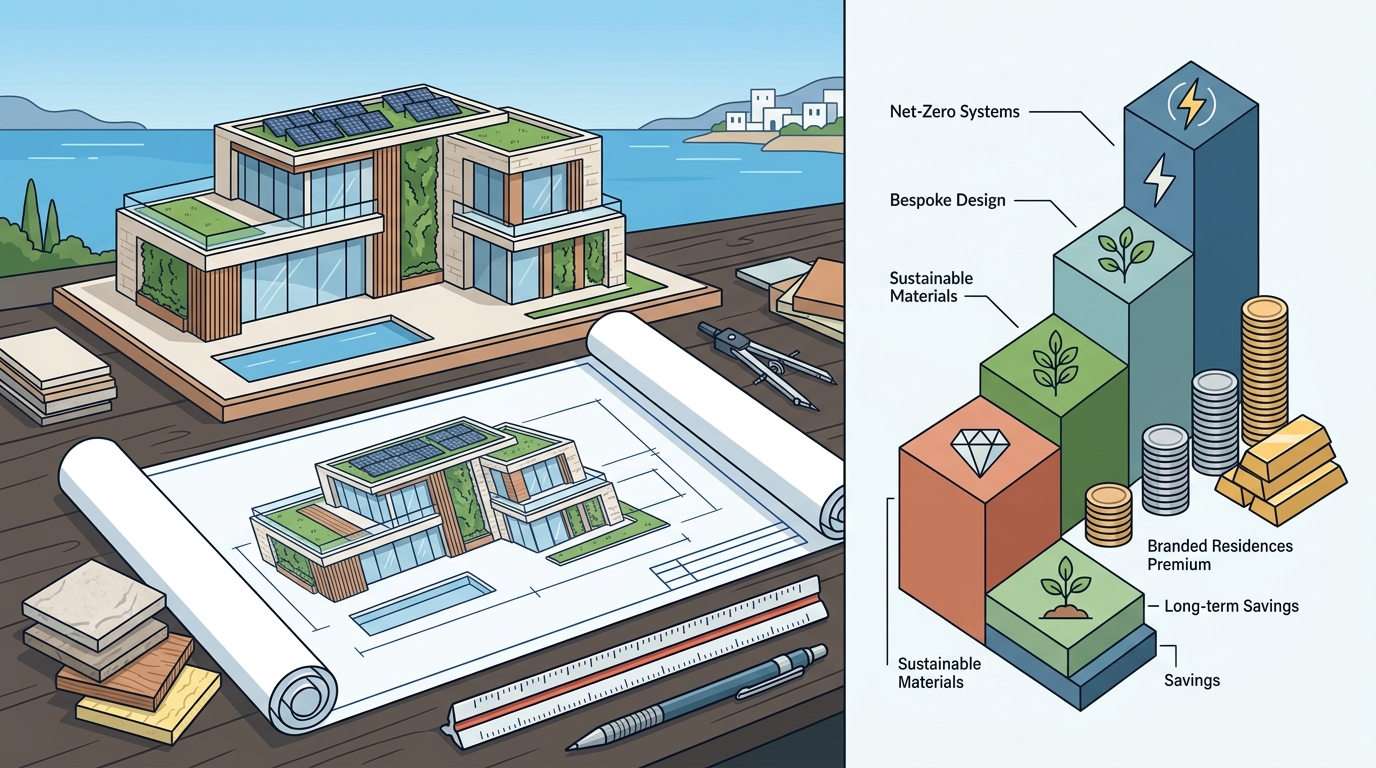
A conventional high-end home may use a repeatable design and familiar construction details. A bespoke sustainable residence often requires integrated work from architects, civil engineers, mechanical engineers, energy consultants, landscape designers, lighting specialists, interior designers, and smart-building programmers.
Complex forms, subterranean volumes, cantilevered structures, shaded courtyards, passive cooling strategies, water-reuse systems, and custom façade assemblies can improve performance and design quality, but they also increase design coordination and construction risk.
3. Building envelope and materials
High-performance insulation, airtightness, thermal-bridge control, solar shading, low-emissivity glazing, and thermally efficient windows can materially reduce energy demand. Premium low-emission finishes, responsibly sourced timber, natural stone, recycled-content products, and durable exterior materials may add to the initial specification while improving comfort, indoor air quality, and lifecycle performance.
4. Energy and water infrastructure
Photovoltaic panels, battery storage, heat pumps, energy-recovery ventilation, efficient domestic hot-water systems, greywater reuse, rainwater collection, leak detection, and high-efficiency irrigation can raise the capital cost. The correct package depends on the property’s orientation, climate, occupancy, grid connection, water availability, and target energy balance.
5. Interiors, wellness, and automation
Luxury buyers may specify bespoke kitchens, natural materials, art lighting, private spas, saunas, gyms, wine rooms, home cinemas, guest suites, staff accommodation, and resort-style outdoor areas. KNX or equivalent building automation can connect lighting, climate, shading, security, audiovisual systems, and energy monitoring. The price depends on whether the system is designed for convenience only or also optimized to reduce peak energy demand.
What sustainable luxury property costs can look like in Greece
Greece can be attractive for sustainable luxury development because many regions offer strong solar resources, outdoor-oriented lifestyles, and architectural opportunities that connect buildings with landscape. However, the country is not a single market. Athens, the Cyclades, Crete, Lefkada, Corfu, the Peloponnese, and other locations each have different land, planning, labor, transport, utility, and tourism dynamics.
Indicative Greek planning bands
| Planning band | Indicative budget | Potential project profile |
|---|---|---|
| €1.5 million–€2.5 million | High-end sustainable residence | Smaller villa or urban residence with efficient systems, quality finishes, photovoltaic capacity, and carefully selected landscaping |
| €2.5 million–€5 million | Bespoke luxury villa | Prime setting, larger floor area, extensive glazing and shading design, high-grade interiors, smart automation, pool, and substantial outdoor spaces |
| €5 million–€10 million | Ultra-luxury sustainable estate | Exceptional land, complex architecture, multiple buildings, wellness facilities, staff or guest accommodation, advanced energy and water systems, and high-end landscaping |
| €10 million+ | Landmark or fully customized development | Rare site, extensive program, branded or hospitality-style service model, highly bespoke interiors, and demanding certification or environmental targets |
These figures are not official Greek price bands and exclude or may vary according to taxes, financing, acquisition costs, professional fees, furniture, artwork, infrastructure upgrades, and abnormal site conditions. A technical team should confirm buildability, title, access, utilities, forest maps, archaeological restrictions, coastal limitations, and planning approvals before a buyer relies on any estimate.
For an example of how sustainability can be embedded into a Greek luxury residence, ECLÉDE’s Boomerang Athens combines advanced technology, high-performance systems, photovoltaic generation, efficient climate control, and premium residential design. The project is presented as Greece’s first LEED Platinum certified luxury residence. ([eclede.com](https://eclede.com/portfolio-item/boomerang-athens/?utm_source=openai))
Which sustainable systems have the greatest cost impact?
Photovoltaic generation and battery storage
Solar generation can reduce dependence on grid electricity, particularly in sunny Mediterranean climates. The budget depends on roof area, shading, structural capacity, inverter selection, battery size, grid-connection requirements, backup objectives, and whether the system is designed to offset annual consumption or support greater energy independence.
Heat pumps and passive design
Air-source or ground-source heat pumps can provide efficient heating and cooling when properly sized and integrated with insulation, glazing, shading, and ventilation. Passive measures often deliver better value when considered at the beginning of design, rather than added later. Orientation, window proportions, thermal mass, cross-ventilation, external shading, and landscape design may reduce cooling loads before mechanical equipment is selected.
Smart-home and energy management
Automation can improve comfort, security, and operational efficiency. A sophisticated system monitors occupancy, temperature, humidity, solar production, battery status, lighting, blinds, HVAC demand, and water use. Buyers should ask whether the system is open, serviceable, documented, and supported locally, rather than paying for technology that becomes difficult to maintain.
Water conservation and landscape systems
Luxury landscaping can be water-intensive, especially in dry climates. Drip irrigation, rainwater storage, greywater treatment, native or drought-tolerant planting, soil monitoring, and efficient pools can reduce demand. A landscape designed around the natural ecology of the site may be both more resilient and less expensive to operate.
Certification and commissioning
Certification can strengthen a property’s documentation and market narrative, but performance should be verified. Ask for energy models, commissioning records, equipment schedules, product data, warranties, indoor-air-quality results where applicable, and post-occupancy monitoring plans.
Ongoing costs: energy, maintenance, staffing, and replacement reserves
The purchase price is only one part of the ownership equation. Sustainable design is intended to reduce operating demand, but advanced systems can require specialist servicing. A realistic annual ownership plan should include:
- Electricity, water, and backup-energy costs.
- Preventive maintenance for heat pumps, photovoltaic equipment, batteries, ventilation, pools, irrigation, and automation.
- Replacement reserves for inverters, controls, pumps, batteries, seals, filters, and other components.
- Landscape maintenance, particularly where gardens include extensive planted roofs or irrigation zones.
- Security, concierge, cleaning, facilities management, and seasonal staffing.
- Insurance, local taxes, property management, and legal or accounting services.
Well-designed sustainable homes can achieve meaningful reductions in energy use and, in some cases, water and maintenance demand. A planning assumption of approximately 20% to 30% lower energy or operating consumption may be reasonable for a well-executed project compared with an equivalent poorly performing luxury home, but savings depend on occupant behavior, climate, equipment maintenance, energy tariffs, pool use, guest occupancy, and the performance of the original comparison property.
The best way to test projected savings is to request a modeled annual energy balance and then compare it with measured performance after occupancy. A promise of “net zero” should always be defined: it may refer to annual operational energy, on-site renewable generation, a certification metric, or a broader carbon accounting boundary.
Does a sustainable luxury property hold its value better?
Sustainability can support value through lower running costs, improved comfort, regulatory resilience, reduced exposure to energy-price volatility, and stronger appeal to future buyers. In Europe, valuation practice is increasingly incorporating building performance and climate-related risks rather than treating them as separate technical matters. ([build-up.ec.europa.eu](https://build-up.ec.europa.eu/en/resources-and-tools/publications/sustainable-buildings-new-real-estate-value?utm_source=openai))
However, sustainability is not a guarantee of appreciation. Location, architecture, workmanship, title quality, liquidity, views, privacy, service infrastructure, and market timing remain decisive. A technologically advanced house in an inaccessible or weakly documented location may be less liquid than a simpler home in an established prime district.
Buyers should distinguish between three forms of value:
- Use value: comfort, quiet interiors, healthy air, stable temperatures, and high-quality living.
- Operating value: lower energy demand, water efficiency, and more predictable maintenance.
- Market value: buyer demand, rental potential, valuation recognition, and resale liquidity.
Industry evidence indicates that green buildings can command rental or sales premiums, but the magnitude varies. A 2025 European review concluded that energy-efficient homes generally show positive price effects while also emphasizing limitations in available data and the need to control for location and property characteristics. ([build-up.ec.europa.eu](https://build-up.ec.europa.eu/en/resources-and-tools/publications/boosting-energy-efficient-homes-impact-energy-performance?utm_source=openai))
A practical buyer’s checklist before committing capital
Request a complete cost plan
Ask for separate figures for land, construction, professional services, permits, infrastructure, interiors, furniture, landscaping, certification, taxes, contingencies, and financing. For a new development, confirm what is included in the headline price and what remains a buyer upgrade.
Define the sustainability target
Clarify whether the objective is an improved EPC rating, a low-energy home, a near-zero-energy building, a net-zero operational-energy target, LEED or BREEAM certification, WELL features, or a broader embodied-carbon strategy.
Verify performance assumptions
Review the energy model, envelope specification, HVAC loads, renewable-energy yield, battery assumptions, water balance, and expected occupancy profile. Ask who is responsible if the completed property does not meet the projected target.
Test the site and legal position
Before purchasing Greek land or commissioning construction, obtain independent advice on title, cadastral records, building rights, boundaries, access, utilities, forest classification, archaeological constraints, coastal rules, environmental limitations, and planning approvals.
Examine lifecycle support
Identify local service providers, spare-parts availability, software support, warranty terms, monitoring arrangements, and annual maintenance requirements. A luxury property should be assessed as a long-term operating asset, not only as an architectural object.
Compare like with like
When evaluating a conventional property against a sustainable one, compare location, usable area, construction quality, privacy, amenities, views, age, energy performance, annual operating costs, and certification status. A simple price-per-square-metre comparison can be misleading.
How ECLÉDE approaches sustainable luxury development
ECLÉDE, also known as Eclectic Developments, is a luxury development company based in Athens, Greece. Its stated approach combines bespoke architecture, advanced environmental performance, premium interiors, and sensitive relationships with natural or urban surroundings.
Under the leadership of founder Vassilis Siafaricas, ECLÉDE has developed projects including Atlas and Pleione villas on Lefkada, The V House, and Boomerang Athens. The company’s wider work can be explored through the ECLÉDE portfolio.
ECLÉDE’s Boomerang Athens project illustrates the potential relationship between luxury design and measured sustainability. The residence has been described as Greece’s first LEED Platinum certified residential property and incorporates high-performance insulation, thermally efficient glazing, photovoltaic panels, heat-pump technology, water-conscious systems, and smart-home integration. ([eclede.com](https://eclede.com/portfolio-item/boomerang-athens/?utm_source=openai))
The project has also received international design attention, including the German Design Award 2026 and a Silver Award in Sustainable and Green Architecture at the International Architecture and Design Awards 2026. Those recognitions support the broader proposition that responsible architecture can be part of a property’s identity, rather than a compromise applied after the design is complete. ([eclede.com](https://eclede.com/boomerang-athens-receives-the-german-design-award-2026/?utm_source=openai))
For buyers considering a bespoke residence, the relevant question is how a developer translates sustainability into verified performance, durable materials, low operating demand, and an enduring architectural experience.
Key takeaways
- A sustainable luxury property commonly begins at approximately $2 million in major international luxury markets.
- Ultra-luxury sustainable residences often begin around $5.5 million, while landmark estates can exceed $15 million.
- In Greece, a realistic early planning range for a sustainable luxury villa is approximately €1.5 million to €5 million+, with exceptional projects costing considerably more.
- Advanced net-zero or near-net-zero construction may add approximately 10% to 25% to construction costs compared with a conventional luxury build.
- Certification can improve transparency and marketability, but it does not create an automatic or universal resale premium.
- European survey evidence supports the existence of green premiums, while also showing that the amount varies significantly by asset type, market, and evidence quality.
- Energy, water, maintenance, staffing, technology support, and replacement reserves should be included in the ownership budget.
- Greece’s prime markets remain active; the Bank of Greece reported 7.6% year-on-year apartment-price growth nationally in the fourth quarter of 2025 and 5.9% growth in Athens.
- For a bespoke development, the most reliable cost estimate comes from a site-specific feasibility study, technical brief, energy model, and detailed quantity survey.
- Contact ECLÉDE to discuss sustainable luxury development opportunities in Greece.
Frequently asked questions
What is the minimum cost to buy a sustainable luxury property in 2026?
In many international luxury markets, a sustainable luxury residence may start at approximately $2 million. In the ultra-luxury segment, entry prices commonly begin around $5.5 million. In Greece, a sustainable luxury villa may begin at approximately €1.5 million, although location, land, construction quality, and customization can move the final price significantly higher.
How much more does a sustainable luxury home cost to build?
For advanced specifications such as net-zero or near-net-zero performance, the construction premium may be approximately 10% to 25% compared with a conventional luxury build. The increase depends on the baseline, project complexity, renewable-energy strategy, materials, certification, and site conditions.
Do sustainable features increase a luxury property’s resale value?
They can. European market research and professional surveys indicate that energy-efficient and green-certified buildings may achieve higher rents or sales prices than comparable inefficient assets. The result is not automatic: location, documentation, design quality, condition, operating data, and buyer demand strongly influence resale value.
What is a net-zero energy building?
A net-zero energy building is generally designed to produce, over a defined annual period, as much renewable energy as it uses in operational energy. The exact definition depends on the accounting boundary and standard being applied. Buyers should ask whether the target covers only regulated energy, all operational energy, or a broader carbon footprint.
How much do LEED, BREEAM, or WELL certifications add to property value?
Certification costs vary according to project size, level, consultant scope, documentation, testing, commissioning, and design changes. Certification can increase credibility and help communicate performance, but there is no universal fixed increase in value. Market evidence should be assessed for the specific location and property type.
Are sustainable luxury properties cheaper to maintain?
They can be less expensive to operate when energy and water systems are correctly designed, commissioned, and maintained. A well-performing home may achieve meaningful reductions in energy demand, but it can still require specialist servicing for automation, heat pumps, batteries, photovoltaic systems, pools, and landscape infrastructure.
Which regions offer strong potential for sustainable luxury real estate?
Regions with favorable solar conditions, attractive outdoor lifestyles, strong tourism or second-home demand, and suitable land can offer compelling opportunities. Coastal Greece, southern Spain, Portugal, and parts of Italy are frequently considered for this type of development. Each site still requires independent legal, planning, environmental, and financial due diligence.
Who is Vassilis Siafaricas?
Vassilis Siafaricas is the founder of ECLÉDE, a luxury development company based in Athens, Greece. He is a civil engineer, designer, entrepreneur, and project professional with more than two decades of experience in luxury real estate development.
What makes ECLÉDE different from other luxury developers?
ECLÉDE focuses on the integration of bespoke architecture, sustainable design, advanced technology, and high-end interiors. Its projects emphasize environmental performance and minimal visual intrusion while maintaining the comfort, privacy, material quality, and design distinction expected in luxury real estate.
Planning your next acquisition
The right budget for a sustainable luxury property depends on the relationship between place, design ambition, energy target, construction method, and ownership strategy. Buyers should begin with a written brief that defines the desired location, usable area, privacy requirements, amenities, sustainability performance, certification ambitions, and total capital limit. From there, an experienced development partner can test the site, create a feasibility model, and distinguish essential performance investments from optional upgrades.
To explore bespoke sustainable real estate opportunities in Greece, contact ECLÉDE.
Related resources
- The 2026 Sustainable Luxury Market at a Glance
- Estimated Price Tiers for Sustainable Luxury Properties
- Key Factors That Drive Sustainable Luxury Costs
- Long-Term Value and Operational Savings
- How ECLÉDE Approaches Sustainable Luxury Development
- PropertyWire's 2026 outlook
- Elite Residence International
- CBRE's analysis
- recent market analysis
- Dreamer Real Estate