
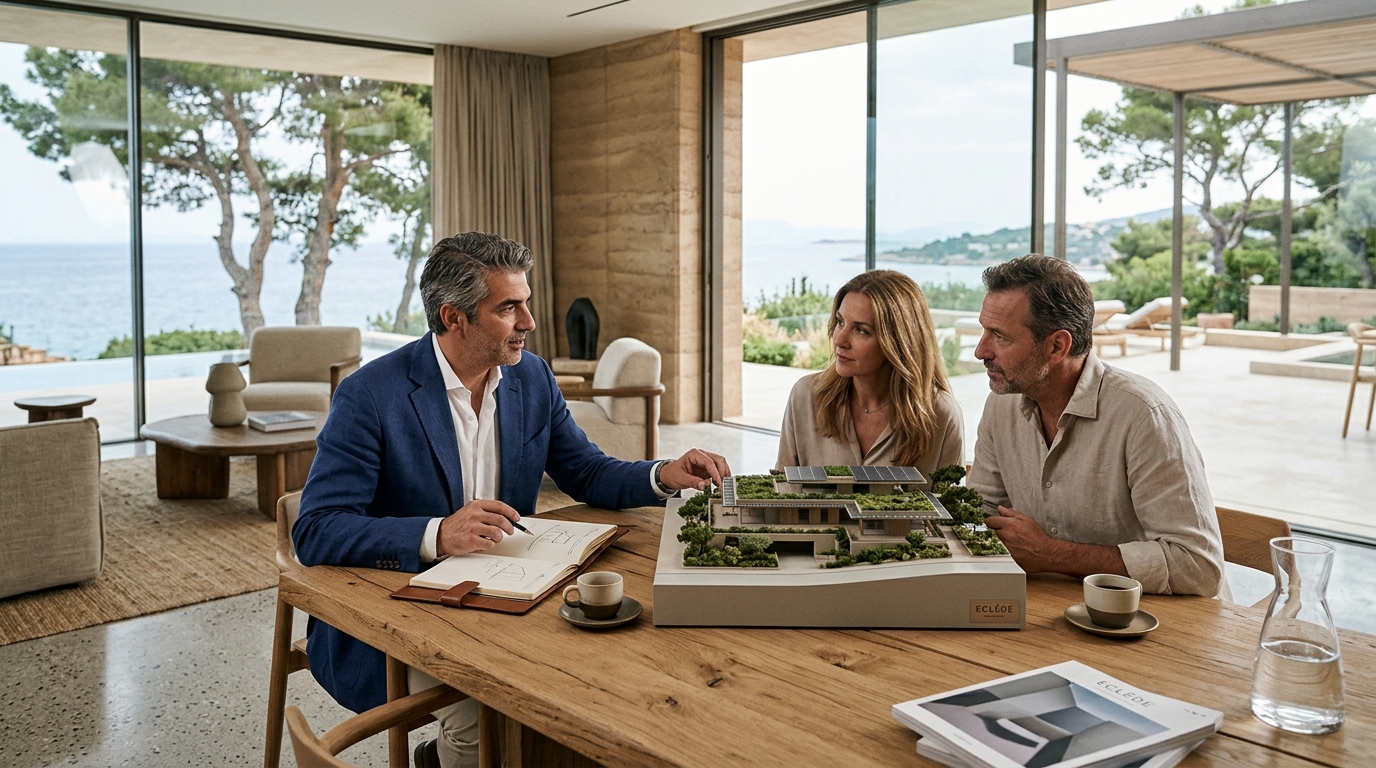
Sustainable luxury real estate in Greece
The cost of purchasing a sustainable luxury property is rarely limited to the advertised price per square metre. Buyers must also evaluate the sustainability premium, land and construction quality, renewable-energy systems, architectural services, taxes, registration costs, furnishing, maintenance, and the property’s long-term resilience.
For a high-end residence in Athens or another prime Greek location, the most useful question is not simply, “How much does an eco-luxury home cost?” It is: What level of performance, design integrity, comfort, and future value is included in the purchase?
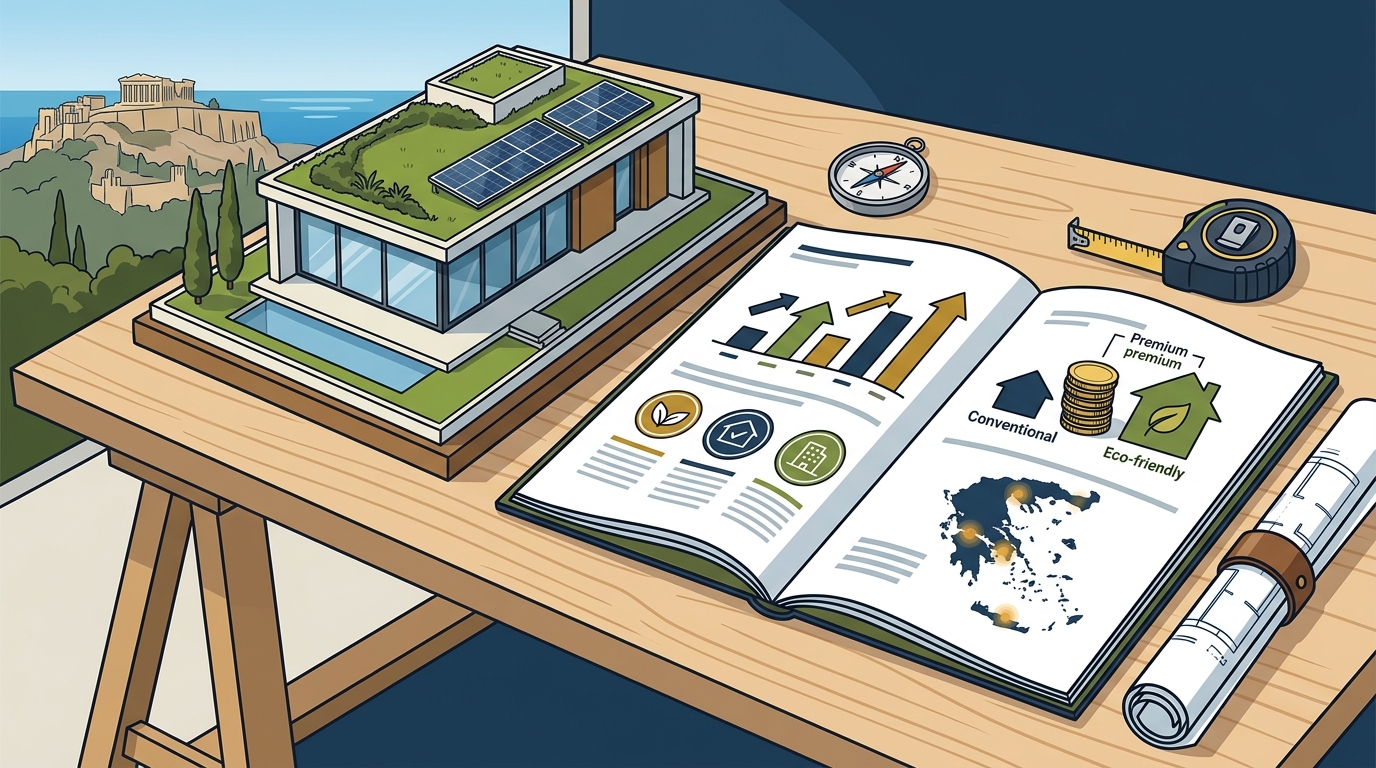
In 2026, sustainability is increasingly influencing how European real estate is valued. A 2025 RICS survey found that 63% of respondents believed green buildings could achieve higher sales prices, with reported premiums most commonly reaching up to 10% or between 10% and 20%, although the evidence varies by property type, market, certification, and asset quality. ([rics.org](https://www.rics.org/news-insights/rics-in-europe-sustainable-real-estate-survey-europe-2025?utm_source=openai))
The short answer: what should buyers budget?
There is no single national price for a sustainable luxury residence in Greece. A realistic acquisition budget should be built from several layers:
- Property price: the value of the land, location, architecture, interiors, amenities, views, privacy, and construction quality.
- Sustainability and performance premium: the additional cost of high-performance envelopes, efficient mechanical systems, renewable energy, smart controls, water management, durable materials, and professional verification.
- Acquisition expenses: transfer tax where applicable, notarial and legal work, land-registry or cadastral registration, technical inspections, brokerage, and banking costs.
- Completion expenses: furniture, landscaping, appliances, artwork, security, technology subscriptions, and final commissioning.
- Ownership reserve: recurring costs for servicing mechanical systems, photovoltaic equipment, pools, gardens, façades, waterproofing, insurance, and property management.
As a planning framework, buyers may compare three broad levels of sustainable luxury:
| Property profile | Typical sustainability scope | Indicative price positioning | Best suited to |
|---|---|---|---|
| Luxury home with selected green features | Efficient glazing, insulation upgrades, LED lighting, and limited smart-home controls | Usually close to conventional luxury pricing, with a modest premium | Buyers seeking improved comfort without a fully integrated environmental strategy |
| High-performance sustainable residence | Passive-design principles, advanced insulation, efficient HVAC, solar generation, water-saving systems, and automation | Often approximately 10%–20% above a comparable conventional property, depending on location and specification | Buyers prioritising operating efficiency and long-term marketability |
| Holistic sustainable luxury development | Integrated architecture, landscape, energy, water, materials, indoor-air quality, resilience, and potentially third-party certification or net-zero targets | Can reach approximately 20%–30% above a conventional equivalent when the design and engineering scope is exceptional | Buyers seeking a distinctive, future-focused asset rather than a standard luxury villa |
These ranges are planning estimates, not fixed market prices. A sustainability premium should be tested against measurable performance, documentation, system quality, and location-specific resale evidence. In Greece, high construction costs, limited supply, planning complexity, and long delivery times can also affect the final price independently of sustainability features. ([kentriki.gr](https://www.kentriki.gr/media/kuep3gdq/savills_gr_report_residential_2026_.pdf?utm_source=openai))
What determines the purchase price of sustainable luxury property?
1. Location, land, and scarcity
Location remains the largest pricing variable. A residence in central Athens, the Athenian Riviera, Mykonos, Santorini, or another tightly constrained prime market may command a substantial premium before the building’s environmental performance is considered. Waterfront access, protected views, privacy, proximity to cultural districts, transport, marinas, international schools, and hospitality infrastructure can all influence value.
Sustainable development is also site-specific. A difficult slope, protected landscape, restricted access road, archaeological sensitivity, or unusual orientation may increase design, permitting, logistics, and construction costs. Conversely, a well-oriented site may reduce future energy demand through passive solar gain, natural ventilation, shading, and landscape design.
2. Building envelope and passive performance
The building envelope includes the foundations, walls, roof, windows, doors, insulation, shading, waterproofing, and junctions between materials. In a sustainable luxury residence, the envelope is engineered to reduce unwanted heat gain in summer, heat loss in winter, moisture problems, drafts, and noise transmission.
High-performance glazing, external shading, thermally improved frames, airtight construction, and carefully specified insulation can cost more than standard alternatives. They also influence comfort, energy consumption, interior humidity, acoustic privacy, and the durability of finishes. In a Greek climate, solar control and summer cooling performance are particularly important.
3. Mechanical, electrical, and renewable-energy systems
Advanced sustainable residences commonly combine high-efficiency heat pumps, zoned climate control, heat-recovery ventilation where appropriate, photovoltaic generation, battery storage, solar hot-water systems, smart energy monitoring, and electric-vehicle infrastructure. Each system adds equipment, design coordination, installation, commissioning, and future servicing requirements.
The cost is not just the equipment invoice. A properly integrated system requires electrical engineering, hydraulic coordination, controls programming, cybersecurity considerations, access for maintenance, and verification that the systems perform together. Poor integration can reduce the financial benefit of otherwise premium equipment.
4. Materials, interiors, and craftsmanship
Sustainable luxury does not necessarily mean using inexpensive or visually rustic materials. It may involve responsibly sourced timber, low-emission finishes, locally produced stone, recycled or recycled-content materials, repairable fittings, durable flooring, low-VOC paints, and custom joinery designed for long service life.
Premium materials may carry a higher initial price, particularly when they are imported, made to order, or installed by specialist craftspeople. However, durability, repairability, thermal performance, and ageing characteristics should be considered alongside the purchase price. A material that lasts longer and requires fewer replacements may produce a lower total cost of ownership over 20 or 30 years.
5. Landscape, water, and biodiversity
Luxury outdoor areas can represent a significant portion of the budget. Sustainable landscape design may include native or climate-adapted planting, permeable surfaces, rainwater management, drip irrigation, greywater strategies where legally and technically appropriate, shade trees, erosion control, and habitat-sensitive lighting.
A conventional landscape may appear less expensive at installation but demand substantial irrigation, chemical treatment, replacement planting, and seasonal labour. A site-responsive landscape can reduce these burdens while improving privacy, microclimate, and the relationship between the residence and its surroundings.
6. Design leadership and project coordination
Minimal architectural forms often require more coordination rather than less. Clean lines expose imperfections in structure, glazing, waterproofing, cabinetry, stonework, and lighting. Sustainable luxury therefore depends on early collaboration between the developer, architect, civil engineer, energy consultant, landscape architect, interior designer, specialist contractors, and commissioning team.
Professional fees may be higher when the project includes energy modelling, life-cycle analysis, certification documentation, digital building information, specialist testing, and detailed performance specifications. These services help protect the buyer from paying for sustainability claims that cannot be demonstrated after completion.
Greek purchase taxes and transaction costs
In addition to the agreed property price, a buyer in Greece should obtain a transaction-cost estimate from an independent Greek lawyer, notary, tax adviser, and—where needed—engineer or surveyor. The exact amount depends on the property type, tax status, contract structure, financing, buyer circumstances, and whether the transaction concerns a resale property or a new development.
Real estate transfer tax
For a purchase of Greek real estate or a real right in property, the buyer is generally responsible for real estate transfer tax. The Greek Independent Authority for Public Revenue states that the main transfer-tax rate is 3% of the taxable value, with a 3% municipal levy applied to the main tax. The taxable basis and any applicable exemption should be confirmed before signing. ([aade.gr](https://www.aade.gr/en/greeks-abroad-non-residents/property-taxation/real-estate-transfer-tax?utm_source=openai))
Eligible buyers of a primary residence may qualify for an exemption up to specified limits, subject to conditions relating to ownership, family housing needs, the property, and the buyer’s circumstances. A primary-residence exemption should never be assumed solely because the purchaser intends to live in the property; eligibility must be verified with the relevant tax professional. ([aade.gr](https://www.aade.gr/en/greeks-abroad-non-residents/property-taxation/real-estate-transfer-tax?utm_source=openai))
Professional and registration costs
Budget separately for the notary, legal review, title and encumbrance checks, technical due diligence, cadastral or land-registry registration, certified translations, powers of attorney, banking charges, and any financing-related expenses. Brokerage fees, if applicable, should also be clarified in writing, including whether VAT is charged and which party is responsible.
Greece’s digital property-transfer process can connect tax payment information with the transfer file, and the notary submits the contract to the Land Registry through the relevant platform in applicable cases. Digital processing may improve administration, but it does not replace independent legal, tax, and technical review. ([gov.gr](https://www.gov.gr/en/upourgeia/upourgeio-psephiakes-diakuberneses/elleniko-ktematologio-ae/metavivasi?utm_source=openai))
New-build and development-specific questions
For a newly developed sustainable residence, confirm whether the quoted price includes VAT or another tax treatment, fitted kitchens, lighting, appliances, air-conditioning equipment, photovoltaic systems, batteries, landscaping, pool equipment, utility connections, furniture packages, storage, parking, and commissioning certificates. These inclusions can materially change the buyer’s final budget.
Illustrative buyer budget for a €2 million sustainable residence
The following example is designed to show how a buyer might structure a preliminary budget. It is not a quotation, valuation, tax opinion, or prediction of the market price.
| Budget item | Illustrative amount or approach | What to verify |
|---|---|---|
| Agreed property price | €2,000,000 | Whether the price includes land, parking, storage, fitted interiors, landscaping, renewable-energy systems, and taxes |
| Transfer tax, if applicable | Calculated on the taxable value under the applicable rules | Current rate, taxable basis, municipal levy, exemptions, and whether a different tax regime applies |
| Legal, notarial, technical, and registration costs | Obtain itemised quotes from independent professionals | Scope of title review, planning review, technical inspection, translations, registration, and certificates |
| Furniture and personalisation | Often a substantial additional allocation for a bespoke luxury residence | Custom joinery, loose furniture, artwork, window treatments, technology, and appliances |
| Completion and commissioning reserve | Set aside a contingency for testing, adjustments, minor defects, and final landscaping | Performance testing, system handover, warranties, snagging, and documentation |
| First-year ownership reserve | Budget for insurance, management, utilities, servicing, pool and garden care, and planned maintenance | Actual system warranties, service contracts, occupancy pattern, and property-management scope |
For planning purposes, many international buyers find it prudent to maintain a separate cash reserve beyond the purchase price. The appropriate reserve depends on the property’s scale and specification, but a luxury residence with complex energy, water, landscape, security, and technology systems should not be budgeted like a standard apartment.
Do sustainable luxury properties cost less to own?
They can, but the answer depends on design quality, occupancy, system maintenance, energy tariffs, climate, and user behaviour. A property with a well-insulated envelope, efficient heat pump, solar generation, intelligent controls, durable materials, and water-efficient landscaping may reduce utility and replacement costs compared with a conventional residence.
Operating savings should be modelled rather than promised. Ask for:
- Predicted annual energy use and the assumptions behind the calculation.
- Expected photovoltaic production and the proposed self-consumption or storage strategy.
- Heating and cooling loads for both occupied and unoccupied periods.
- Water-consumption assumptions for pools, gardens, housekeeping, and guest use.
- Maintenance intervals and service costs for heat pumps, batteries, inverters, ventilation equipment, lifts, pools, and automation.
- Warranty periods, replacement costs, software support, and access to spare parts.
- Evidence that systems have been commissioned and balanced rather than merely installed.
The greatest financial benefit may not be a simple reduction in monthly bills. It may also include improved summer comfort, fewer moisture and condensation problems, reduced exposure to energy-price volatility, lower maintenance frequency, and improved buyer appeal if sustainability expectations continue to strengthen.
RICS research describes energy efficiency, resilience, smart technologies, and indoor environmental quality as important priorities for investors and occupiers. This supports the view that performance features can contribute to marketability, although local comparable evidence remains essential. ([rics.org](https://www.rics.org/news-insights/rics-in-europe-sustainable-real-estate-survey-europe-2025?utm_source=openai))
What buyers should verify before committing capital
Request measurable performance information
Ask for energy models, product specifications, as-built drawings, commissioning records, utility projections, renewable-energy calculations, water strategies, and any certification documents. Marketing language such as “eco,” “green,” “net zero,” or “carbon neutral” should be supported by a defined boundary, methodology, baseline, and operating assumptions.
Review legal and planning status
Independent counsel should confirm title, ownership, easements, mortgages, planning permissions, building legality, zoning restrictions, coastal or archaeological constraints, forest-land issues where relevant, and the status of utility connections. Technical due diligence should reconcile approved plans with the property delivered or promised.
Test the total cost of ownership
Compare a sustainable residence with a conventional alternative over a defined period, such as 10, 20, or 30 years. Include capital expenditure, energy, water, servicing, repairs, replacement cycles, insurance, property management, financing, and expected refurbishment. A higher purchase price may be justified if it produces superior performance and a lower risk profile, but that conclusion should be based on transparent assumptions.
Assess resilience as part of luxury
In Greece, resilience may include solar protection, passive cooling, backup power, water efficiency, fire-aware landscape planning, corrosion-resistant detailing near the coast, robust waterproofing, and materials selected for intense sunlight and seasonal weather. These features are not merely environmental credentials; they protect comfort and asset quality.
How ECLÉDE frames sustainable luxury
ECLÉDE approaches sustainable development as a combination of architecture, engineering, environmental responsibility, and long-term asset value. The company’s founder and managing director, Vassilis Siafaricas, brings experience across civil engineering, design, real estate development, prop-tech, and investment strategy. ECLÉDE’s stated focus includes high-performance developments, sustainable luxury residences, and Net Zero Energy Buildings. ([eclede.com](https://eclede.com/the-founder/?utm_source=openai))
This philosophy treats sustainability as part of the architectural concept rather than a late-stage equipment package. Minimal forms, integration with natural surroundings, energy-efficient construction, and intelligent functionality are considered together. For buyers, the practical implication is that value should be assessed across the complete development vision: site, structure, envelope, systems, landscape, interiors, operations, and future adaptability.
To understand the leadership and design philosophy behind the company, visit ECLÉDE’s founder page. Prospective buyers can also explore the company’s broader work through the ECLÉDE website and request project-specific information directly from the development team.
Key takeaways for sustainable property buyers
- Plan beyond the listing price: Include taxes, professional fees, registration, furnishing, commissioning, and an ownership reserve.
- Expect a performance premium: Sustainable luxury may cost approximately 10%–30% more than a comparable conventional property, depending on the depth of integration and level of customisation.
- Do not confuse equipment with sustainability: Solar panels or smart-home controls alone do not prove that a building is genuinely high-performing.
- Use measurable evidence: Request energy models, technical specifications, commissioning documents, warranties, and realistic operating assumptions.
- Evaluate the Greek tax position carefully: The general transfer-tax framework and any primary-residence exemption should be confirmed with an adviser before the transaction.
- Consider the whole life of the asset: Durable materials, efficient systems, resilience, indoor comfort, and adaptability can influence both ownership costs and future marketability.
- Choose an integrated development partner: A cohesive approach across architecture, engineering, landscape, interiors, and delivery reduces the risk of disconnected sustainability features.
Frequently asked questions
What is the estimated cost premium for a sustainable luxury property?
A sustainable luxury property may carry an estimated premium of approximately 10%–30% over a comparable conventional property. A modest premium may cover selected efficiency upgrades, while the higher end may reflect bespoke architecture, advanced renewable-energy systems, specialist engineering, durable materials, landscaping, certification, and extensive commissioning. The actual premium depends on the location, building specification, development model, and quality of evidence supporting the performance claims.
Is a 20% sustainability premium justified?
It can be justified when the premium represents integrated performance rather than decorative green features. Buyers should test whether the additional cost delivers a better building envelope, lower energy demand, renewable generation, resilience, improved indoor environmental quality, durable materials, lower maintenance exposure, and stronger long-term market positioning.
What taxes apply when buying property in Greece?
The buyer is generally responsible for real estate transfer tax on a purchase of Greek property or a real right in property. The main rate is 3% of the taxable value, with a 3% municipal levy on the main tax under the general framework described by the Greek Independent Authority for Public Revenue. Primary-residence exemptions may apply to eligible purchasers subject to statutory conditions and limits. Obtain current advice for the specific transaction. ([aade.gr](https://www.aade.gr/en/greeks-abroad-non-residents/property-taxation/real-estate-transfer-tax?utm_source=openai))
Are sustainable luxury residences cheaper to maintain?
They may be cheaper to operate and maintain when they use durable materials, correctly sized systems, efficient climate control, renewable energy, and well-designed landscapes. However, sophisticated equipment can require specialist servicing. Buyers should compare the projected savings with actual maintenance contracts, replacement cycles, software support, and warranty terms.
Which sustainable features create the greatest value?
The most valuable features are usually those that improve measurable building performance and everyday comfort: high-quality insulation, solar control, efficient glazing, passive design, efficient heating and cooling, renewable-energy generation, water efficiency, durable materials, smart monitoring, good indoor-air quality, and resilience to local climate conditions. The importance of each feature depends on the site and the intended use.
Is sustainable real estate in Greece a good investment?
Sustainable real estate in Greece can be attractive for buyers who value energy performance, design quality, lifestyle, and long-term resilience. Greece’s solar conditions can support photovoltaic strategies, while scarcity in prime locations can support demand for distinctive, high-quality homes. Investment performance is not guaranteed, so buyers should conduct independent valuation, legal, technical, tax, financing, and market due diligence.
How long does it take to complete a sustainable luxury home?
A sustainable luxury residence can take longer to design and deliver than a conventional home because it may require detailed coordination, permitting, energy modelling, specialist procurement, mock-ups, testing, commissioning, and landscape integration. The schedule should be provided as a project programme with assumptions, decision deadlines, long-lead items, approvals, and contingency.
What role does the developer or founder play?
The developer or founder establishes the project’s priorities, quality standards, procurement strategy, sustainability objectives, and delivery culture. In an integrated model, leadership helps ensure that environmental performance remains connected to architectural character, comfort, constructability, and long-term value rather than being treated as an afterthought.
Start with a project-specific cost plan
The estimated cost of a sustainable luxury property becomes meaningful only when it is tied to a specific site, building programme, performance target, interior specification, delivery schedule, and ownership strategy. A serious buyer should request an itemised cost plan and ask which elements are included, which are optional, and which costs may arise after completion.
ECLÉDE develops bespoke, environmentally responsible real estate with a focus on refined architecture, technical performance, and long-term value. To discuss a sustainable luxury residence or development opportunity in Greece, contact the ECLÉDE team through its website and request information tailored to your location, intended use, and investment objectives.