

Building a luxury villa is a significant investment, but the real financial story unfolds over decades of ownership. Earth-sheltered construction—where earth covers walls, roofs, or both—fundamentally changes the maintenance equation. This guide breaks down every cost category so you can make an informed decision about whether burying your villa in the hillside is the smartest financial move you will ever make.
What Is Earth-Sheltered Construction?
Earth-sheltered construction refers to buildings that are partially or fully embedded in the surrounding terrain. There are two primary approaches used in luxury residential projects:
- Bermed designs — Earth is piled against one or more exterior walls, and sometimes over the roof, while one façade (typically south-facing) remains exposed for natural light and views.
- Underground or atrium designs — The entire structure sits below grade, with living spaces arranged around a central courtyard that delivers daylight and ventilation.
Modern earth-sheltered luxury villas use reinforced concrete as the primary structural material because it is strong, durable, and fire-resistant. Steel reinforcement, advanced waterproofing membranes, and high-performance insulation complete the building envelope.
Upfront Cost Premium vs. Lifetime ROI
There is no avoiding the fact that earth-sheltered construction costs more to build. Industry estimates place the premium at roughly 10–20 percent above a comparable conventional home. For a luxury villa budgeted at $2 million, that means an additional $200,000–$400,000 at the construction stage.
However, the calculus changes dramatically when you factor in decades of reduced utility bills, minimal exterior upkeep, lower insurance premiums, and an extended structural lifespan. A greater initial investment can actually mean your ongoing costs—heating, cooling, and maintenance—will be reduced substantially over the life of the house.
Exterior Maintenance: The Biggest Savings Category
For a conventional luxury villa, exterior maintenance is a relentless expense: repainting every 5–7 years, re-staining timber cladding, replacing damaged siding after storms, pressure-washing, and repairing roofing materials. On a large property these tasks can easily cost $15,000–$30,000 per cycle.
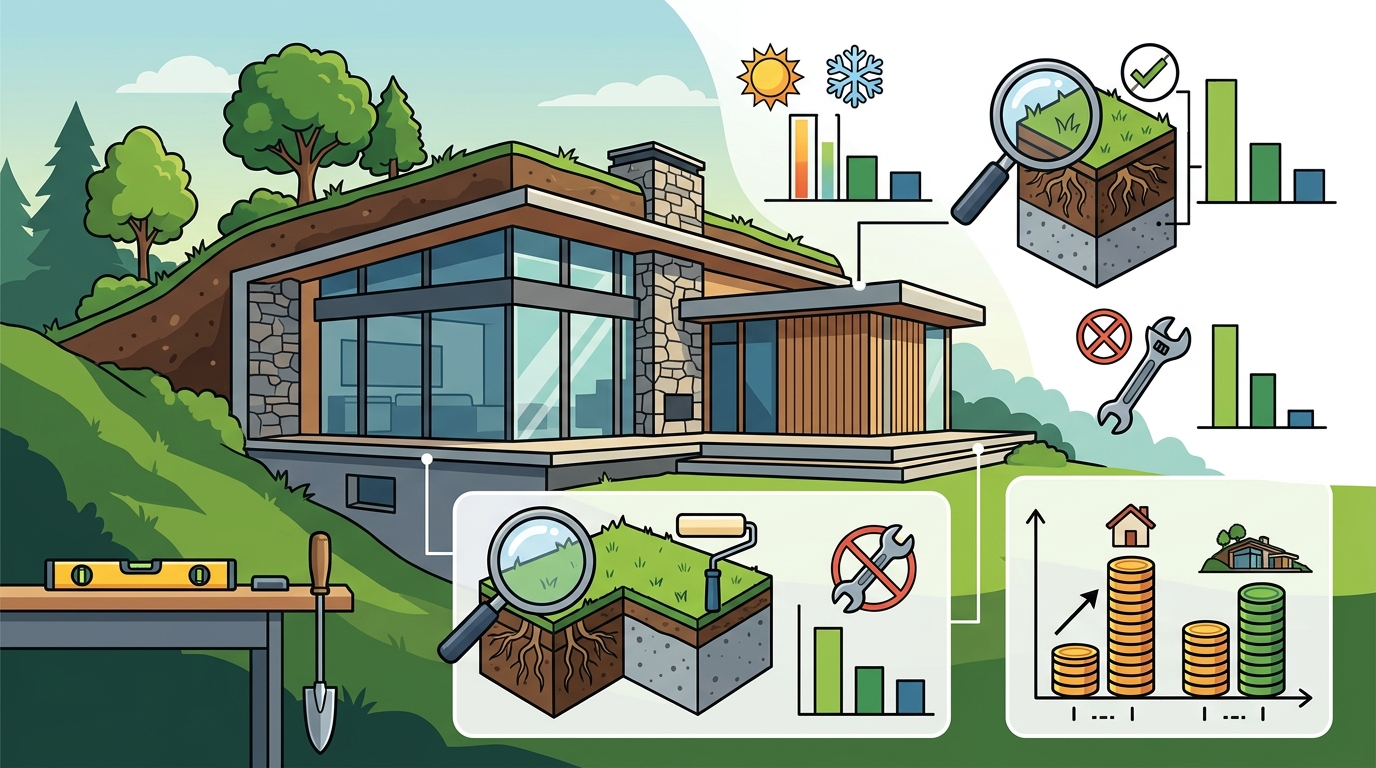
Earth-sheltered villas sidestep nearly all of this. In a typical home you are maintaining four sides plus the roof, whereas in an earth-sheltered home you are maintaining only one exposed façade and, in some cases, just the entryway. The outer parts of these structures are nearly maintenance-free—they require no painting, no siding replacement, and no roof shingle repairs.
When high-quality clad windows, stone, stucco, or brick are used on the single exposed face, owners can expect little or no exterior maintenance for the lifetime of the home.
Energy and HVAC Maintenance
Radically Lower Energy Bills
The earth surrounding an earth-sheltered building acts as insulation, so the interior maintains a remarkably stable temperature year-round. Proponents estimate that families living in earth-sheltered homes can save up to 80 percent on heating and air-conditioning costs compared to a conventional above-ground house.
In practical terms, a luxury villa that would require a 10-ton HVAC system in conventional construction may need only about one-quarter of that output when earth-sheltered. A smaller system means lower purchase cost, lower energy consumption, and crucially, lower long-term maintenance and replacement expenses.
Fewer HVAC Replacements
Because the mechanical system runs fewer hours per day and experiences less thermal stress, compressors, heat exchangers, and ductwork last significantly longer. Over a 30-year ownership period, a conventional villa may require two or three full HVAC replacements at $25,000–$60,000 each, while an earth-sheltered villa may need only one.
Passive Solar Synergies
Earth-sheltered buildings are typically designed with passive solar features to further reduce mechanical heating and cooling requirements. South-facing glazing captures winter sun, and the concrete thermal mass absorbs that energy during the day and releases it at night, smoothing temperature swings without any mechanical input at all.
Waterproofing and Moisture Management: The One Cost That Increases
Waterproofing is the critical maintenance area where earth-sheltered construction demands more attention and expense than conventional building. If moisture management is neglected, the consequences are severe: water seepage, internal condensation, mould growth, and even structural compromise.
Prevention Starts at Construction
Proper site selection on well-drained slopes, sub-surface drainage systems, and multiple waterproofing membrane layers are essential. For a luxury villa, specifying a premium bentonite or rubberised-asphalt membrane system adds cost up front but dramatically reduces the risk of failure.
Ongoing Inspection Costs
Budget for a professional waterproofing inspection every 3–5 years. In a luxury earth-sheltered villa, this might cost $2,000–$5,000 per inspection. Drainage channels, sump pumps (if installed), and dehumidification systems also need periodic servicing. While these are real costs, they are far outweighed by the savings in other maintenance categories.
Structural Longevity and Repair Cycles
Constructed of concrete and steel, earth-sheltered homes are built to last well over 100 years. The reinforced concrete shell does not rot, warp, or degrade from UV exposure. There is no timber framing to attract termites, no vinyl siding to crack, and no asphalt shingles to curl.
For a luxury villa owner, this means the structural envelope essentially becomes a fixed asset rather than a depreciating one. Conventional luxury homes often require foundation repairs, timber-frame remediation, or complete re-roofing within 20–30 years. Earth-sheltered villas avoid virtually all of these costs.
Insurance and Disaster Resilience
Earth-sheltered homes can cost less to insure because they offer extra protection against high winds, hailstorms, tornadoes, and hurricanes. Solid concrete homes do not burn, and extreme weather events pass over them with negligible impact.
For a luxury villa in a wildfire-prone or hurricane-prone region, the insurance premium difference can be substantial—often 25–40 percent lower than a conventional wood-frame or steel-frame structure of equivalent value. Over 30 years this can represent savings of $50,000–$150,000 depending on the property value and location.
Pest and Decay Resistance
Reinforced concrete construction means there is nothing organic for pests to consume. Earth-sheltered homes are termite-proof, rodent-resistant, and impervious to the wood-boring insects that plague conventional luxury timber homes.
This eliminates recurring extermination costs (typically $500–$2,000 per year for a large villa) and removes the risk of catastrophic structural damage from undetected infestations—a repair bill that can run into six figures on a high-end property.
Green Roof and Landscape Upkeep
Many luxury earth-sheltered villas feature living green roofs that double as gardens, putting greens, or natural meadows. While visually stunning, green roofs do require maintenance:
- Irrigation system servicing — Annual inspection and winterisation.
- Vegetation management — Seasonal planting, mowing, or wildflower meadow management.
- Drainage layer inspection — Ensuring root barriers and filter fabrics remain intact.
Expect to budget $3,000–$8,000 annually for green roof upkeep on a luxury villa. However, this replaces conventional roofing maintenance and extends the waterproofing membrane lifespan by shielding it from UV radiation and thermal cycling.
30-Year Maintenance Cost Comparison: Earth-Sheltered vs. Conventional Luxury Villa
| Maintenance Category | Conventional Villa (30-Year Total) | Earth-Sheltered Villa (30-Year Total) |
|---|---|---|
| Exterior painting, siding, cladding | $90,000–$150,000 | $5,000–$15,000 |
| Roof replacement/repairs | $40,000–$80,000 | $0–$10,000 |
| HVAC replacements and energy | $180,000–$300,000 | $40,000–$80,000 |
| Waterproofing and moisture mgmt | $5,000–$10,000 | $20,000–$40,000 |
| Pest control | $15,000–$60,000 | $0–$2,000 |
| Insurance premiums (cumulative) | $120,000–$200,000 | $75,000–$140,000 |
| Green roof / landscape | N/A (standard landscaping $60,000+) | $90,000–$240,000 |
| Structural repairs | $30,000–$80,000 | $0–$10,000 |
| Estimated 30-Year Total | $540,000–$940,000 | $230,000–$537,000 |
Note: Figures are estimates for a 5,000+ sq ft luxury property. Actual costs vary by region, climate, and specification level.
Key Takeaways
- Exterior maintenance virtually disappears. With earth covering most surfaces, there is no painting, no siding repair, and no roof shingle replacement.
- Energy savings are dramatic. Up to 80 percent reduction in heating and cooling costs, plus longer HVAC equipment life.
- Waterproofing is the trade-off. It is the one maintenance category that costs more, but proactive inspections keep expenses manageable.
- Structural lifespan exceeds 100 years. Reinforced concrete does not rot, warp, or attract pests, eliminating the most expensive repair categories.
- Insurance costs drop significantly. Fire resistance, storm protection, and seismic resilience translate directly into lower premiums.
- Net 30-year savings can exceed $300,000 compared to a conventional luxury villa of similar size and quality.
Frequently Asked Questions
How much more does an earth-sheltered luxury villa cost to build?
Earth-sheltered construction typically adds 10–20 percent to the build cost compared to a conventional home of similar size and finish level. For a luxury villa, this premium covers reinforced concrete structure, advanced waterproofing membranes, specialised excavation, and drainage engineering.
Do earth-sheltered homes have moisture problems?
They can if not properly designed and constructed. Waterproofing is the most critical design consideration. With correct site selection on well-drained soil, professional-grade membrane systems, and routine inspections every 3–5 years, moisture issues are preventable.
How much can I save on energy bills with an earth-sheltered villa?
Industry estimates suggest savings of up to 80 percent on heating and cooling costs. The earth maintains a steady sub-surface temperature (roughly 10–15°C or 50–59°F in most temperate climates), which dramatically reduces the workload on mechanical systems.
Are earth-sheltered homes harder to resell?
Resale can require more effort because the buyer pool is smaller. However, earth-sheltered homes that are well-designed and well-maintained have historically achieved strong resale values—some studies indicate 30–40 percent higher values than comparable conventional homes.
How long does an earth-sheltered home last?
Constructed of reinforced concrete and steel, these structures are designed to last well over 100 years with proper waterproofing maintenance. The absence of organic structural materials means there is nothing to rot, decay, or attract destructive pests.
Can I get a mortgage and insurance for an earth-sheltered villa?
Yes, though the process may require more research. Some lenders and insurers are less familiar with earth-sheltered construction. Credit unions, farm credit organisations, and lenders specialising in green building are often the best starting points. Insurance premiums are typically lower due to the home's resilience against fire, storms, and natural disasters.