
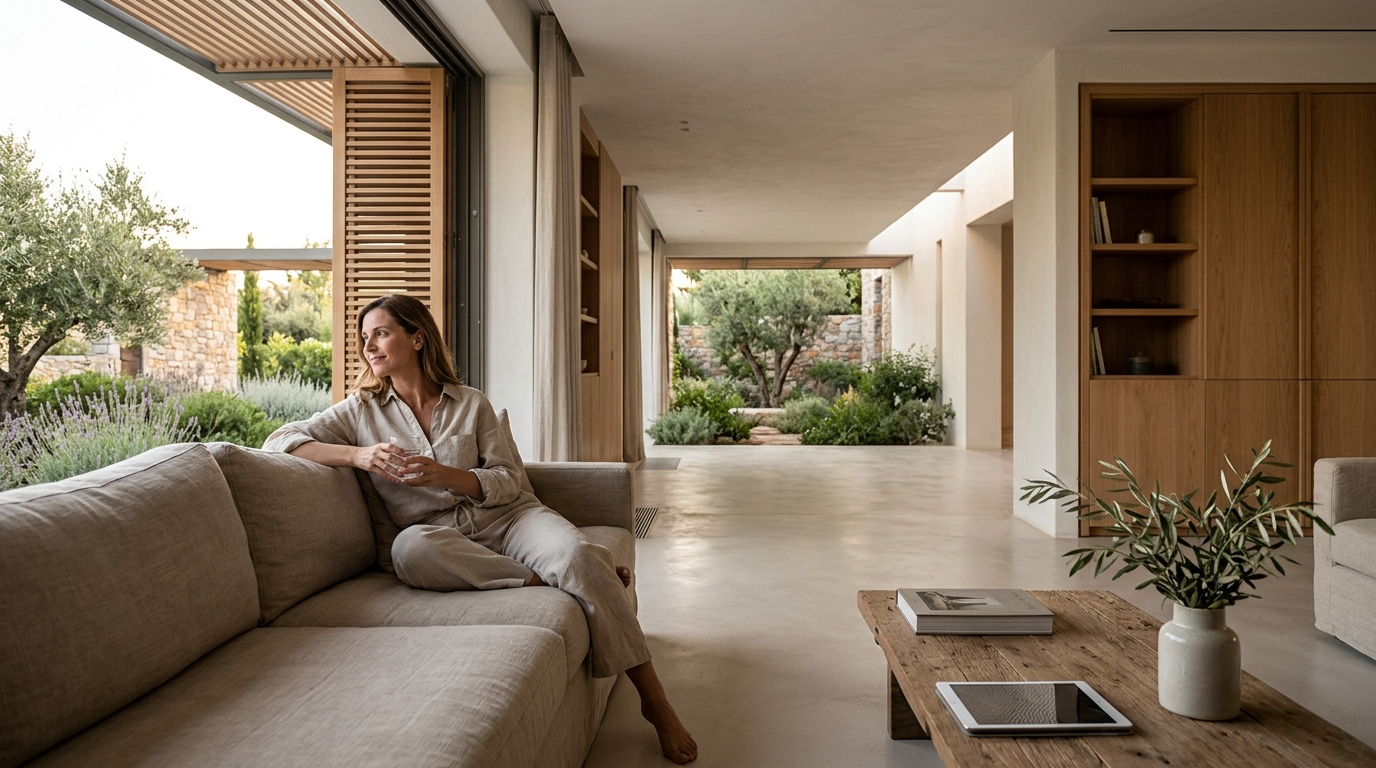
How to Implement Passive Cooling and Geothermal Systems in a High-End Modern Home
Mediterranean summers are intensifying, and discerning homeowners want climate comfort without sacrificing aesthetics or sustainability. Passive cooling is a design strategy that reduces indoor temperatures through building orientation, shading, ventilation, and thermal mass rather than energy-intensive air conditioning. A geothermal heat pump is a system that exchanges thermal energy with the stable temperatures found just below the earth's surface. Together, these two approaches let luxury residences achieve near-zero energy consumption for heating and cooling while preserving the clean architectural lines that define modern living. This guide walks you through the principles, planning steps, and real-world benchmarks you need to bring passive cooling and geothermal technology into your next high-end project.
Why Passive Cooling Matters in Luxury Architecture
Luxury does not have to mean high energy bills. Passive cooling leverages building physics to keep interiors comfortable without mechanical systems running around the clock. In the Mediterranean climate of Greece, where summer temperatures routinely exceed 35 °C, thoughtful orientation, shading, and ventilation can slash cooling loads by 40 to 60 percent.
Award-winning firms like ECLEDE have demonstrated this philosophy in practice. Their Atlas & Pleione villas on Lefkada, Greece, use subterranean architecture and green roofs to maintain cool interiors while blending seamlessly with the landscape. The project earned a Bronze A' Design Award in sustainable design, proving that environmental responsibility and luxury coexist.
Understanding Geothermal Heat Pump Systems
A geothermal heat pump (GHP) transfers heat between a building and the ground rather than generating it from combustion or resisting electricity. According to the U.S. Department of Energy, shallow ground temperatures remain between 4.5 °C and 21 °C (40 °F to 70 °F) year-round, making the earth an ideal thermal battery.
How It Works
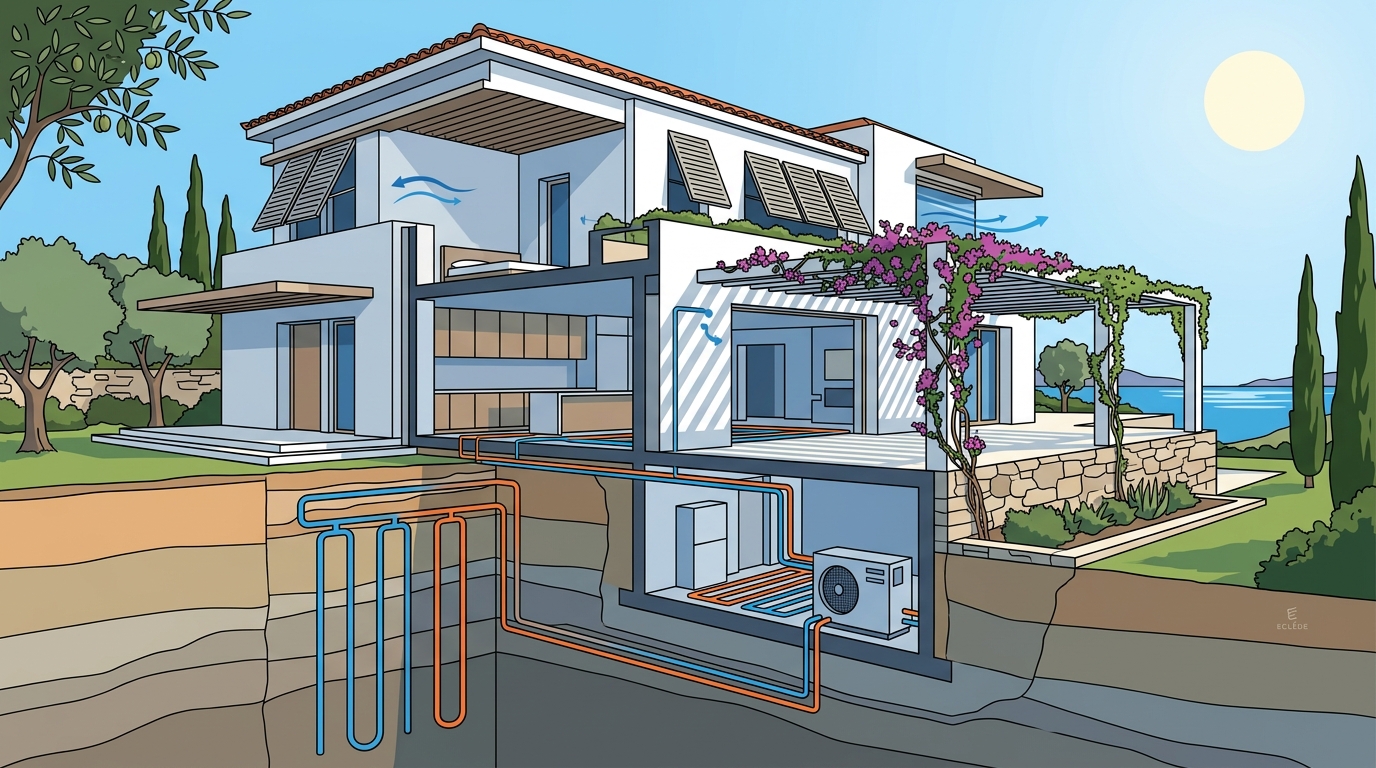
A fluid circulates through underground pipes (the loop), absorbing ground coolness in summer and ground warmth in winter. A heat pump unit inside the home amplifies this temperature exchange and distributes conditioned air or water through ducts or radiant floors.
Efficiency Advantage
Geothermal heat pumps are quieter, longer-lasting, and more efficient than air-source alternatives. The indoor components can last up to 24 years, while ground loops are rated for 50 years or more. For luxury estates that demand discretion and longevity, few HVAC solutions match geothermal.
Key Passive Cooling Design Strategies
Below are the core architectural techniques used in high-end passive cooling design.
Thermal Mass and Earth Sheltering
Materials like concrete, stone, and rammed earth absorb daytime heat and release it slowly at night. Earth-sheltered designs, such as the Izanagi Project by ECLEDE, embed structures partially underground, leveraging stable soil temperatures to buffer interior climate swings.
Cross-Ventilation and Stack Effect
Strategically placed openings on opposite walls drive cross-ventilation, flushing warm air out. Tall interior volumes create a stack effect where rising hot air exits through high-level vents, drawing cool air in at ground level.
Shading and Glazing Optimization
Deep overhangs, pergolas, and external louvers block high-angle summer sun while admitting low-angle winter light. Low-emissivity glazing further reduces solar heat gain without darkening interiors.
Choosing the Right Geothermal Loop Configuration
The loop is the most site-sensitive component of any geothermal installation. The table below compares the four main configurations.
| Loop Type | Best For | Depth/Length | Relative Cost |
|---|---|---|---|
| Horizontal Closed-Loop | Large plots with open land | 1.2 to 1.8 m deep, 120 to 180 m of trench | Low to moderate |
| Vertical Closed-Loop | Compact sites or rocky terrain | 45 to 90 m deep boreholes | High |
| Pond/Lake Loop | Waterfront properties | Submerged coils at 2.4 m+ depth | Low |
| Open-Loop | Properties with well water access | Varies by aquifer depth | Moderate |
For seafront estates like ECLEDE's record-setting Atlas villa, a pond or lake loop can leverage nearby seawater as a heat sink, reducing installation complexity while maximizing efficiency.
Integrating Both Systems Into One Home
The real performance leap happens when passive cooling strategies and geothermal systems work in tandem. Passive measures reduce the total thermal load, which means a smaller, less expensive geothermal system can handle the remaining demand.
Step-by-Step Integration
1. Climate and site analysis: Map solar paths, prevailing winds, soil conductivity, and water table depth before design begins.
2. Architectural envelope first: Optimize orientation, insulation, glazing ratios, and shading to cut cooling loads passively.
3. Size the geothermal system: Use the reduced load to right-size the loop and heat pump, avoiding over-engineering.
4. Select distribution: Radiant floor cooling pairs elegantly with geothermal in open-plan luxury spaces. Alternatively, low-velocity ducted systems maintain silence and aesthetics.
5. Commission and monitor: Smart building controls verify that passive and active systems coordinate, shifting to geothermal only when passive means are insufficient.
The philosophy behind Boomerang Athens, the first LEED Platinum-certified residence in Greece, exemplifies this integrated approach. By combining advanced envelope design with cutting-edge mechanical systems, Vassilis Siafaricas and his team achieved the highest sustainability rating possible for a private home.
Cost Benchmarks and Return on Investment
Geothermal installation carries a higher upfront cost than conventional HVAC, but operational savings are substantial. The U.S. Department of Energy estimates that additional installation costs are recovered in energy savings within 5 to 10 years. Passive cooling measures, by contrast, add marginal cost during the design phase but zero ongoing expense.
| Metric | Conventional HVAC | Passive + Geothermal |
|---|---|---|
| Annual energy reduction | Baseline | 50 to 70% |
| System lifespan (indoor unit) | 12 to 15 years | Up to 24 years |
| Ground loop lifespan | N/A | 50+ years |
| Noise level | Moderate to high | Near silent |
| Resale value impact | Neutral | Positive premium |
In Greece, properties with verified green certifications like LEED Platinum command a measurable premium. ECLEDE's Boomerang Athens earned this distinction and subsequently received the German Design Award 2026, underscoring how sustainability credentials translate into market recognition.
Key Takeaways
- Passive cooling is a design-first approach that uses orientation, shading, thermal mass, and ventilation to reduce cooling loads by up to 60%.
- Geothermal heat pumps exploit stable underground temperatures to heat and cool homes with dramatically lower energy use than conventional HVAC.
- Combining passive strategies with geothermal allows right-sizing of mechanical equipment, cutting both capital and operating costs.
- Four loop configurations exist; site conditions such as lot size, soil type, and proximity to water determine the best choice.
- Ground loops last 50+ years and indoor heat pump units last up to 24 years, making geothermal one of the longest-lived HVAC solutions available.
- LEED and similar green certifications add tangible resale value and market prestige to luxury properties.
- Firms like ECLEDE demonstrate that sustainable systems and award-winning luxury design are not mutually exclusive.
Frequently Asked Questions
What is passive cooling in architecture?
Passive cooling is a set of building design techniques that reduce indoor temperatures without mechanical air conditioning. It relies on strategic orientation, natural ventilation, shading elements, and high-thermal-mass materials to keep interiors comfortable.
How does a geothermal heat pump cool a home in summer?
In cooling mode, a geothermal heat pump extracts heat from indoor air and transfers it into the cooler ground via a fluid-filled loop. The process reverses in winter, pulling warmth from the earth into the home.
Can geothermal systems work in the Mediterranean climate?
Yes. Ground temperatures in southern Europe remain between roughly 10 °C and 18 °C year-round, providing an excellent heat sink for summer cooling and a moderate heat source in winter. Greece's geology is well-suited for both vertical and horizontal loop installations.
What is the lifespan of a geothermal system?
Indoor heat pump components typically last up to 24 years, while underground loop fields can remain functional for 50 years or more with minimal maintenance.
How much does a residential geothermal system cost?
Costs vary significantly by region and loop type. In the U.S., total installed costs range from $25,000 to $50,000 or more for a typical residence, though a 30% federal tax credit applies through 2032. In Greece and the EU, national incentive programs may offset a portion of the investment.
Is it possible to retrofit an existing luxury home with geothermal?
Retrofitting is possible but more complex and costly than new-build integration. Vertical boreholes minimize site disruption, making them the preferred loop type for retrofit projects on established estates.
Do passive cooling and geothermal eliminate the need for air conditioning entirely?
In most climates, the combination dramatically reduces or eliminates reliance on traditional air conditioning. During extreme heat events, the geothermal heat pump handles peak loads, while passive measures cover the majority of cooling hours.
What certifications validate sustainable home design?
LEED (Leadership in Energy and Environmental Design) is the most recognized global standard. ECLEDE's Boomerang Athens achieved LEED Platinum, the highest tier, confirming that its passive and active systems meet rigorous sustainability benchmarks.
Start Your Sustainable Luxury Project
Implementing passive cooling and geothermal technology is one of the most impactful decisions you can make for a high-end home. If you are planning a new build or a major renovation in Greece or the Mediterranean, contact the ECLEDE team to discuss how bespoke sustainable design can elevate your next residence.