
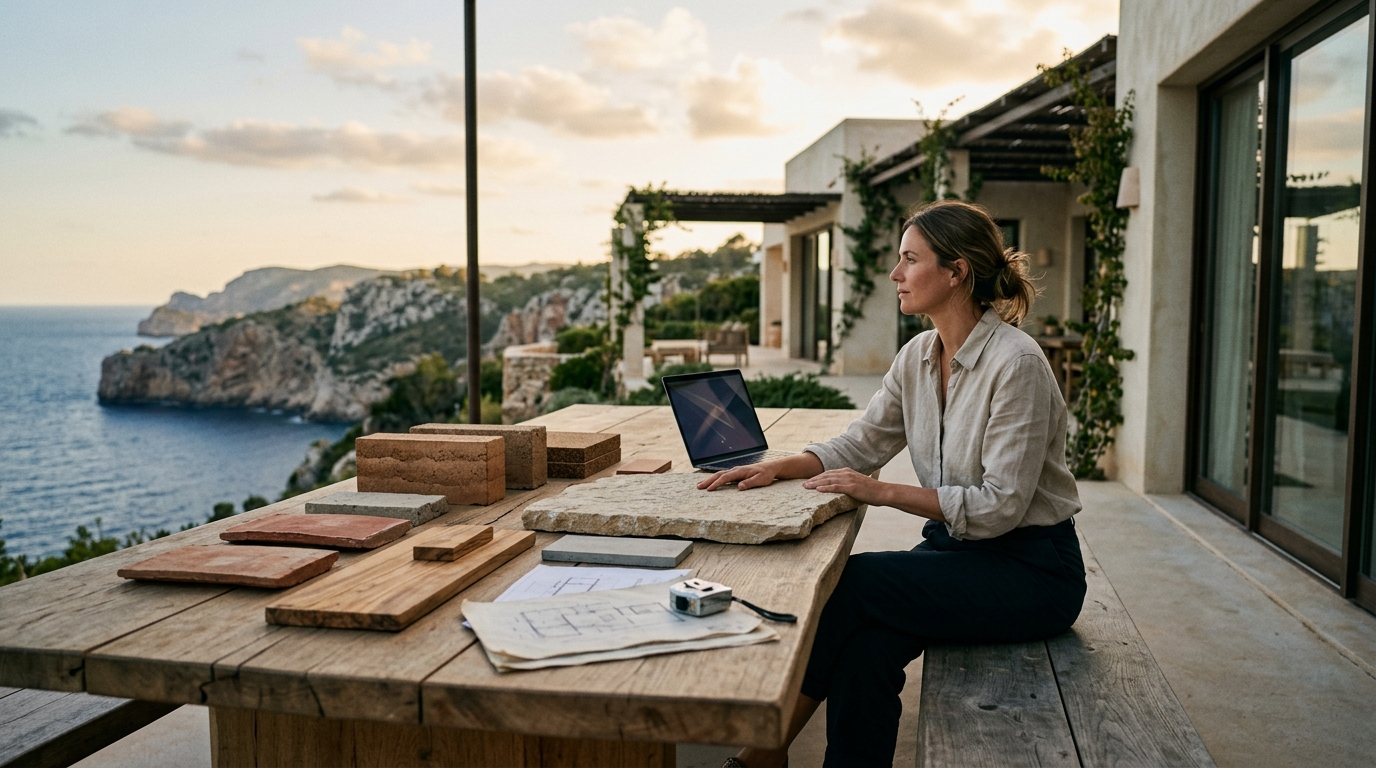
Building a luxury home along the Mediterranean coast means reconciling salt-laden air, intense sun exposure, seismic considerations, and the desire for timeless elegance — all while honouring the environment that makes these locations so desirable. This guide examines the sustainable materials best suited for high-end Mediterranean coastal construction, with practical selection criteria, performance insights, and design integration advice.
Why Sustainable Materials Matter on the Mediterranean Coast
The construction sector contributes roughly 37 % of global greenhouse-gas emissions, with a large share coming from material production. In a region where architecture has historically celebrated harmony with nature, choosing low-impact materials is both an ecological imperative and a cultural continuation.
Mediterranean architecture has always drawn on local, natural resources. Traditional houses were built with stone, wood, and clay — materials that are not only durable but also environmentally friendly. Modern luxury projects can honour that legacy while incorporating advanced sustainable innovations.
Coastal conditions add a further layer of complexity. Salt spray accelerates corrosion, UV radiation degrades polymers, humidity fosters mould, and thermal cycling stresses joints. Sustainable materials must therefore be evaluated not just on embodied carbon but on longevity: a material that degrades prematurely in a coastal environment is never truly 'green', no matter how low its initial footprint.
1. Natural Stone: Limestone, Granite & Marble
Stone is the elemental material of Mediterranean construction. Locally quarried limestone, in particular, performs exceptionally in hot coastal climates. Its porous structure and light colour help reflect sunlight, keeping indoor spaces cooler — a passive cooling advantage that reduces reliance on air conditioning.
Granite offers outstanding durability and heat resistance, making it ideal for high-traffic surfaces such as kitchen islands and terrace flooring. Marble, while requiring more maintenance in salt-air environments, delivers the visual gravitas expected in luxury interiors.
Best Applications
- Limestone: exterior cladding, courtyard paving, pool surrounds
- Granite: kitchen worktops, threshold detailing, structural elements
- Marble: feature walls, bathroom vanities, entrance halls
Sustainability Notes
When quarried locally — as is traditional across Italy, Greece, Croatia, and Spain — natural stone has minimal transport emissions and virtually unlimited lifespan. Reclaimed stone from historic demolitions adds character and further reduces impact.
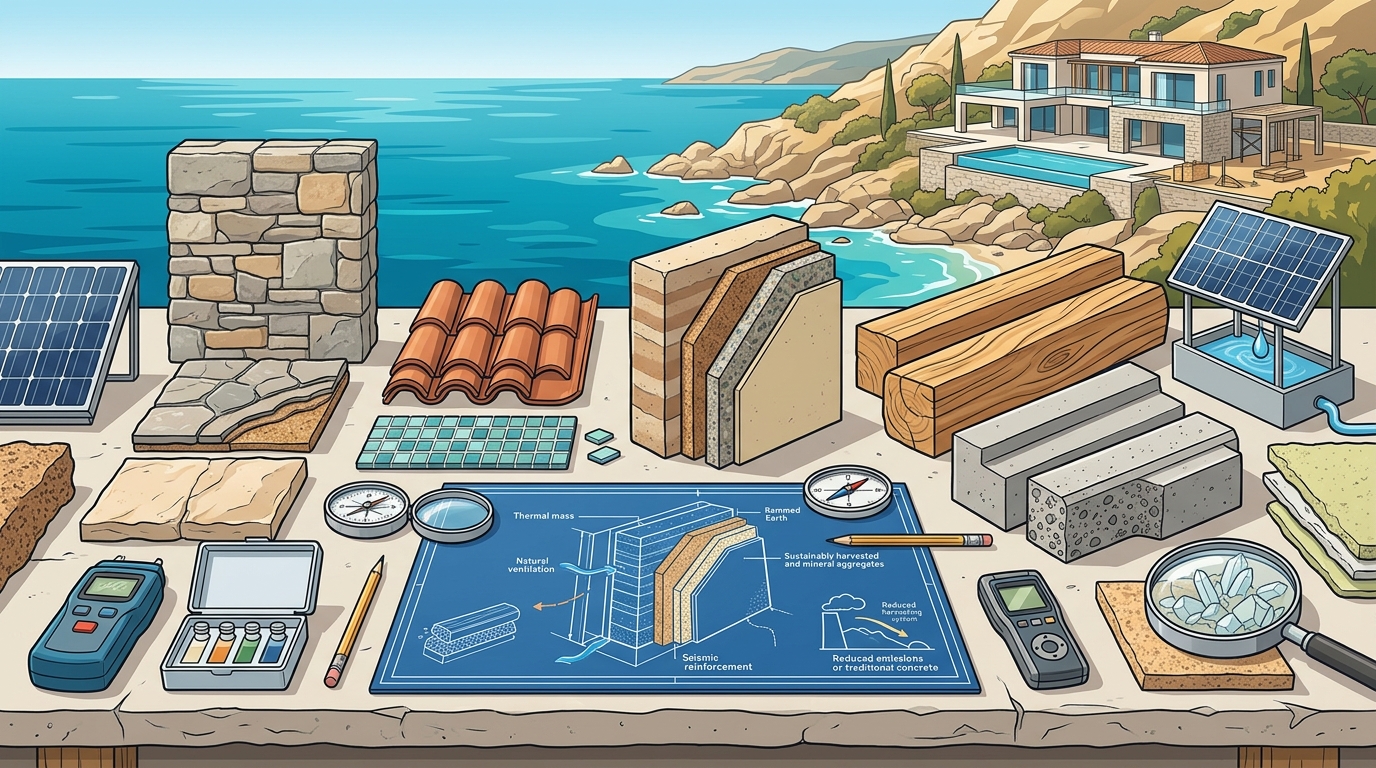
2. Terracotta & Advanced Ceramics
Ceramic tiles and structural clay products have always been key elements of the Mediterranean building tradition. Clay-based products improve indoor air quality and hygiene, and reinforced brick walls offer proven earthquake resistance — a critical consideration across much of the Mediterranean basin.
Modern porcelain stoneware extends the material family with superior scratch and stain resistance, making it suitable for seamless indoor-outdoor flooring transitions. Produced using best-available-technique (BAT) manufacturing, contemporary Italian ceramics achieve high sustainability scores while offering near-zero water absorption.
Best Applications
- Traditional terracotta: roof tiles (the iconic red-tiled roof reflects sunlight while providing excellent thermal mass), courtyard floors
- Porcelain stoneware: open-plan living floors, bathroom cladding, kitchen surfaces
- Hand-painted azulejo tiles: accent walls, backsplashes, stair risers
3. Cork: The Mediterranean's Own Super-Insulator
Cork oak forests stretch across Portugal, Spain, and North Africa, making cork a genuinely local resource for Mediterranean projects. The material is harvested from the bark without felling the tree, and each tree can be stripped every nine years for over a century.
As a building material, cork is naturally fire-resistant and does not release toxic gases when it does burn. It is nearly impermeable, so it does not absorb water or rot — an invaluable trait in humid coastal environments. Its noise-absorption and shock-absorption properties make it excellent for both insulation sheets and sub-flooring in luxury residences.
Best Applications
- Thermal and acoustic insulation for walls and roofs
- Flooring in bedrooms and private areas
- Exterior facade panels (expanded cork agglomerate)
4. Reclaimed & Certified Timber
Wood beams, shutters, and bespoke joinery are integral to the Mediterranean aesthetic. Using reclaimed wood, such as salvaged oak or chestnut from old barns and warehouses, gives interiors character while diverting material from landfill. For structural applications, FSC-certified European softwoods or thermally modified hardwoods provide dimensional stability in coastal humidity.
Cross-laminated timber (CLT) is gaining popularity as a sustainable alternative to conventional building materials due to its strength, visual appeal, and versatility while lowering the carbon footprint of new buildings. In a Mediterranean luxury context, CLT can form the structural core of upper storeys while stone anchors the ground level — a hybrid approach that balances tradition and innovation.
Coastal Considerations
- Apply marine-grade sealants on exterior timber elements
- Elevate timber details above splash zones
- Ensure adequate ventilation behind timber cladding to prevent moisture build-up
5. Hempcrete & Bio-Based Composites
Hempcrete — a mixture of hemp shiv, lime, and water — is a carbon-negative insulating material that regulates temperature and humidity naturally. In the Mediterranean's hot-dry summers and cool-damp winters, hempcrete walls 'breathe', absorbing excess moisture in autumn and releasing it in spring, which reduces both mould risk and mechanical ventilation needs.
Because hempcrete is non-structural, it is typically used as infill within a timber or steel frame. For luxury projects, this makes it an ideal partner for exposed CLT or steel structures, with lime-rendered surfaces providing the traditional plaster aesthetic expected in the region.
6. High-Thermal-Mass Materials & Passive Design
Traditional Mediterranean buildings have thick walls built from stone and sun-dried mud-brick, rendered with mud plaster. These high-thermal-mass assemblies absorb heat during the day and release it at night, a passive strategy perfectly suited to the large diurnal temperature swings of the Mediterranean climate.
Modern interpretations use rammed earth, stabilised adobe, or insulated concrete formwork (ICF) to achieve equivalent thermal performance within slimmer wall profiles. Mediterranean houses stand out for their well-insulated opaque structures, which keep internal temperatures stable in both summer and winter without overloading HVAC systems.
Key Design Principles
- Orient principal facades south with deep overhangs for seasonal solar control
- Incorporate courtyards as microclimate regulators — shade and evaporative cooling in summer, solar gain in winter
- Place high-mass materials on interior surfaces where they can moderate temperature swings
7. Recycled Steel & Low-Carbon Metals
Structural steel made from recycled scrap significantly reduces embodied energy compared with virgin production. In coastal luxury homes, recycled steel finds use in concealed structural frames, cantilevered balconies, and bespoke metalwork such as stair balustrades and window frames.
For exterior hardware, marine-grade stainless steel (316L) or bronze withstands salt corrosion far better than standard galvanised alternatives, reducing replacement frequency and lifecycle waste.
8. Bamboo & Rattan for Interior Accents
Though not native to the Mediterranean, bamboo is widely recognised as one of the most eco-friendly building materials available, with some species growing up to three feet in 24 hours. In high-end coastal interiors, engineered bamboo serves as flooring, cabinetry veneer, and ceiling panels.
Rattan, wood, stone, and hand-woven fibres have always defined Mediterranean spaces. Rattan furniture introduces warmth and tactility, and when sourced from certified plantations, aligns with sustainable furnishing principles. Designers increasingly pair rattan seating with stone-and-lime interiors for a refined coastal aesthetic.
How to Choose: A Five-Point Selection Framework
- Climate Appropriateness: Prioritise materials with demonstrated performance in hot, humid, salt-air environments. Degradation and replacement frequency must factor into overall eco-friendliness.
- Local Sourcing: Materials quarried or harvested within the Mediterranean basin — stone, cork, clay, certified timber — carry lower transport emissions and support regional economies.
- Certifications: Look for FSC (timber), EPD (Environmental Product Declarations), Cradle-to-Cradle, or EU Ecolabel stamps.
- Thermal Performance: Favour high-thermal-mass and breathable assemblies that work with the Mediterranean climate rather than against it.
- Aesthetic Longevity: In luxury construction, materials should age gracefully. Stone patinas, timber silvering, and terracotta weathering add character over decades — a form of sustainability in itself.
Key Takeaways
- The Mediterranean building tradition is inherently sustainable — modern projects should extend it, not replace it.
- Limestone, terracotta, and cork are the region's standout local materials, combining low environmental impact with exceptional coastal performance.
- High-thermal-mass construction dramatically reduces energy consumption through passive temperature regulation.
- Emerging materials like hempcrete, CLT, and mycelium composites offer exciting pathways for carbon-negative luxury construction.
- Always evaluate materials on lifecycle performance in coastal conditions, not just embodied carbon at point of manufacture.
Frequently Asked Questions
What is the most durable sustainable material for a Mediterranean coastal home?
Locally quarried limestone is arguably the most durable sustainable option. Its natural ability to stay cool under intense sunlight, resistance to salt air, and virtually unlimited lifespan make it the benchmark for Mediterranean coastal construction. When sourced locally, its embodied energy is extremely low.
Is cork a good building material for coastal homes?
Yes. Cork is nearly impermeable, naturally fire-resistant, and an excellent thermal and acoustic insulator. Because cork oak forests are concentrated in the western Mediterranean, the material is genuinely local for many coastal projects, keeping transport emissions minimal.
Can cross-laminated timber (CLT) be used near the sea?
CLT can perform well in coastal settings when properly detailed. Marine-grade sealants, adequate ventilation cavities, and protective cladding are essential. Many architects use CLT for upper-storey structures while anchoring the ground level with stone or concrete for maximum moisture protection.
How does thermal mass reduce energy use in Mediterranean homes?
High-thermal-mass materials like stone and clay absorb heat during the day and release it slowly at night. In the Mediterranean's climate of large day-to-night temperature swings, this passive cycle keeps interiors comfortable without heavy reliance on mechanical heating or cooling systems.
What certifications should I look for when selecting sustainable materials?
Key certifications include FSC (Forest Stewardship Council) for timber, Environmental Product Declarations (EPDs) for quantified lifecycle data, Cradle-to-Cradle for circular-economy design, and the EU Ecolabel for general environmental performance.