
How to Implement Passive Cooling and Geothermal Systems in a High-End Modern Home
Luxury living no longer means choosing between comfort and sustainability. Passive cooling is a design strategy that reduces indoor temperatures through building orientation, thermal mass, shading, and natural ventilation rather than mechanical air conditioning. Geothermal heating and cooling, meanwhile, leverages the stable underground temperatures of the shallow earth to exchange heat with remarkable efficiency. Together, these two approaches form the backbone of a truly net-zero-energy residence. In this guide, we walk through the practical steps, costs, and design considerations for integrating both systems into a high-end modern home, drawing on the multidisciplinary design philosophy that defines our work at the intersection of luxury and environmental responsibility.
Why Combine Passive Cooling with Geothermal?
Each system addresses a different layer of the energy equation. Passive cooling minimizes heat gain at the building envelope level, while geothermal handles any remaining active heating or cooling load with extraordinary efficiency. According to the U.S. Department of Energy, geothermal heat pumps take advantage of constant subsurface temperatures of 40 to 70 degrees Fahrenheit to heat and cool homes year-round.
When you reduce the cooling load through passive design first, the geothermal system you need is smaller, less expensive, and even more efficient. This "envelope-first" philosophy is central to how firms like ours approach sustainable luxury projects.
Passive Cooling Strategies for Modern Architecture
Orientation, Shading, and Thermal Mass
Proper building orientation is the most cost-effective passive cooling measure. In Mediterranean and warm climates, orienting the longest facade north-south limits direct solar gain. Deep overhangs, brise-soleil screens, and strategically placed deciduous planting provide seasonal shade without sacrificing winter light.
Thermal mass is the ability of heavy materials like concrete, stone, and rammed earth to absorb heat during the day and release it slowly at night. High thermal mass walls and floors stabilize indoor temperatures, reducing peak cooling demand by as much as 25 to 30 percent in well-designed homes.
Earth-Sheltered and Subterranean Design
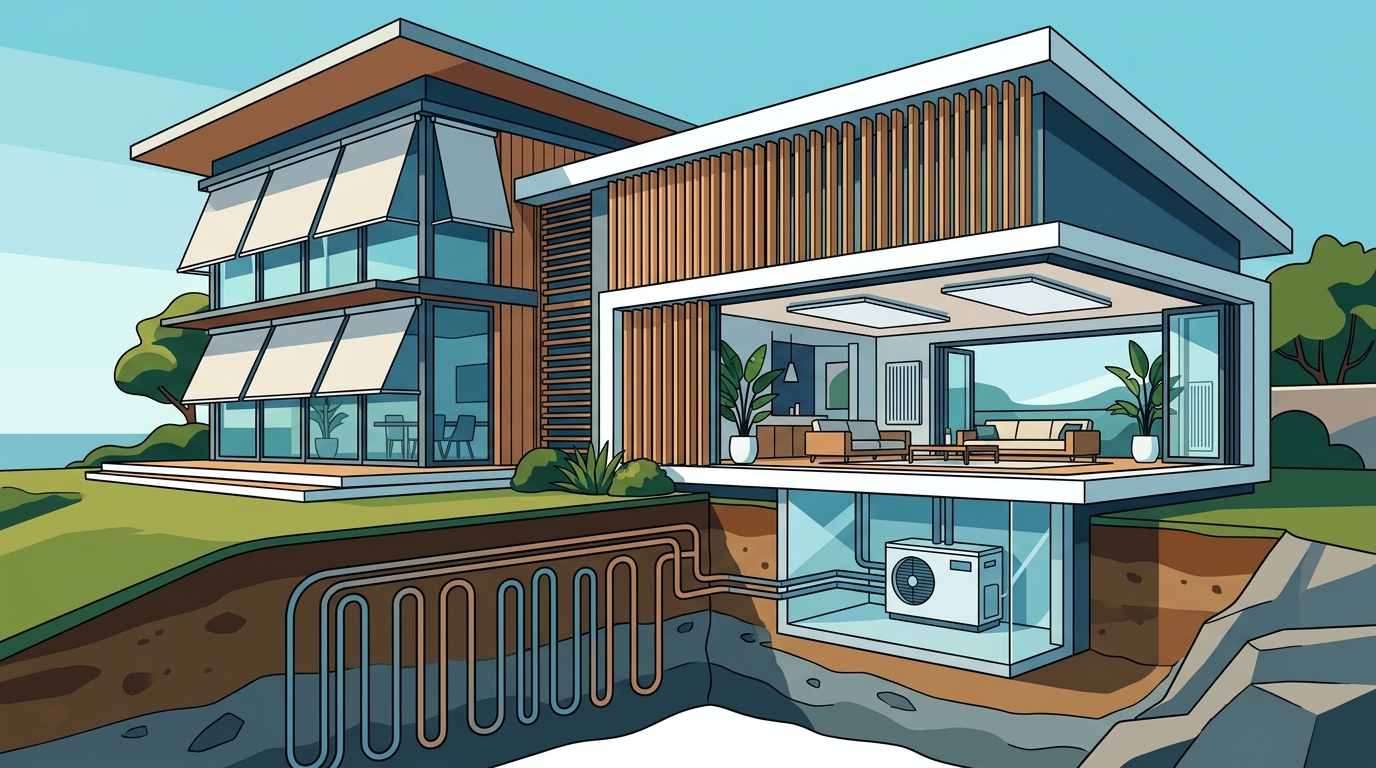
Building partially or fully underground is one of the most effective passive cooling techniques for luxury homes. Earth-sheltered construction uses the soil itself as insulation and thermal buffer, maintaining interior temperatures close to the stable ground temperature year-round. This approach is a hallmark of our design philosophy, where architecture integrates with the landscape rather than sitting on top of it.
Natural Ventilation and Earth Tubes
An earth tube is a non-electric, zero-energy geothermal passive heating and cooling system that draws filtered air through buried pipes to temper its temperature before it enters the home. Runs of 20 to 100 feet at depths of 5 to 6 feet are typical for a noticeable cooling effect. Combined with stack-effect ventilation design, earth tubes can meaningfully reduce or even eliminate the need for mechanical cooling in moderate climates.
Understanding Geothermal Heat Pump Systems
A geothermal heat pump (GHP) is a mechanical system that circulates a water-based fluid through underground loops to exchange heat with the earth. In summer, the system absorbs excess heat from your home and transfers it into the cooler ground. In winter, the process reverses.
GHPs deliver 300 to 600 percent efficiency, meaning you receive 3 to 6 units of heating or cooling for every unit of electricity consumed. That makes them the most efficient active climate-control technology available for residential use.
| System Type | Loop Configuration | Best For | Typical Depth |
|---|---|---|---|
| Horizontal Closed-Loop | Trenches across property | Large lots with open land | 5 - 6 ft |
| Vertical Closed-Loop | Deep boreholes | Limited surface area | 200 - 500 ft |
| Open-Loop | Well water supply/return | Properties near aquifers | Varies |
| Hybrid | Ground loop + cooling tower | Cooling-dominant climates | Varies |
For luxury homes with expansive floor plans, vertical closed-loop systems are often preferred because they require minimal surface disruption and integrate cleanly with high-end landscaping.
Integrating Both Systems During the Design Phase
Start with the Building Envelope
Airtight construction, high-performance insulation (double-stud walls, triple-pane windows), and underground insulation are non-negotiable foundations. A superior envelope reduces the mechanical load so dramatically that the geothermal system can be downsized, lowering capital costs.
Pair Geothermal with Radiant Delivery
Radiant floor heating and cooling is the ideal distribution partner for a geothermal heat pump in a luxury setting. It operates silently, eliminates visible ductwork, and provides even temperature distribution across large open-plan spaces. This combination is especially effective in custom villa developments where aesthetics matter as much as performance.
Coordinate with Renewable Energy
Pairing geothermal with rooftop or ground-mounted solar PV and battery storage creates a fully net-zero energy ecosystem. The geothermal system's modest electricity demand is easily offset by solar generation, achieving true energy independence for discerning homeowners.
Costs, Incentives, and Long-Term ROI
A residential geothermal system typically costs between $20,000 and $31,000 before incentives. However, underground loops can last 50 to 100 years, and indoor heat pump components last 20 to 25 years with minimal maintenance. Homeowners can expect to save 30 to 50 percent on cooling costs and up to 60 percent on heating costs annually compared to conventional HVAC.
In the United States, the One Big Beautiful Bill Act (H.R. 1), passed in July 2025, maintained a 30 to 50 percent federal Commercial Investment Tax Credit for geothermal heat pumps through 2034 and, for the first time, allowed third-party leasing of residential geothermal systems. In the EU and Greece, similar incentive programs exist through national energy renovation schemes.
When passive cooling strategies are layered in, the required system size shrinks further, improving payback periods from 5 to 10 years down to as few as 3 to 7 years depending on climate and energy costs.
Case Study: Earth-Sheltered Luxury in the Mediterranean
The Izanagi Project in Lefkada, Greece, is a subterranean villa complex that exemplifies the integration of passive cooling and sustainable design. Led by Eclede and G Architects, the project uses earth-sheltered construction to achieve natural cooling while blending Japanese architectural inspiration with Greek vernacular influences. The development won the 2025 A' Hospitality, Recreation, Travel and Tourism Design Award, demonstrating that high-end residential projects can be both visually striking and radically energy-efficient.
This project reflects a broader commitment to minimally intrusive, holistic design that promotes human well-being while respecting the surrounding landscape and local culture.
Key Takeaways
- Passive cooling reduces cooling loads at the envelope level through orientation, thermal mass, shading, and earth-sheltered design.
- Geothermal heat pumps deliver 300 to 600 percent efficiency by exchanging heat with the stable subsurface.
- An envelope-first approach allows you to downsize the geothermal system, cutting costs and improving payback.
- Earth tubes offer zero-energy air tempering and pair well with high thermal mass construction.
- Underground loops last 50+ years, making geothermal one of the longest-lasting residential investments.
- Federal incentives (30 to 50 percent tax credits through 2034) and leasing options are making geothermal more accessible than ever.
- Combining passive cooling, geothermal, and solar PV creates a true net-zero luxury home.
Frequently Asked Questions
What is passive cooling in residential architecture?
Passive cooling is a set of design strategies that reduce indoor temperatures without mechanical systems. It relies on building orientation, thermal mass, natural ventilation, shading devices, and earth-sheltered construction to minimize heat gain and promote natural heat dissipation.
How does a geothermal heat pump work?
A geothermal heat pump circulates fluid through underground pipes that exchange heat with the earth. In summer it moves excess indoor heat into the cooler ground; in winter it extracts warmth from the ground and delivers it indoors. The constant subsurface temperature (40 to 70 degrees Fahrenheit) makes this process highly efficient.
Can passive cooling and geothermal work together?
Absolutely. Passive cooling reduces the total load the geothermal system must handle, which means you can install a smaller, less costly system that runs even more efficiently. The combination is considered best practice for net-zero luxury homes.
How much does a residential geothermal system cost?
Typical residential installations range from $20,000 to $31,000 before incentives. Federal tax credits of 30 to 50 percent and new leasing programs can substantially reduce the effective upfront investment.
Is geothermal suitable for warm Mediterranean climates?
Yes. Hybrid geothermal systems are particularly effective where cooling needs exceed heating needs. When combined with passive strategies like earth-sheltered construction and earth tubes, geothermal performs exceptionally well in Mediterranean and warm-climate regions.
How long do geothermal ground loops last?
Underground loop systems are estimated to last 50 to 100 years, while indoor heat pump components typically last 20 to 25 years with minimal maintenance, making geothermal one of the most durable residential energy systems available.
What is an earth tube and how does it differ from a geothermal heat pump?
An earth tube is a passive, non-electric system of buried pipes that tempers incoming fresh air using the ground's stable temperature. Unlike a geothermal heat pump, it requires no compressor or electricity. Earth tubes complement a GHP by handling part of the ventilation load passively.
Do geothermal systems work with radiant floor heating?
Yes. Radiant floor systems are the ideal delivery method for geothermal in luxury homes. They operate silently, distribute heat evenly across large spaces, and eliminate visible ductwork, preserving the clean aesthetic of modern architecture.
Ready to Design Your Net-Zero Luxury Home?
Whether you are planning a new build or retrofitting an existing property, integrating passive cooling with geothermal technology is the most effective path to sustainable, high-performance living. Get in touch with our team to explore how earth-sheltered design, geothermal systems, and renewable energy can transform your next project into a landmark of modern sustainable architecture.