
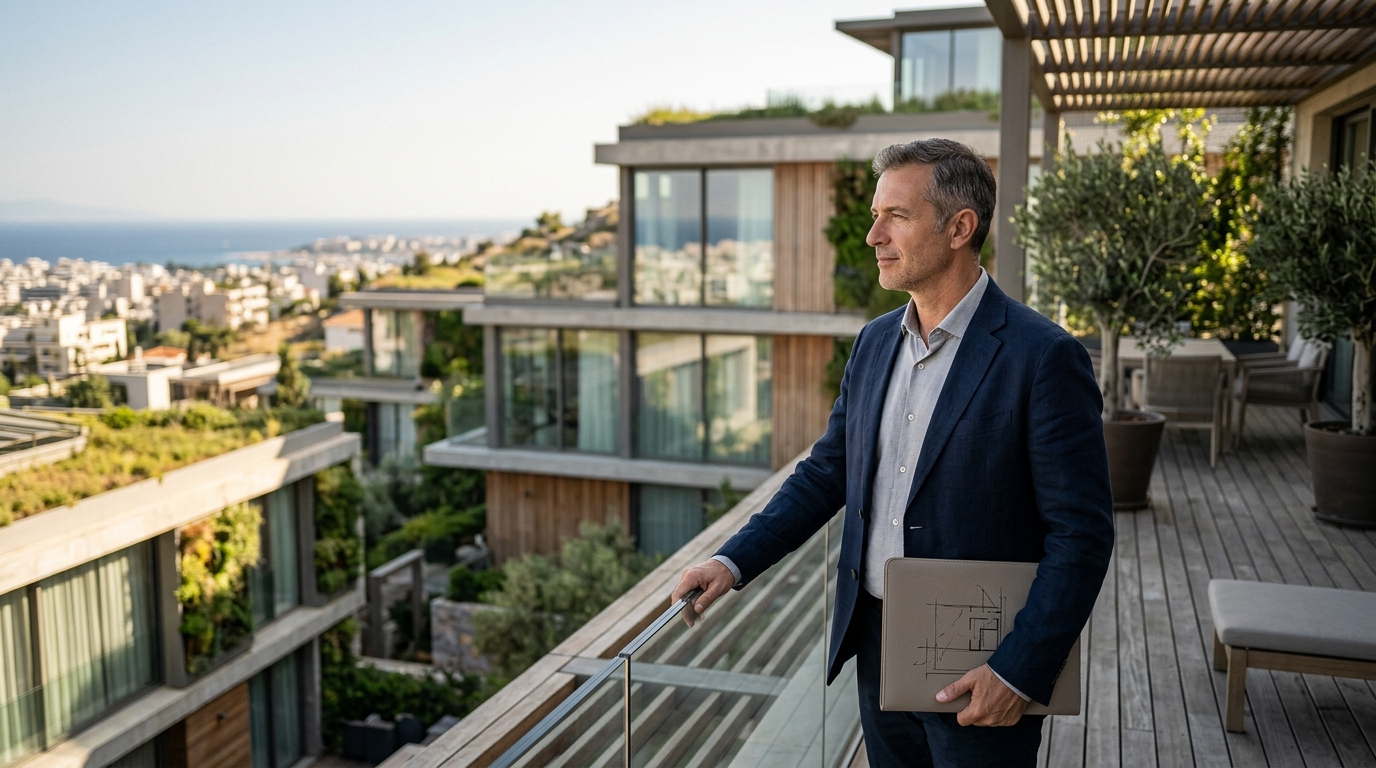
When you invest in property, you are not only buying location, space, and design. You are also buying the building’s future operating costs, regulatory exposure, resilience, tenant appeal, and ability to retain value. That is why sustainable and eco-friendly property investment can offer advantages that become more visible over a holding period of five, ten, or twenty years.
A sustainable property is designed to use resources more intelligently. It may combine passive solar design, high-performance insulation, efficient heating and cooling, renewable energy, water-saving systems, durable materials, smart controls, and healthier indoor environments. The objective is not simply to reduce environmental impact. It is to create a property that costs less to operate, remains attractive to occupants, adapts more easily to changing standards, and performs more consistently as market conditions evolve.
For investors in Athens and other premium Mediterranean markets, sustainability is especially relevant. Hotter summers, cooling demand, energy-price volatility, water-management concerns, and increasingly demanding European building policies all make building performance an important part of long-term value. The International Energy Agency reports that buildings account for approximately 30% of global energy demand, while space cooling is one of the fastest-growing building energy uses. ([iea.org](https://www.iea.org/reports/energy-efficiency-2025/buildings?utm_source=openai))
The short answer: what do you gain over time?
Sustainable property investment can benefit you long-term in seven connected ways:
- Lower operating expenses: Efficient envelopes, HVAC systems, lighting, appliances, and water fixtures can reduce recurring costs.
- More resilient cash flow: Lower exposure to energy and maintenance-cost increases can help protect net operating income.
- Better regulatory positioning: High-performing buildings are less likely to require expensive upgrades as energy and carbon standards become stricter.
- Stronger market appeal: Buyers, tenants, and hospitality guests increasingly value comfort, efficiency, health, and responsible design.
- Potential value premium: A well-documented sustainable building may attract a broader buyer pool and support stronger pricing than an otherwise comparable inefficient asset.
- Improved resilience: Passive cooling, shading, water efficiency, backup systems, and durable construction can help a property remain usable during heat, supply, or infrastructure stress.
- Longer design relevance: Timeless architecture and adaptable systems can reduce functional obsolescence and preserve desirability.
Sustainability does not guarantee a profit, and a green label alone cannot compensate for poor location, weak construction, excessive purchase price, or inadequate management. The strongest investment case is created when sustainability is integrated with sound development fundamentals.
1. Sustainable design can improve the property’s annual cash flow
For an income-producing asset, the most direct financial benefit of sustainability is often operational efficiency. Every euro not spent unnecessarily on electricity, heating, cooling, water, or avoidable repairs can contribute to stronger net operating income, assuming the savings are not offset by higher debt, maintenance, or management costs.
Where the savings typically come from
- Building envelope: Better insulation, airtightness, glazing, exterior shading, and thermal-bridge control reduce unwanted heat gain and heat loss.
- Heating and cooling: Efficient heat pumps, zoned controls, variable-speed systems, and properly commissioned equipment can reduce wasted energy.
- Solar generation: Photovoltaic systems can offset part of a building’s electricity demand, subject to local regulations, design constraints, grid arrangements, and operating profile.
- Lighting and appliances: LED lighting, occupancy sensors, daylight controls, and high-efficiency equipment lower consumption without reducing functionality.
- Water systems: Low-flow fixtures, leak detection, irrigation controls, rainwater collection where appropriate, and drought-tolerant landscaping can reduce water use.
- Maintenance planning: Durable materials, accessible plant rooms, monitoring systems, and robust detailing can reduce premature replacement and service disruption.
The financial effect compounds. A modest annual saving may appear insignificant in a single month, but over a long ownership period it can become a meaningful contribution to total return. Energy efficiency also supports affordability and resilience by reducing exposure to energy-price shocks. ([iea.org](https://www.iea.org/reports/energy-efficiency-2025/executive-summary?utm_source=openai))
A simple investment example
Consider two similar luxury apartments with the same location and comparable rental potential. Apartment A has inefficient cooling, limited shading, poor glazing, and high common-area energy use. Apartment B has a well-insulated envelope, external shading, efficient mechanical systems, smart metering, and renewable-energy integration. If Apartment B costs more to acquire but consistently produces lower utility and maintenance expenses, the investor should compare the additional purchase price with the projected lifetime savings, occupancy advantage, financing terms, and resale appeal.
The relevant question is not simply, “Which property is cheaper today?” It is, “Which property is likely to produce the stronger risk-adjusted performance throughout the ownership period?”
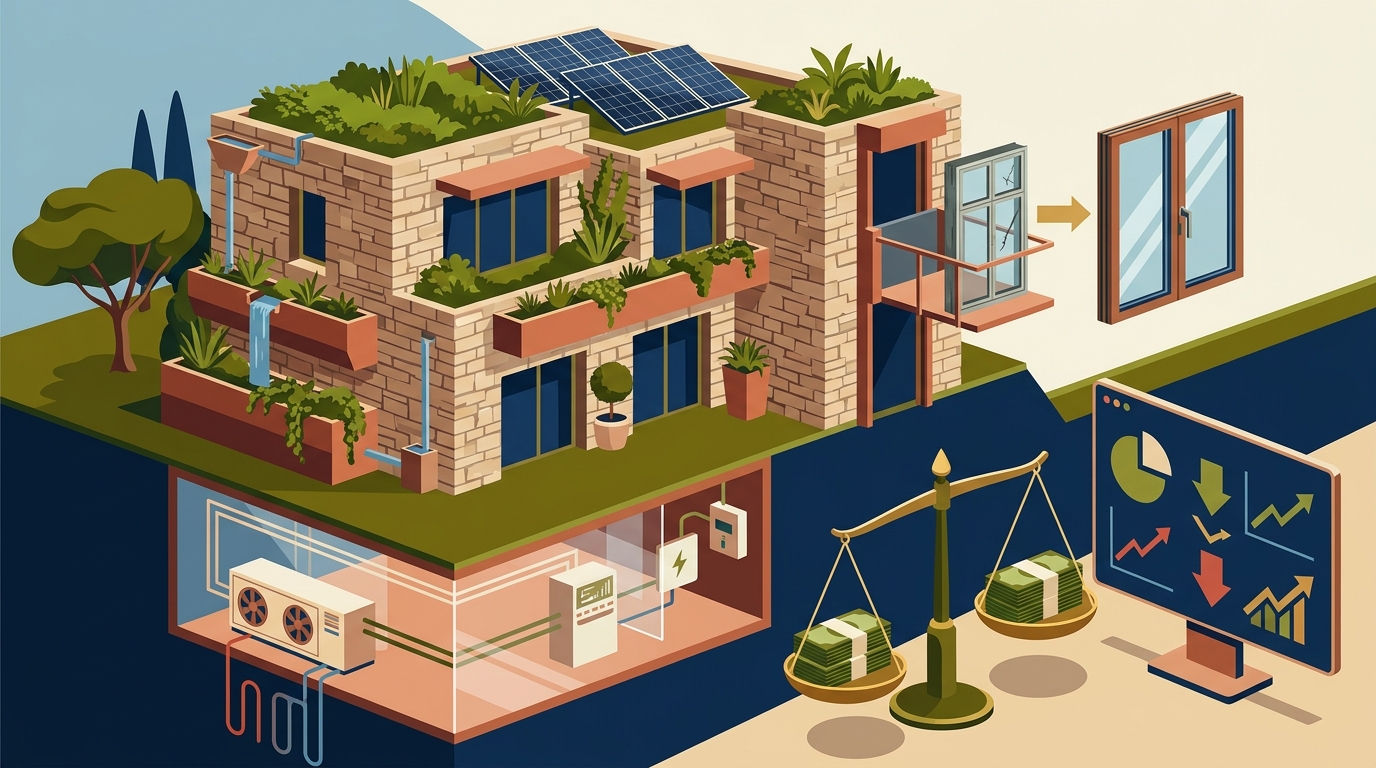
2. Efficiency reduces exposure to energy-price volatility
Energy is a variable cost that can directly affect landlords, residents, hospitality operators, and building managers. A property with high cooling and heating demand is more vulnerable when electricity or fuel prices rise. A property that needs less energy to maintain comfort has a built-in degree of protection.
This is particularly important in Mediterranean climates, where summer cooling can be a major component of residential and hospitality consumption. Passive design measures such as orientation, cross-ventilation, solar control, deep overhangs, planted areas, reflective surfaces, and thermal mass can reduce reliance on mechanical cooling. Efficient systems then provide the remaining cooling more economically.
The European Commission describes zero-emission buildings as highly efficient buildings with very low energy needs and no on-site fossil-fuel emissions, supported by renewable sources where feasible. It also notes that such buildings are less affected by fossil-fuel price fluctuations and can provide improved comfort during heat waves and cold spells. ([energy.ec.europa.eu](https://energy.ec.europa.eu/topics/energy-efficiency/energy-performance-buildings/energy-performance-buildings-directive/zero-emission-buildings_en?utm_source=openai))
For an investor, this resilience can support more predictable budgets. It may also make a property easier to market because prospective buyers can understand the practical value of lower and more stable running costs.
3. Sustainable properties may retain stronger resale appeal
Property value is shaped by more than floor area and postcode. Over time, buyers increasingly assess a building’s energy performance, running costs, comfort, renovation needs, and compliance position. A sustainable asset can therefore stand out when it is time to sell, refinance, or transfer ownership.
In real estate, the term green premium is commonly used to describe additional value associated with sustainability features or certified environmental performance. The premium is not automatic. It depends on whether the features are credible, measurable, desirable in the local market, and supported by appropriate documentation.
What can support a value premium?
- Strong energy-performance documentation and transparent utility data.
- Recognized certifications where they are relevant to the asset type and market.
- High-quality passive design rather than technology added without a coherent strategy.
- Renewable-energy systems that are properly sized, maintained, and legally integrated.
- Superior indoor comfort, daylight, acoustics, ventilation, and air quality.
- Low-maintenance landscaping and durable, repairable materials.
- EV-readiness, bicycle storage, secure mobility infrastructure, and adaptable parking arrangements.
- Evidence that the building’s design responds to local climate risks such as heat and water stress.
Research from the World Green Building Council has tracked industry use of metrics related to higher sale values and occupancy, reflecting the growing effort to connect green-building performance with commercial outcomes. ([worldgbc.org](https://worldgbc.org/wp-content/uploads/2022/03/World-Green-Building-Trends-2016-SmartMarket-Report-FINAL-2.pdf?utm_source=openai))
In practice, the most defensible value proposition is not “this building is sustainable.” It is a clear chain of evidence: the building uses less energy, costs less to operate, offers better comfort, faces fewer foreseeable upgrade requirements, and is more attractive to the next buyer.
4. Sustainable development helps reduce regulatory and retrofit risk
Building regulations are moving toward higher energy performance, better indoor environmental quality, electrification, renewable-energy readiness, and lower operational emissions. Investors who purchase or develop inefficient buildings may face future capital expenditure to remain competitive or compliant.
The revised European Energy Performance of Buildings Directive, adopted as Directive EU/2024/1275, entered into force on 28 May 2024, with EU countries required to transpose it into national law by 29 May 2026. The framework targets renovation of the worst-performing buildings and sets national trajectories for reducing residential building energy use. ([energy.ec.europa.eu](https://energy.ec.europa.eu/topics/energy-efficiency/energy-performance-buildings/energy-performance-buildings-directive_en?prefLang=sv&utm_source=openai))
The directive also establishes the zero-emission building as the standard for new buildings from the relevant implementation dates and as the benchmark for ambitious renovation. For new buildings, the EU framework sets a pathway toward zero-emission standards beginning with public buildings in 2028 and all new buildings in 2030. ([energy.ec.europa.eu](https://energy.ec.europa.eu/topics/energy-efficiency/energy-performance-buildings/energy-performance-buildings-directive/zero-emission-buildings_en?utm_source=openai))
Rules affecting charging infrastructure, building automation, renovation, and indoor environmental quality also make it important to consider future functionality at the design stage. The European Commission notes that major renovation can trigger requirements connected with energy performance and electric-vehicle charging infrastructure. ([energy.ec.europa.eu](https://energy.ec.europa.eu/topics/energy-efficiency/energy-performance-buildings/energy-performance-buildings-directive/sustainable-mobility-and-buildings_en?utm_source=openai))
For investors, the benefit is strategic rather than merely administrative: designing for higher performance today can reduce the probability of disruptive retrofits, protect liquidity, and preserve the building’s competitiveness as standards evolve. Local legal, tax, and permitting advice remains essential because implementation differs between countries and asset categories.
5. Sustainability can attract and retain better-fit occupants
A property’s long-term income depends on whether people want to live, work, stay, or operate there. Sustainable design strengthens that proposition when it improves the occupant experience rather than functioning as a marketing label.
Residential buyers and tenants may value lower utility bills, cooler interiors in summer, natural light, cleaner air, acoustic comfort, private outdoor space, and a connection to nature. Commercial occupiers may value employee comfort, corporate sustainability objectives, energy predictability, and the ability to demonstrate responsible operations. Hospitality guests increasingly expect a combination of luxury, wellness, authenticity, and environmental responsibility.
Better occupant experience can support:
- Higher enquiry and conversion rates.
- Reduced vacancy periods.
- Lower tenant turnover and reletting costs.
- Greater pricing power where the market recognizes the difference.
- Stronger reviews and brand perception for hospitality assets.
- More stable relationships with corporate tenants and operating partners.
In premium real estate, the strongest sustainable features are often those occupants can feel every day: stable temperatures, quiet interiors, abundant daylight, fresh air, shaded terraces, well-designed landscaping, and low operating costs. Environmental performance becomes more valuable when it is translated into a better way of living.
6. Health, comfort, and resilience protect functional value
A building can be energy-efficient and still be uncomfortable. Successful sustainable development therefore considers energy, materials, ventilation, humidity, daylight, acoustics, thermal comfort, and the relationship between indoor and outdoor spaces.
These qualities influence a property’s functional value: how well it serves its users and how easily it can adapt to changing expectations. A residence with excellent solar control and natural ventilation may remain comfortable during a heat event. A building with adaptable rooms, efficient infrastructure, and flexible technology can remain useful even as household, work, and hospitality patterns change.
Climate resilience is also becoming an investment consideration. Measures such as shaded outdoor areas, drought-tolerant planting, water-storage capacity, flood-aware detailing, robust façades, and efficient cooling can reduce operational disruption. The exact measures should be based on local risk assessment rather than a generic checklist.
The International Energy Agency emphasizes that building codes, standards, and certifications can embed energy efficiency, material efficiency, circularity, low-emissions design, and climate resilience across a building’s life cycle. ([iea.org](https://www.iea.org/reports/breakthrough-agenda-report-2025/building?utm_source=openai))
7. Why sustainable property investment matters in Athens and Greece
Athens combines a strong architectural identity, a dense urban fabric, intense summer sun, growing demand for high-quality residences, and a building stock that includes many older properties. These conditions create both challenges and opportunities for sustainable development.
In Athens, design decisions such as solar shading, orientation, façade performance, roof treatment, planting, glazing specification, ventilation, and high-efficiency cooling can materially affect comfort and running costs. Urban regeneration projects can also improve underused or outdated properties by combining contemporary performance with respect for the character of the surrounding neighborhood.
For international and local investors, a sustainable Athens property may offer a more compelling proposition when it combines:
- A well-connected and defensible location.
- Distinctive architecture with lasting visual appeal.
- Verified energy and construction performance.
- Low-friction operation and maintenance.
- High-quality interior and exterior amenities.
- Efficient cooling suited to the local climate.
- Strong natural light and outdoor living opportunities.
- Clear documentation for future buyers, lenders, operators, and property managers.
ECLÉDE, led by founder Vassilis Siafaricas, positions its development approach around the relationship between architecture, sustainability, and long-term investment value. The company’s published philosophy emphasizes minimal architectural lines, integration with natural surroundings, energy-efficient construction, sustainable urban regeneration, and high-performance developments including Net Zero Energy Buildings. ([eclede.com](https://eclede.com/the-founder/?utm_source=openai))
ECLÉDE’s Boomerang Athens project illustrates this approach through a luxury residence on the slopes of Lycabettus Hill, where environmental responsibility, technology, and refined design are presented as complementary rather than competing objectives. ([eclede.com](https://eclede.com/boomerang-athens-the-vision-of-eclede-and-vassilis-siafaricas-in-ad/?utm_source=openai))
8. How to evaluate a sustainable property before investing
Do not evaluate sustainability by counting solar panels or relying on broad claims such as “eco-friendly.” Use a structured due-diligence process that connects design decisions with measurable investment outcomes.
Step 1: Examine the location and climate response
Assess solar exposure, prevailing winds, urban heat, flood or wildfire exposure, transport access, water conditions, and the surrounding development pipeline. A sustainable building in a weak location may still be a weak investment.
Step 2: Review the building envelope
Ask for information about insulation continuity, glazing, airtightness, shading, thermal bridges, roof performance, façade materials, and maintenance requirements. In a hot climate, external shading and glazing specification can be as important as mechanical equipment.
Step 3: Verify systems and expected consumption
Request equipment specifications, predicted energy demand, renewable-energy calculations, heating and cooling system efficiencies, ventilation details, domestic hot-water strategy, lighting controls, and commissioning records. Separate modeled performance from measured performance where the building is already operating.
Step 4: Calculate total cost of ownership
Compare purchase price, financing, service charges, energy, water, insurance, maintenance, replacement cycles, taxes, vacancy assumptions, and expected capital expenditure. Sustainability should be assessed through lifecycle economics, not only initial construction cost.
Step 5: Check certification and documentation
Where applicable, examine energy-performance certificates, sustainability certifications, planning approvals, warranties, operating manuals, and records of compliance. A claim that cannot be documented may have limited value during resale or financing.
Step 6: Test the market proposition
Identify the likely buyer, tenant, guest, or corporate occupier. Which sustainable features will they pay for or choose over competing properties? The answer may be lower bills, quietness, wellness, prestige, resilience, or alignment with an ESG policy.
Step 7: Stress-test the investment
Model higher energy prices, lower occupancy, slower resale, interest-rate changes, equipment replacement, and potential regulatory upgrades. A sustainable property should remain financially credible under conservative assumptions.
Traditional versus sustainable property investment
| Factor | Conventional property | Sustainable property |
|---|---|---|
| Initial cost | May be lower when efficient systems and durable materials are excluded. | May require additional upfront design, materials, systems, commissioning, and documentation. |
| Energy exposure | Typically more sensitive to energy-price increases when demand is high. | Potentially lower demand and greater resilience when efficiency is properly designed and operated. |
| Maintenance | Can be higher where systems, finishes, and envelope details are low quality or difficult to access. | Can be lower over time when durable materials and maintainable systems are selected. |
| Regulatory position | May face greater risk of future upgrades as standards become stricter. | May be better positioned for evolving energy and emissions requirements. |
| Occupant appeal | Based primarily on location, layout, finishes, and amenities. | Combines those qualities with comfort, efficiency, wellness, and responsible design. |
| Resale story | May depend more heavily on market timing and conventional comparables. | Can benefit from measurable operating performance and broader sustainability criteria. |
| Investment risk | May appear simpler but can carry hidden operating and retrofit liabilities. | May involve greater technical complexity but can reduce selected long-term risks. |
This comparison is directional rather than a promise of performance. Location, construction quality, management, purchase price, financing, and market conditions remain decisive.
How ECLÉDE connects luxury with long-term responsibility
Sustainable luxury is not defined by adding visible technology to an otherwise conventional building. It is created by making the entire property more intelligent: the site, structure, envelope, systems, landscape, interiors, maintenance strategy, and user experience should support one another.
ECLÉDE’s work under Vassilis Siafaricas reflects a development philosophy that combines technical precision with creative direction. The company states that it has delivered luxury residential projects in Greece and that its work includes the first LEED Platinum residential project in Greece. Its portfolio and published recognitions also emphasize the integration of design quality, environmental responsibility, and long-term value creation. ([eclede.com](https://eclede.com/the-founder/?utm_source=openai))
This approach is relevant to investors because the best sustainable properties are not merely efficient machines. They are desirable places with a clear identity, strong craftsmanship, intelligent performance, and a reason for future occupants to choose them.
Key takeaways
- Think in lifecycle terms: Compare the total cost and income potential of a property over its intended holding period, not just its purchase price.
- Efficiency supports cash flow: Lower energy, water, and maintenance costs can strengthen net operating income.
- Resilience matters: Passive cooling, efficient systems, renewable energy, and water-conscious design can reduce exposure to volatility and climate stress.
- Regulation is moving forward: European building policy is placing greater emphasis on renovation, energy performance, indoor quality, electrification, and zero-emission standards. ([energy.ec.europa.eu](https://energy.ec.europa.eu/topics/energy-efficiency/energy-performance-buildings/energy-performance-buildings-directive_en?prefLang=sv&utm_source=openai))
- Design quality remains essential: Sustainability does not replace location, architecture, construction quality, or sound investment underwriting.
- Documentation creates credibility: Performance data, certificates, commissioning records, warranties, and operating information help convert sustainability into an investable proposition.
- Occupant experience drives demand: Comfort, daylight, air quality, quietness, outdoor space, and lower running costs can support stronger market appeal.
- Luxury and sustainability can reinforce one another: The most successful developments make environmental responsibility part of the architecture and everyday experience.
Frequently asked questions
What is the main long-term financial benefit of sustainable property investment?
The main benefit is the potential to improve risk-adjusted returns through lower operating expenses, more stable cash flow, stronger occupant demand, and reduced exposure to future retrofit costs. The actual result depends on the property’s location, purchase price, design quality, financing, management, and market conditions.
Does a sustainable property always cost more to buy?
Not always. High-performance construction can involve additional design, materials, equipment, testing, and certification costs, but pricing depends on the project and market. Investors should compare the upfront premium with projected energy savings, maintenance, occupancy, financing, regulatory exposure, and resale value.
Can energy efficiency protect an investment from inflation?
It can provide partial protection by reducing exposure to operating-cost increases, particularly for energy-intensive buildings. It is not a complete inflation hedge, because rent growth, interest rates, taxes, insurance, construction costs, and market values are also affected by inflation.
Are green certifications necessary for a sustainable investment?
A certification is not the only measure of sustainability, but it can provide structure, independent criteria, and useful documentation. Investors should also examine actual energy demand, construction quality, comfort, maintenance, water performance, lifecycle carbon, and the relevance of the certification to the local market.
Why is passive design important in Athens?
Passive design can reduce the amount of mechanical energy required to maintain comfort. Orientation, external shading, insulation, glazing, ventilation, thermal mass, and landscape design can help manage intense solar exposure and summer heat before mechanical systems are used.
How does the EU Energy Performance of Buildings Directive affect property investors?
The revised directive creates a European framework for improving building performance, renovating the worst-performing buildings, strengthening national renovation plans, and moving new construction toward zero-emission standards. Investors should obtain Greece-specific legal, technical, tax, and energy-performance advice because national implementation and exemptions vary. ([energy.ec.europa.eu](https://energy.ec.europa.eu/topics/energy-efficiency/energy-performance-buildings/energy-performance-buildings-directive_en?prefLang=sv&utm_source=openai))
What should I request during sustainable-property due diligence?
Request energy-performance certificates, modeled and measured consumption data, equipment schedules, renewable-energy calculations, commissioning records, maintenance plans, warranties, water-use information, material specifications, certification documents, planning approvals, and projected capital-expenditure requirements.
How does ECLÉDE approach sustainable development?
ECLÉDE describes its approach as a balance of architecture, sustainability, environmental responsibility, and long-term investment value. Under Vassilis Siafaricas, the company focuses on high-performance developments, sustainable luxury residences, energy-efficient construction, and designs that integrate with their surroundings. ([eclede.com](https://eclede.com/the-founder/?utm_source=openai))
A practical next step for eco-conscious investors
If you are considering a sustainable residence, development opportunity, or luxury investment in Athens, begin with a lifecycle assessment rather than a feature checklist. Define your intended holding period, expected use, income strategy, financing structure, target occupant, operating assumptions, and acceptable risk. Then test whether the property’s design and documentation support those objectives.
ECLÉDE brings together luxury real estate development, sustainable design, architecture, and investment-focused thinking in projects shaped for long-term relevance. To explore the company’s work and development philosophy, visit the ECLÉDE founder profile and review the company’s published work, including Boomerang Athens. For project-specific decisions, consult qualified architects, engineers, lawyers, tax advisers, valuers, and financial professionals.