
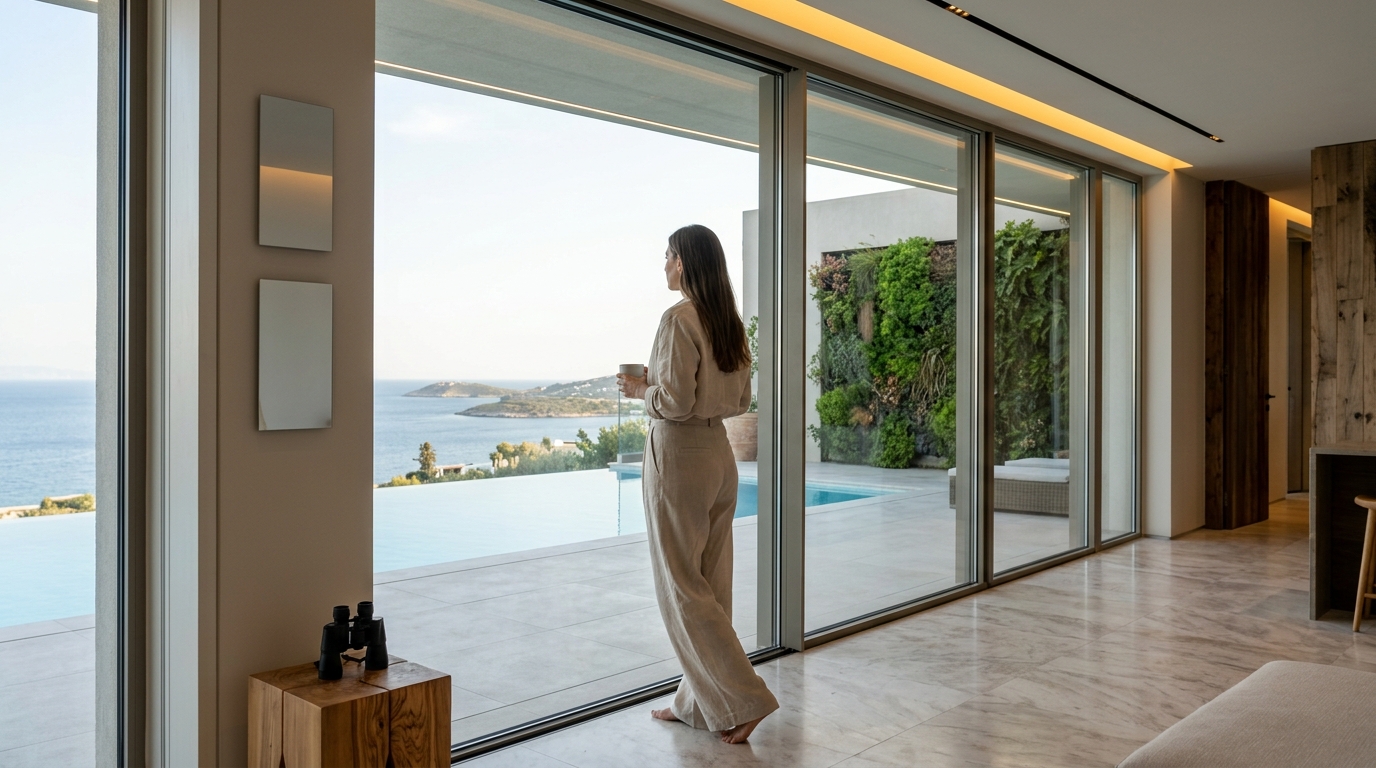
Luxury property has traditionally been judged by location, craftsmanship, privacy, proportions, and the quality of its finishes. Today, a more complete definition is emerging: the best high-end residences should also be comfortable to operate, healthy to occupy, resilient in changing conditions, and carefully integrated with their surroundings.
That distinction matters because visible green features—such as photovoltaic panels, planted roofs, or a dramatic living wall—do not automatically make a property sustainable. A genuinely responsible luxury development is designed as a coordinated system. Its orientation, envelope, mechanical services, water strategy, material palette, landscape, technology, and maintenance plan should work together to reduce resource use without diminishing comfort or architectural character.
For buyers considering a villa, penthouse, or private residential development in Athens, Greece, the most useful question is not simply, “Does this property look sustainable?” It is, “Can the developer demonstrate how the property performs?” This guide explains the features, documentation, and design decisions worth examining.
1. Start with measurable building performance
The most reliable sustainable features are not necessarily the most decorative. Begin by asking for performance information: energy modelling, predicted annual energy demand, insulation specifications, glazing performance, renewable-energy capacity, water-use calculations, commissioning records, and the property’s energy certificate.
In the European Union, the direction of travel is clear. The revised Energy Performance of Buildings Directive establishes zero-emission buildings as the standard for new construction from 2030, with the requirement applying to new buildings owned by public bodies from 1 January 2028, subject to specific provisions and exemptions. The European Commission defines a zero-emission building as one with no on-site fossil-fuel emissions, very high energy performance, and energy supplied through clean on-site, nearby, or grid-connected sources. ([energy.ec.europa.eu](https://energy.ec.europa.eu/topics/energy-efficiency/energy-performance-buildings/nearly-zero-energy-and-zero-emission-buildings_en?prefLang=es&utm_source=openai))
For a luxury buyer, this means sustainability should be assessed as an operating characteristic rather than a marketing adjective. A property with documented performance targets is more credible than one that merely lists premium equipment.
2. Look for passive design before active technology
Passive design reduces the amount of energy a building needs before mechanical systems are switched on. It is often the clearest sign that sustainability was considered early in the architectural process.
Orientation and solar control
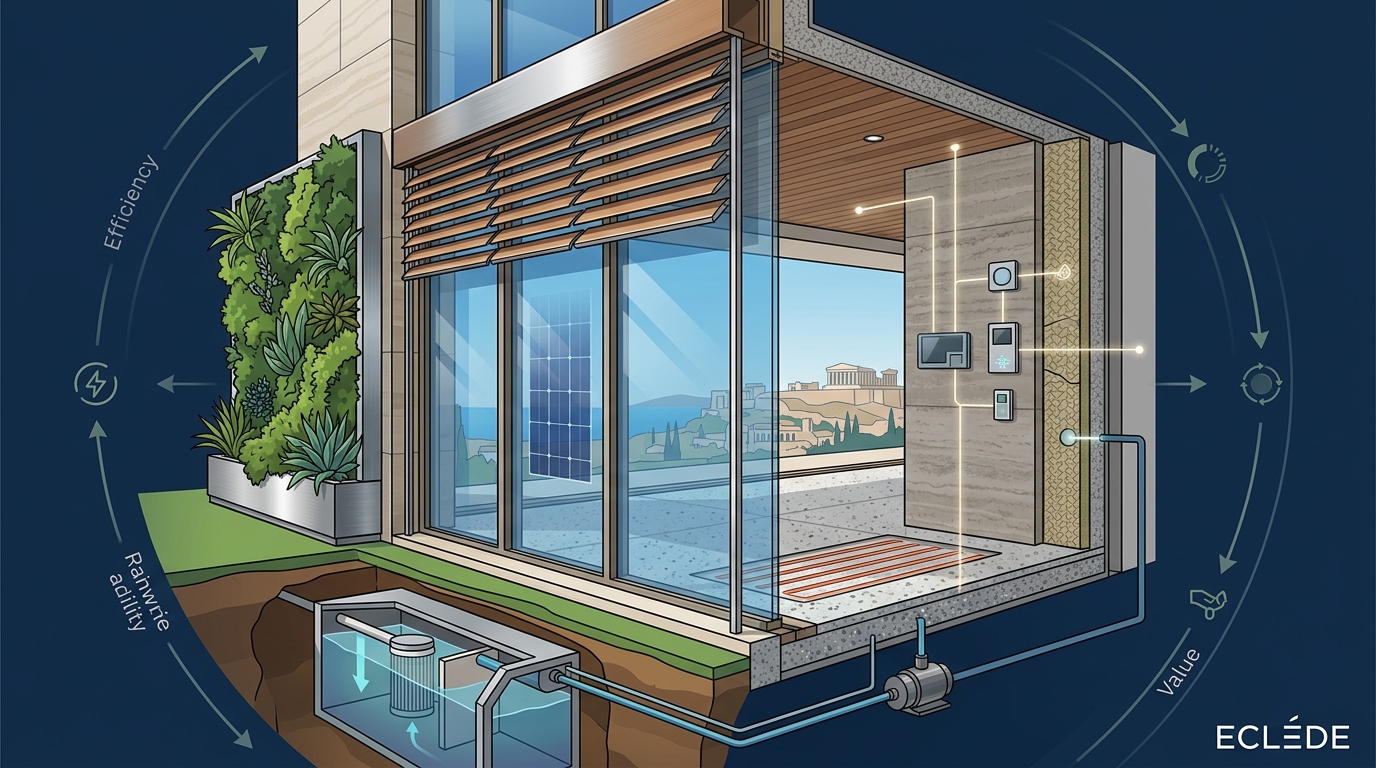
In a Mediterranean climate, orientation, shading, and glazing strategy are particularly important. A well-designed residence may use deep balconies, pergolas, external louvers, recessed openings, shutters, or carefully positioned trees to reduce summer solar gain while preserving winter daylight. External shading is generally more effective than relying only on interior blinds because it prevents a significant portion of solar heat from entering the building.
High-performance envelope
The building envelope includes the roof, walls, windows, doors, and junctions that separate conditioned interiors from the exterior. Look for continuous insulation, thermally broken frames, airtight construction, high-performance glazing, and careful treatment of thermal bridges. These details help maintain stable indoor temperatures, reduce drafts, and improve acoustic privacy—benefits that are immediately perceptible in a luxury home.
Natural ventilation and daylight
Cross-ventilation, operable windows, shaded courtyards, atria, and carefully placed openings can reduce the need for mechanical cooling during suitable weather. Daylight-responsive design can also lower lighting demand while creating a more generous and visually connected interior. Natural ventilation should be balanced with filtration, humidity control, and occupant comfort rather than treated as a substitute for a complete indoor-air strategy.
3. Evaluate energy generation and intelligent systems
Energy efficiency is the practice of delivering the same level of comfort or service with less energy. In a luxury property, the best systems are usually quiet, discreet, automated, and designed around the building’s actual loads.
Heat pumps and geothermal systems
High-efficiency air-source or ground-source heat pumps can provide heating, cooling, and sometimes domestic hot water with lower operating emissions than conventional fossil-fuel systems. Geothermal systems use the relatively stable temperature of the ground as part of the heating and cooling process. They can offer consistent comfort and quiet operation, but their suitability depends on site conditions, drilling requirements, available land, geology, and the project’s engineering design.
Photovoltaics and battery storage
Photovoltaic panels can generate electricity on site, while battery storage may help shift energy use and improve resilience. In a refined development, panels should be integrated into the roofscape or screened in a way that respects the architectural composition. Ask whether the stated solar capacity is based on usable roof area, whether shading studies have been completed, and how production will be monitored after handover.
Smart energy management
A sophisticated building-management system can coordinate HVAC, lighting, shading, hot-water production, pool equipment, ventilation, and renewable generation. Occupancy sensors, room-by-room controls, automated blinds, and energy dashboards can reduce unnecessary consumption without requiring residents to manage every setting manually.
Smart glass is another technology worth considering. Electrochromic or dynamic glazing can adjust its tint in response to sunlight, helping control glare and solar heat while retaining views and natural light. Its value depends on correct specification, controls, maintenance, and compatibility with the property’s wider façade strategy.
High-performance insulation, including advanced panel systems where appropriate, can deliver strong thermal resistance without unnecessarily thick walls. This may help preserve valuable interior floor area while supporting stable temperatures and lower HVAC demand.
4. Examine water conservation from roof to garden
Water efficiency is especially relevant in regions that experience seasonal heat, variable rainfall, or pressure on municipal supplies. A sustainable luxury property should address both consumption and runoff.
Efficient fixtures and leak detection
Low-flow taps, efficient showers, dual-flush toilets, smart irrigation controllers, and appliance selection can reduce potable-water demand without compromising the user experience. Leak-detection sensors and automatic shut-off valves are valuable in large residences because a hidden leak can cause significant damage and waste before it becomes visible.
Greywater reuse
Greywater recycling is the collection and treatment of wastewater from sources such as showers, bathroom sinks, and laundry for approved non-potable uses. Depending on local regulations and the system design, treated greywater may be used for landscape irrigation or toilet flushing. Buyers should ask what sources are connected, how the water is treated, where it is stored, and who is responsible for filter and tank maintenance.
Rainwater harvesting
Rainwater systems collect runoff from suitable roof surfaces and store it in tanks for later non-potable use. The practical value depends on rainfall patterns, roof area, tank capacity, first-flush treatment, filtration, and demand. In Athens and other Mediterranean locations, rainwater harvesting is most effective when paired with efficient irrigation and a landscape designed for seasonal conditions.
Water-sensitive landscaping
Xeriscaping uses drought-tolerant planting, efficient irrigation, mulch, and soil improvement to reduce landscape water requirements. Native or climate-adapted plants can create a strong visual identity while lowering irrigation, fertilizer, and maintenance needs. A sustainable garden should be beautiful throughout the year, not dependent on excessive watering to appear green during the hottest months.
5. Assess materials, durability, and embodied impact
Material sustainability is broader than choosing a natural-looking finish. Evaluate where a material came from, how much energy and water were used to produce it, how far it travelled, how durable it is, whether it can be repaired, and what happens at the end of its service life.
Reclaimed and responsibly sourced materials
Reclaimed timber can provide distinctive grain, patina, and historical character while reducing demand for newly harvested wood. Responsibly sourced timber, certified stone, recycled metals, recycled-content products, and locally produced materials may also reduce environmental impact when supported by credible documentation.
Natural stone can be a durable and visually sophisticated choice, but sustainability depends on quarrying practices, transport distance, slab yield, maintenance, and service life. A nearby material that lasts for decades may have a different overall profile from a fashionable imported product that requires frequent replacement.
Low-emitting finishes
Paints, adhesives, sealants, flooring, composite wood, and furnishings can affect indoor air quality. Low-VOC or low-emitting products help reduce the release of volatile organic compounds into occupied spaces. Product declarations and technical data sheets are more useful than broad claims such as “eco-friendly.”
Life-cycle thinking
Durability is a sustainability feature. A well-made stone floor, façade, door, or piece of joinery that can be maintained and repaired may outperform a lower-impact product that needs replacement after a short period. Ask whether the design includes accessible service zones, replaceable components, spare materials, and a maintenance manual.
Life-cycle assessment is increasingly relevant to premium development because it considers impacts beyond the opening day of a building. BREEAM, for example, evaluates sustainability across a broad range of categories, including energy, ecology, carbon, resilience, health, and whole-life performance. ([breeam.com](https://breeam.com/en-US/?utm_source=openai))
6. Consider indoor environmental quality
Sustainable luxury should feel healthier, quieter, and more comfortable—not merely more energy efficient. Indoor environmental quality includes air, light, temperature, humidity, acoustics, and the control of pollutants.
Ventilation and filtration
Energy-efficient homes are often tightly sealed, so controlled ventilation becomes important. Mechanical ventilation with heat recovery can introduce fresh air while recovering energy from outgoing air. High-quality filtration may help manage outdoor particles, but filters must be correctly selected and replaced according to the manufacturer’s maintenance schedule.
Thermal and acoustic comfort
Stable temperatures, limited drafts, low equipment noise, and strong separation from traffic or neighboring properties contribute directly to the feeling of privacy and refinement. These qualities should be verified through specifications and, where possible, post-completion testing.
Natural light and views
Daylight, visual connection to vegetation, and views of the surrounding landscape can support a sense of calm and spaciousness. The goal is not simply to install larger windows; it is to balance daylight with glare control, thermal performance, privacy, and nighttime energy use.
7. Review landscape and biophilic design
Biophilic design is an architectural approach that strengthens occupants’ connection with nature. In a luxury property, it may appear through courtyards, planted terraces, water-sensitive gardens, natural textures, filtered daylight, views, natural ventilation, and a layout that encourages indoor-outdoor living.
Living walls and indoor gardens can add visual richness and a calming sensory experience, but they are not automatically low-impact. They require lighting, irrigation, drainage, plant replacement, pest management, and skilled maintenance. Ask whether the planting strategy is appropriate for the interior environment and whether its resource requirements have been included in the building’s operational plan.
Large sliding doors, shaded outdoor rooms, rooftop terraces, and courtyards can extend the usable living area and reduce the psychological boundary between house and landscape. In Athens, a successful design may use outdoor shading, drought-tolerant planting, stone surfaces, and seasonal planting to create comfort without treating the landscape as a high-consumption decorative accessory.
8. Ask how the smart home supports sustainability
Technology should make responsible operation effortless. Useful controls include occupancy-based lighting, automated shading, zoned heating and cooling, pool and spa scheduling, water-use monitoring, irrigation weather adjustments, and alerts for abnormal consumption.
Avoid systems that are impressive at handover but difficult to operate or impossible to repair. Ask whether the controls use open standards, whether the owner receives administrator access, how software updates are handled, and whether essential functions remain available if the internet connection fails. A sustainable smart home should be intuitive, interoperable, secure, and serviceable over the long term.
Commissioning is equally important. Equipment should be tested as an integrated system rather than installed as separate products. A property may contain efficient heat pumps and solar panels yet perform poorly if controls are misconfigured, sensors are misplaced, or occupants are not trained to use the system.
9. Understand certifications and evidence
Third-party certification can provide a useful layer of assurance, although it should not replace technical due diligence. LEED evaluates areas including energy, water, materials, waste, indoor environmental quality, and location-related factors. Projects complete prerequisites, earn points, and undergo verification and review, with certification levels ranging from Certified through Platinum. ([usgbc.org](https://www.usgbc.org/leed?utm_source=openai))
BREEAM is another internationally used assessment framework. It can be applied across new construction, refurbishment, fit-out, and in-use performance, and it addresses topics such as carbon, energy, health, ecology, resilience, materials, and whole-life impacts. ([breeam.com](https://breeam.com/en-US/?utm_source=openai))
When reviewing a claimed certification, request the project name, rating level, certificate or assessment reference, scope, date, and whether the certification covers the entire building or only a particular phase. Also request the actual energy and water performance targets. A certificate is valuable, but operational data is what shows how a property performs in practice.
ECLÉDE’s founder, Vassilis Siafaricas, describes the company’s approach as a balance of architecture, sustainability, technical precision, and long-term investment value. The founder’s profile also identifies experience in environmentally responsible developments, sustainable urban regeneration, Net Zero Energy Buildings, and the development of a LEED Platinum residential project in Greece. ([eclede.com](https://eclede.com/the-founder/?utm_source=openai))
10. A practical buyer’s checklist
Before purchasing or commissioning a sustainable luxury property, ask the project team for clear answers to the following questions:
- What is the predicted annual energy demand, and how was it calculated?
- Which systems provide heating, cooling, ventilation, and domestic hot water?
- Is renewable energy generated on site, and is battery storage included?
- What insulation levels, glazing specifications, and shading measures are used?
- Has the building envelope been tested for airtightness and thermal performance?
- Are there water meters for the home, irrigation, pool, and other major uses?
- Does the property include greywater treatment or rainwater harvesting?
- Which landscape areas require irrigation during summer?
- Are timber, stone, finishes, and furnishings supported by sourcing or emissions documentation?
- What ventilation and filtration systems protect indoor air quality?
- Which smart-home functions can be monitored and controlled by the owner?
- Who maintains the renewable-energy, water-treatment, landscape, and automation systems?
- Is there a recognized certification such as LEED or BREEAM, and what exactly does it cover?
- Will the owner receive as-built drawings, warranties, commissioning records, and an operations manual?
The answers should be specific. “Energy efficient,” “green,” and “eco-conscious” are not performance metrics. Look for models, test results, product data, certificates, maintenance schedules, and post-occupancy monitoring plans.
Sustainable luxury feature comparison
| Feature | What it can improve | Luxury experience | What to verify |
|---|---|---|---|
| High-performance envelope | Heating and cooling demand | Stable temperatures, fewer drafts, quieter rooms | Insulation, glazing, airtightness, thermal-bridge details |
| Heat pump or geothermal HVAC | Operational energy and emissions | Quiet, consistent climate control | System sizing, seasonal efficiency, service access |
| Solar photovoltaic system | Grid electricity demand | Greater energy independence and resilience | Capacity, shading analysis, monitoring, battery strategy |
| Greywater recycling | Potable-water consumption | Efficient irrigation and greater self-sufficiency | Permitted uses, treatment method, maintenance responsibility |
| Rainwater harvesting | Landscape and cleaning-water demand | Lower dependence on mains water | Tank capacity, filtration, overflow, seasonal yield |
| Reclaimed or responsibly sourced materials | Resource use and material impact | Distinctive character and craftsmanship | Origin, chain of custody, durability, repairability |
| Low-emitting finishes | Indoor pollutant levels | Cleaner-smelling, healthier interiors | VOC or emissions documentation |
| Biophilic landscape design | Ecological value and occupant well-being | Privacy, shade, views, and indoor-outdoor connection | Plant selection, irrigation demand, long-term maintenance |
Key takeaways
- The strongest sustainable luxury properties combine passive design, efficient systems, responsible materials, water management, healthy interiors, and resilient landscape design.
- Start with measurable performance data rather than visible features or broad environmental claims.
- In Mediterranean locations such as Athens, solar control, shading, thermal mass, efficient cooling, water-sensitive landscaping, and seasonal outdoor comfort deserve particular attention.
- Heat pumps, photovoltaics, smart controls, high-performance insulation, and dynamic glazing can improve comfort when they are correctly designed and commissioned as an integrated system.
- Greywater recycling, rainwater harvesting, leak detection, efficient fixtures, and drought-tolerant planting can reduce pressure on potable-water supplies.
- Reclaimed timber, responsibly sourced stone, low-emitting finishes, durability, repairability, and life-cycle assessment make material selection more credible.
- LEED and BREEAM can help provide third-party assurance, but buyers should still request project-specific documentation and operational targets.
- ECLÉDE, led by Vassilis Siafaricas, positions sustainable architecture and long-term asset value at the center of its luxury development philosophy.
Frequently asked questions
What is the most valuable sustainable feature to look for first?
Begin with the building envelope: insulation, glazing, airtightness, thermal-bridge control, orientation, and external shading. These measures reduce the energy required for heating and cooling and are difficult to correct after construction. Smart controls and efficient equipment are important, but they cannot fully compensate for a poorly designed envelope.
Are sustainable luxury properties more expensive to maintain?
They are not necessarily more expensive to maintain. Efficient equipment can reduce energy costs, and durable materials may lower replacement and repair requirements. However, systems such as geothermal HVAC, greywater treatment, living walls, batteries, and advanced automation require planned servicing. Ask for a complete annual maintenance budget rather than assuming that every green feature reduces costs.
How can I tell whether a property’s sustainability claims are credible?
Request evidence: energy models, product specifications, water calculations, commissioning records, certification documents, warranties, and monitoring data. Confirm whether certification covers the whole property and whether the stated performance is predicted or measured. Credible sustainability claims are precise, documented, and linked to a maintenance plan.
Is reclaimed wood always the most sustainable choice?
No. Reclaimed wood can reduce demand for new timber and introduce valuable character, but its sustainability depends on its source, treatment, transport, durability, and intended use. Responsibly sourced new timber or another long-lasting local material may be more appropriate in some applications. Compare the full life cycle rather than selecting materials solely for appearance.
How does greywater recycling work in a luxury residence?
Greywater systems collect wastewater from approved sources such as showers, bathroom sinks, and laundry. The water is treated, stored, and reused for non-potable applications permitted by local regulations, commonly irrigation or toilet flushing. A buyer should verify the connected fixtures, treatment process, disinfection, storage, monitoring, and maintenance requirements.
Can an older luxury property be upgraded for sustainability?
Yes. Retrofit opportunities may include roof and wall insulation, high-performance windows, external shading, heat pumps, photovoltaic panels, smart controls, efficient fixtures, rainwater storage, low-emitting finishes, and climate-adapted landscaping. Historic or architecturally significant properties require a tailored approach so that efficiency improvements do not damage original fabric or character.
Which certifications should I look for?
LEED and BREEAM are widely recognized options, but the most relevant certification depends on the project location, asset type, assessment scope, and development team. For a property in Greece, ask the developer which local energy-performance requirements apply and whether an international certification has been independently verified. Certification is useful evidence, but it should be considered alongside actual design and operational data.
Does biophilic design automatically make a property sustainable?
No. Biophilic design can improve connection to nature through daylight, views, courtyards, planting, natural ventilation, and outdoor spaces, but some features—especially indoor gardens and living walls—can require substantial water, lighting, and maintenance. The best approach combines biophilic qualities with climate-appropriate planting, efficient irrigation, and a realistic operating plan.
Designing sustainable luxury in Athens and beyond
For a high-end property, sustainability is most successful when it is embedded in the architecture from the beginning. It should be visible in the calmness of the interior climate, the quality of the daylight, the quietness of the mechanical systems, the resilience of the landscape, and the clarity of the documentation—not only in a technology package added at the end.
ECLÉDE develops bespoke, environmentally responsible real estate with a focus on clean architectural lines, natural integration, technical intelligence, and long-term value. Under the direction of Vassilis Siafaricas, the company brings together development, design, architecture, and innovation to create refined residences intended to perform as well as they look. To discuss a sustainable development or investment opportunity, visit the ECLÉDE contact page, explore the company’s portfolio of completed and current projects, or learn more about the founder’s vision on the Vassilis Siafaricas founder page.