
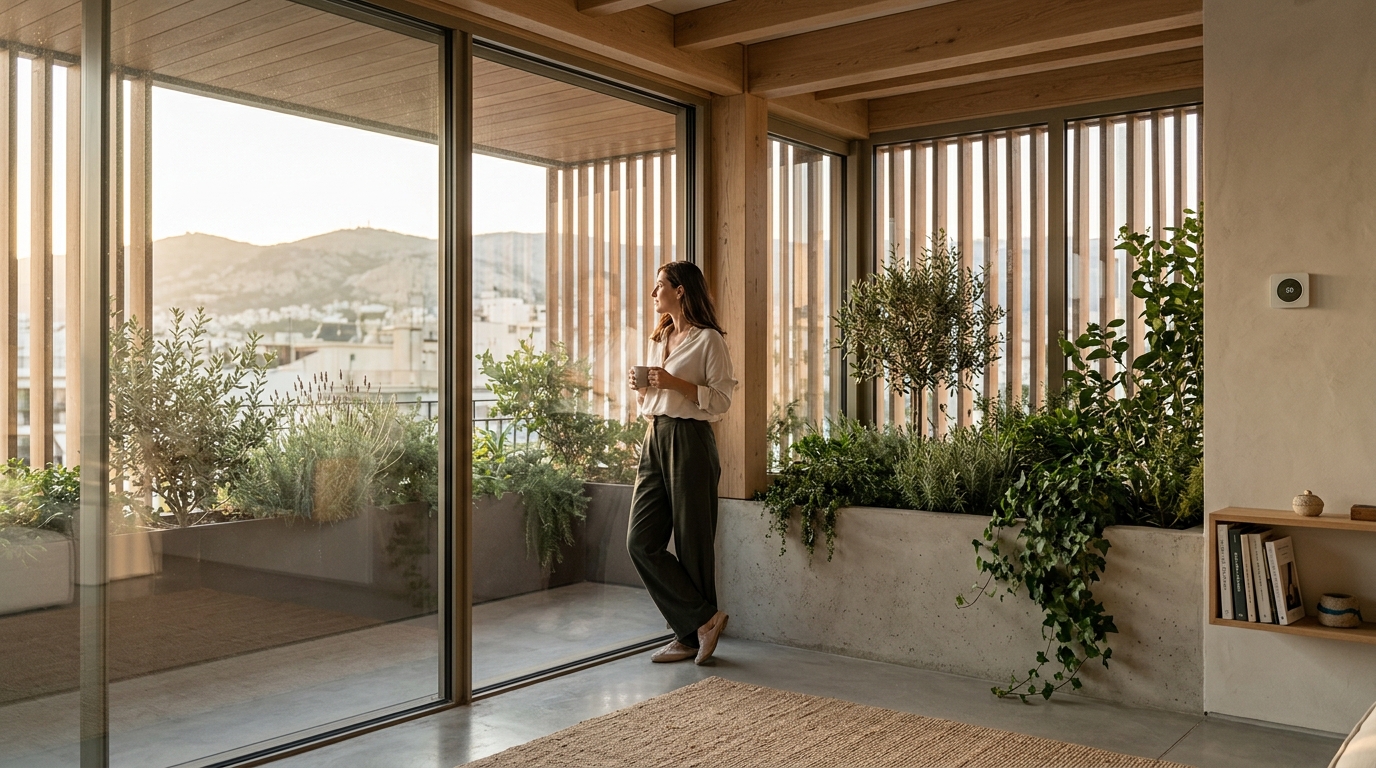
The most successful sustainable homes do not treat environmental responsibility as an added feature. They make sustainability part of the architecture itself: the building responds to its climate, uses resources intelligently, supports well-being, and remains adaptable for decades. For luxury residential development in Athens and beyond, this integrated approach creates living spaces that are more comfortable, efficient, resilient, and enduring.
Buildings account for approximately 39% of global energy-related carbon emissions, including emissions from building operations as well as materials and construction. That figure makes residential design an important opportunity for reducing environmental impact while improving everyday life. ([worldgbc.org](https://worldgbc.org/article/bringing-embodied-carbon-upfront/?utm_source=openai))
For ECLÉDE, sustainable design is most effective when it combines technical performance with architectural clarity. The goal is not to make a home look visibly “green,” but to create a refined environment in which daylight, thermal comfort, landscape, material quality, water stewardship, and intelligent controls work together.
1. Begin with the Site and Climate
The first sustainable design decision is made before the floor plan is drawn. A home should be shaped by its location, orientation, topography, vegetation, prevailing winds, solar exposure, local water conditions, and surrounding built environment.
In Athens, where hot summers, strong solar exposure, and periods of water stress can influence comfort and operating costs, early climate analysis can inform the position of openings, terraces, courtyards, shading elements, planting, and service spaces. A coastal property may require a different response to salt exposure and wind than an urban residence in a dense neighborhood. A sloping site may offer opportunities for passive cooling, stepped massing, or partially embedded spaces, but it may also require careful stormwater and foundation planning.
A site-responsive strategy can include:
- Mapping the sun’s path throughout the year before fixing window sizes and room orientation.
- Studying prevailing breezes to support cross-ventilation where outdoor air quality and climate conditions permit.
- Retaining mature trees and natural landforms instead of treating the site as a blank surface.
- Positioning outdoor living areas according to seasonal comfort rather than visual appeal alone.
- Reducing unnecessary excavation, retaining walls, and hardscape to limit embodied impacts.
- Planning access, deliveries, parking, and service areas to minimize disruption to the landscape.
This is an example of integrated design: energy, water, landscape, structure, interiors, and operations are considered together rather than delegated to separate stages. Integrated design, energy performance, water conservation, indoor environmental quality, lower-impact materials, and resilience are also identified as core sustainable building principles by the U.S. Environmental Protection Agency. ([epa.gov](https://www.epa.gov/greeningepa/guiding-principles-sustainable-federal-buildings?utm_source=openai))
2. Design for Passive Comfort Before Adding Equipment
Passive design uses the orientation, form, envelope, materials, and openings of a building to moderate indoor conditions with less dependence on mechanical heating and cooling. The U.S. Department of Energy describes passive solar design as an approach that uses windows, walls, floors, layout, and the surrounding landscape to collect, store, distribute, or deflect solar heat. ([energy.gov](https://www.energy.gov/sites/prod/files/guide_to_passive_solar_home_design.pdf?utm_source=openai))
A high-performing home generally starts with a well-considered envelope. Continuous insulation, airtight construction, thermally appropriate windows, and careful detailing at junctions help reduce unwanted heat transfer and drafts. The Department of Energy identifies continuous thermal insulation as a foundational part of a zero-energy building envelope and notes that orientation and shading help control direct solar penetration. ([energy.gov](https://www.energy.gov/cmei/buildings/zeb-technologies-building-envelope-architectural-considerations?utm_source=openai))
Use orientation and shading as architectural elements
In the Northern Hemisphere, orientation can help capture lower winter sun while limiting excessive summer gain. External shading is often more effective than relying solely on interior blinds because it stops solar radiation before it enters the glass. Deep reveals, pergolas, adjustable louvers, shutters, planted screens, balconies, and carefully sized overhangs can all provide shade while contributing to a residence’s identity.
For a contemporary Greek residence, shading should be designed as part of the façade rather than added after the building is complete. A shaded terrace can extend the usable living area, reduce glare, protect interior finishes, and create a more comfortable transition between indoors and outdoors.
Use thermal mass intelligently
Stone, concrete, masonry, and other materials with suitable thermal properties can help moderate temperature swings when correctly integrated with insulation, shading, and ventilation. The Department of Energy explains that thermal mass can store the effects of intermittent exterior conditions and reduce temperature variation inside a building. ([energy.gov](https://www.energy.gov/cmei/buildings/zeb-technologies-passive-design-techniques?utm_source=openai))
Thermal mass is not automatically beneficial in every climate or configuration. It must be paired with a strategy that allows the stored heat to be released or absorbed at the right time. The design team should therefore test the proposed envelope and massing through energy modelling instead of relying on material assumptions alone.
3. Use Daylight, Views, and Ventilation Strategically
Natural light is central to both sustainable performance and the experience of a luxury home. Well-designed daylighting can reduce the need for artificial lighting during the day, improve visual comfort, and strengthen the connection between rooms and landscape. However, more glass is not automatically more sustainable. Oversized or poorly shaded windows can increase glare, overheating, heat loss, and cooling demand.
A more precise approach balances:
- Window-to-wall ratios appropriate to each orientation.
- Low-emissivity, double- or triple-glazed systems where the climate and design brief justify them.
- External shading for high-exposure façades.
- Light-coloured or reflective surfaces that distribute daylight without excessive glare.
- Clerestory windows, rooflights, or internal courtyards where they can provide useful light without compromising thermal performance.
- Layered lighting controls that combine daylight sensors, occupancy detection, and user-adjustable scenes.
The Department of Energy notes that successful daylighting depends on the interaction of climate zone, fenestration, ceiling height, shading, views, and the overall daylighting system. ([energy.gov](https://www.energy.gov/cmei/buildings/zeb-technologies-building-envelope-architectural-considerations?utm_source=openai))
Natural ventilation can complement mechanical systems when outdoor conditions are suitable. Opposing openings, shaded courtyards, operable windows, ventilated stairwells, and carefully controlled night flushing may help remove accumulated heat. In dense urban areas, ventilation design should also account for noise, pollution, security, humidity, and local regulations.
Biophilic design extends these principles by connecting occupants with nature through views, planting, natural textures, water, daylight, seasonal change, and access to outdoor space. The strongest applications are purposeful: a planted courtyard that cools a transitional zone, a framed view that gives a bedroom visual relief, or a natural stone surface selected for both tactile quality and regional relevance.
4. Choose Durable, Low-Impact Materials
Material selection should consider more than appearance and initial price. A responsible specification evaluates extraction, manufacturing, transport, installation, maintenance, service life, repairability, recyclability, and end-of-life recovery. This life-cycle perspective is particularly important in luxury development, where finishes are expected to remain visually and technically compelling for many years.
Prioritize longevity and repairability
Durable materials can reduce replacement frequency and the waste associated with premature renovation. Natural stone, responsibly sourced timber, high-quality metalwork, lime-based finishes, and well-made joinery can all support long service lives when they are suitable for the local environment and properly detailed.
Longevity does not mean choosing the most permanent material in every location. It means selecting a material that can withstand its actual exposure, be maintained with reasonable resources, and be repaired rather than discarded. A replaceable timber panel, accessible mechanical component, or modular flooring system may be more sustainable than a technically complex product that cannot be serviced.
Reduce embodied carbon through informed specification
Embodied carbon includes emissions associated with material production, transportation, construction, replacement, and disposal. The World Green Building Council separates the commonly cited 39% building-sector figure into operational emissions and emissions related to materials and construction, emphasizing the importance of addressing both parts of a building’s life cycle. ([worldgbc.org](https://worldgbc.org/article/bringing-embodied-carbon-upfront/?utm_source=openai))
Practical measures include:
- Retaining and refurbishing an existing structure where feasible instead of demolishing and rebuilding.
- Using efficient structural spans and avoiding unnecessary material quantities.
- Comparing concrete, steel, timber, stone, and hybrid systems through project-specific life-cycle assessment.
- Specifying products with environmental product declarations where reliable data is available.
- Choosing recycled-content metals and products designed for future recovery.
- Using timber from responsibly managed forests and requesting appropriate chain-of-custody documentation.
- Selecting regional stone, clay, timber, and craft products when they meet performance requirements.
Local sourcing can reduce transport impacts and support regional expertise, but distance alone does not determine sustainability. A locally produced material with a short service life may perform worse over time than a more distant product with exceptional durability. The appropriate decision depends on the complete life-cycle profile.
Design for disassembly
A circular approach keeps products and materials in use for as long as possible. In a residence, this can mean using mechanical fixings rather than unnecessary permanent adhesives, documenting concealed services, separating layers that may need replacement, and designing kitchens, bathrooms, partitions, and façades for future adaptation.
These choices also improve the practical flexibility of a home. A residence designed for disassembly is easier to renovate, repair, reconfigure, or partially upgrade without sending large quantities of material to landfill.
5. Reduce and Reuse Water Without Sacrificing Comfort
Water efficiency should address both indoor consumption and the landscape. Low-flow fixtures, leak detection, efficient appliances, pressure management, and hot-water pipe planning can reduce demand while preserving a high level of comfort. Shorter distances between the water heater and frequently used fixtures can also reduce waiting time and wasted water.
Capture rainwater where appropriate
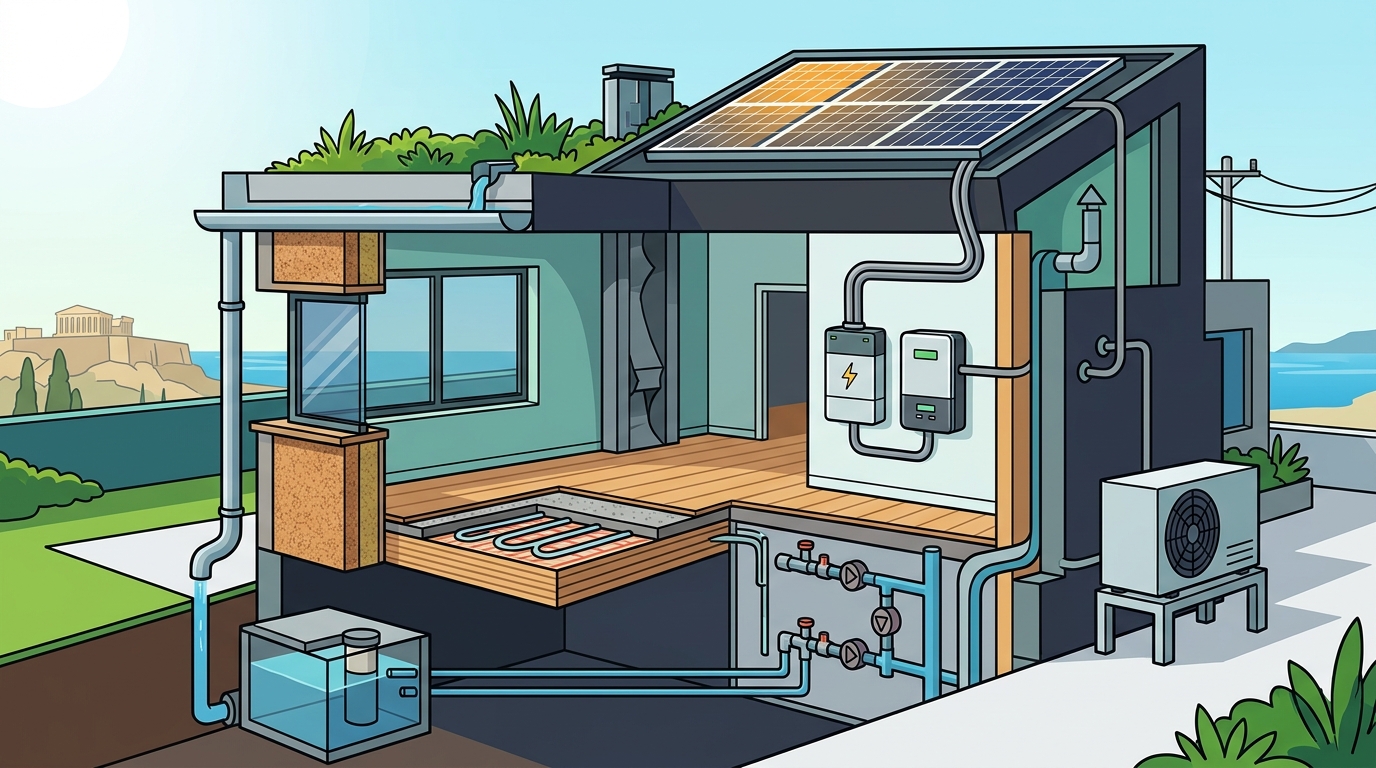
Rainwater harvesting collects runoff from roofs or other suitable surfaces and stores it for non-potable uses such as landscape irrigation or, where regulations and treatment systems permit, toilet flushing and laundry. Cisterns, filtration, first-flush diversion, pumps, and overflow routes should be coordinated with the architecture from the beginning.
Green infrastructure approaches such as rain gardens, bioretention areas, permeable paving, green roofs, and rainwater harvesting can help capture or infiltrate water near where it falls. ([epa.gov](https://www.epa.gov/water-research/green-and-gray-infrastructure-research?utm_source=openai))
Rainwater reuse is not a substitute for efficient irrigation and drought-appropriate planting. The EPA recommends combining harvesting with water-efficient landscaping and irrigation practices. ([19january2017snapshot.epa.gov](https://19january2017snapshot.epa.gov/www3/watersense/outdoor/rainwater_reuse.html?utm_source=openai))
Consider greywater systems carefully
Greywater from showers, baths, bathroom sinks, and laundry may be treated for selected non-potable uses, depending on local requirements and the system design. Reuse systems need clear separation from potable water, suitable filtration, reliable maintenance access, and safeguards against cross-connection. A system that is difficult to operate or maintain may underperform, so the client should receive clear documentation and training.
For projects in regions exposed to drought, rainwater infiltration and harvesting can improve resilience by helping replenish groundwater or creating reserves for non-potable uses. The EPA advises that local ordinances and regulations should be checked before specifying harvesting systems. ([epa.gov](https://www.epa.gov/green-infrastructure/prepare-drought?utm_source=openai))
6. Design Landscapes for Resilience, Not Just Appearance
A sustainable residence includes its gardens, terraces, pools, driveways, and boundary treatments. Landscape design can reduce heat, manage runoff, support biodiversity, and make outdoor spaces more comfortable.
Effective strategies include:
- Using native or climate-adapted plants with low irrigation requirements.
- Grouping plants according to water needs rather than irrigating the entire site uniformly.
- Replacing excessive areas of impermeable paving with permeable surfaces where soil and structural conditions allow.
- Using shade trees and planted pergolas to cool paths, terraces, and west-facing areas.
- Creating rain gardens, bioswales, or planted drainage channels to slow runoff.
- Using soil improvement and mulching to retain moisture.
- Designing pool filtration, covers, and backwash management to reduce water loss.
In a luxury setting, resilience can be expressed through sensory quality: a shaded citrus garden, a stone courtyard that remains cool under summer sun, aromatic planting around a walkway, or a planted roof that improves views from upper floors. Environmental performance and aesthetic richness do not need to compete.
7. Add Smart Technology After the Fundamentals
Smart-home technology can improve efficiency, comfort, and operational visibility, but it works best when it supports a well-designed building rather than attempting to compensate for a weak envelope.
Useful systems may include:
- Smart thermostats and zoned heating and cooling.
- Occupancy sensors for lighting and selected building services.
- Automated blinds, shutters, and external shading linked to solar exposure.
- Energy meters that show whole-home and major-system consumption.
- Water meters and leak-detection sensors.
- Photovoltaic monitoring and battery-management interfaces where renewable systems are installed.
- Predictive maintenance alerts for pumps, filters, HVAC equipment, and water systems.
Automated shading can close or adjust during periods of intense solar gain, while occupancy-based controls can reduce conditioning or lighting in unused areas. The value is not automation for its own sake; it is the ability to make the home respond appropriately to changing weather, occupancy, and energy conditions.
Controls should remain understandable and overrideable. A sustainable home must still be comfortable when sensors fail, internet access is interrupted, or residents prefer manual control. Commissioning, user education, cybersecurity, and long-term service support are as important as the initial installation.
8. Measure Performance Across the Building Life Cycle
Sustainable design becomes more credible when its objectives can be measured. Before construction, the project team can establish targets for energy use, water consumption, thermal comfort, daylight, embodied carbon, renewable energy generation, biodiversity, and maintenance.
Useful project tools include:
- Whole-building energy modelling to test orientation, glazing, shading, insulation, and equipment combinations.
- Life-cycle assessment to compare structural and finish options.
- Water-balance calculations for demand, storage, irrigation, and reuse.
- Daylight and glare analysis for key living spaces.
- Thermal-comfort modelling for indoor and outdoor areas.
- Construction waste tracking and responsible procurement documentation.
- Post-occupancy monitoring to compare predicted performance with actual operation.
The design process should also include commissioning. Equipment needs to be installed, balanced, tested, and documented; otherwise, even a highly efficient specification may not deliver its intended performance. In a high-end home, commissioning protects both environmental goals and the owner’s investment by ensuring that complex systems operate quietly, reliably, and intuitively.
Key Takeaways
- Start with the site: Climate, orientation, topography, vegetation, and prevailing winds should shape the design from the beginning.
- Reduce demand first: A high-performance envelope, external shading, insulation, airtightness, and thermal mass can reduce reliance on mechanical systems.
- Balance glass with performance: Daylight and views are valuable, but glazing must be coordinated with solar control, thermal comfort, and glare prevention.
- Specify for the full life cycle: Evaluate embodied carbon, durability, repairability, transport, maintenance, and end-of-life recovery.
- Use water intelligently: Combine efficient fixtures, drought-appropriate planting, rainwater capture, infiltration, and carefully designed reuse systems.
- Make landscapes functional: Planting, shade, permeable surfaces, and green infrastructure can improve comfort and manage runoff.
- Use technology as an enabler: Smart controls should reveal waste, automate routine adjustments, and support—not replace—good architecture.
- Verify results: Energy modelling, life-cycle assessment, commissioning, and post-occupancy monitoring turn sustainability goals into measurable outcomes.
Frequently Asked Questions
What is the most effective sustainable design practice for a modern home?
There is no single solution that performs best in every location. The most effective approach is integrated design: begin with climate and site analysis, reduce energy demand through orientation and envelope performance, manage water, select durable materials, and then add efficient equipment and smart controls. The interaction between these measures is more important than any isolated feature.
How can passive design improve everyday comfort?
Passive design can moderate temperature, reduce drafts, control glare, and make better use of daylight and natural ventilation. Orientation, external shading, insulation, airtight detailing, high-performance glazing, and thermal mass can help stabilize indoor conditions before heating or cooling equipment is used.
Is a large amount of glass sustainable?
Large areas of glass can provide daylight and views, but they may also increase overheating, glare, heat loss, and cooling demand. The sustainable solution is not simply more or less glazing; it is the right glazing for each orientation, combined with external shading, suitable glass performance, thermal breaks, and energy modelling.
Which materials are best for sustainable luxury interiors?
The best material depends on the application and location. Generally, prioritize materials that are durable, repairable, responsibly sourced, low-emitting, and supported by credible environmental information. Regional stone, certified timber, recycled-content metals, mineral finishes, and modular products may all be appropriate when their technical performance and life-cycle impacts are understood.
Can rainwater harvesting be used in a private residence?
Rainwater harvesting can collect and store runoff for non-potable uses such as irrigation and, where permitted and properly treated, selected indoor applications. The system must be designed around local rainfall, roof materials, storage capacity, filtration, overflow, maintenance, and applicable health and building regulations.
What is greywater recycling?
Greywater recycling treats selected wastewater streams, commonly from showers, baths, bathroom sinks, or laundry, for approved non-potable uses. It requires separate plumbing, treatment, monitoring, maintenance access, and safeguards against cross-connection. Local regulations should be confirmed before implementation.
Does sustainable design cost more?
Some strategies require additional upfront design work or specialist equipment, but the financial outcome depends on the project. Better passive performance can reduce equipment size and operating costs; durable materials can reduce replacement; and water or energy monitoring can identify waste. A life-cycle cost analysis is more useful than comparing initial construction prices alone.
How can sustainability be added to an existing home?
Begin with an energy and water audit. Common priorities include improving insulation and airtightness, upgrading windows where appropriate, adding external shading, sealing ductwork, installing efficient equipment, reducing irrigation demand, adding leak detection, and introducing smart monitoring. Renovation should be sequenced so that cosmetic work does not prevent later performance improvements.
Why is commissioning important in a sustainable home?
Commissioning verifies that systems are installed, configured, balanced, and operating as designed. It can identify incorrect controls, airflow problems, sensor faults, water-system issues, and equipment interactions that would otherwise reduce comfort and efficiency after handover.
Sustainable Development with ECLÉDE
Creating a modern living space that is simultaneously luxurious, efficient, resilient, and deeply connected to its setting requires more than selecting environmentally preferable products. It requires a coherent design vision, technical coordination, and attention to how the property will be lived in, maintained, adapted, and valued over time.
ECLÉDE, led by Vassilis Siafaricas, approaches luxury real estate development through bespoke design, architectural quality, and responsible integration with place. For a new residence, renovation, or development in Athens and Greece, the strongest starting point is a conversation about the site, the intended experience, the project’s performance targets, and the long-term expectations of its owners.
Explore the ECLÉDE portfolio to see how refined architectural language can work alongside environmental responsibility, learn more about the company’s philosophy on the about page, or contact the team to discuss a sustainable development brief.