
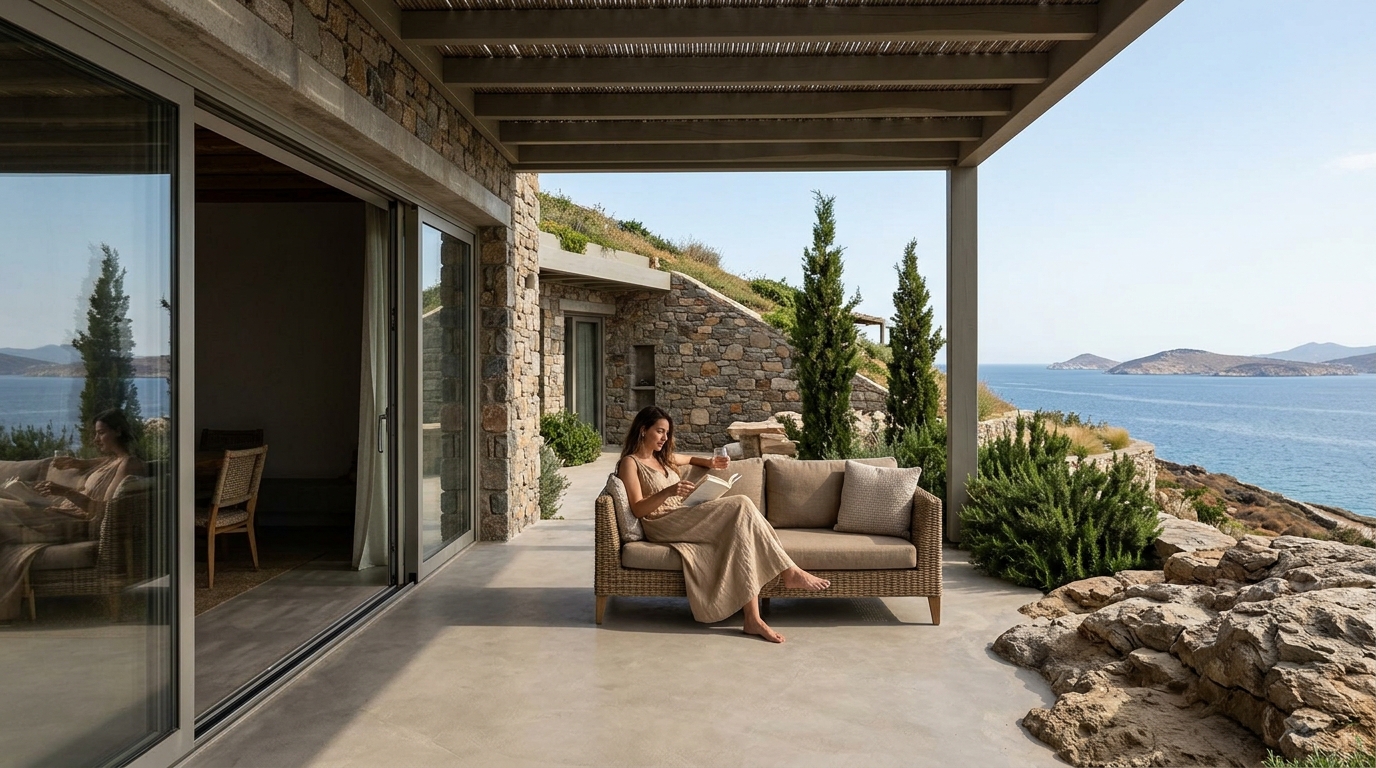
Earth-sheltered architecture is one of the oldest and most effective building strategies for staying cool without burning through energy. In hot climates like the Mediterranean, where summer temperatures regularly exceed 35°C, burying a structure partially or fully into the earth can slash cooling costs by as much as 50%. This guide explores the core benefits of earth-sheltered design for energy efficiency, drawing on peer-reviewed research and real-world projects from firms like ECLÉDE, which specializes in subterranean luxury villas across Greece.
What Is Earth-Sheltered Architecture?
Earth-sheltered construction is the practice of building homes or other structures primarily underground or partially buried in earth. This approach leverages the ground's stable thermal mass to moderate interior temperatures year-round. There are two main types: underground structures, which are fully covered by earth, and bermed structures, which are surrounded by earth on one or more sides.
The concept is not new. Subterranean dwellings have existed across the Mediterranean region from the prehistoric to the pre-industrial era. Modern versions, however, use reinforced concrete, advanced waterproofing, and smart ventilation systems to deliver luxury-grade comfort.
How Earth-Sheltering Reduces Cooling Loads
The fundamental mechanism is simple: soil temperature is far more stable than air temperature. While outdoor air in Athens can swing from 15°C to 42°C across seasons, the ground just a few meters deep holds steady between 18°C and 22°C. This means an earth-sheltered building exchanges heat with a much cooler medium than a conventional above-ground structure does in summer.
The Heat Sink Effect
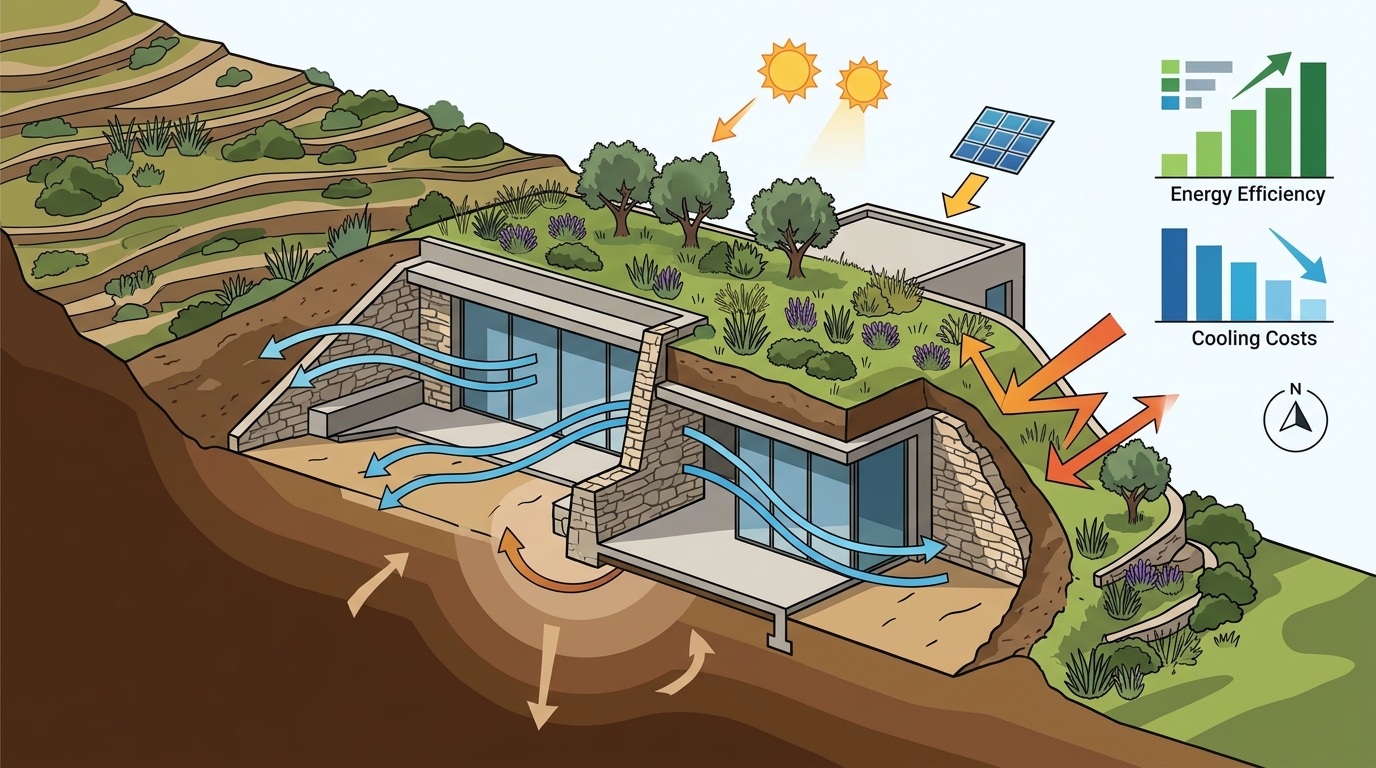
In hot climates, the earth acts as a heat sink, absorbing excess thermal energy from the building envelope and keeping interiors naturally cooler. This dramatically reduces the workload on air-conditioning systems. According to the U.S. Department of Energy, the earth can absorb extra heat from a house in hot weather, functioning as passive insulation without any mechanical input.
Reduced Conduction Losses
Earth-sheltered construction saves energy by reducing conduction heat transfer through the walls and roof. The temperature difference between the building and the adjacent ground is typically much less than between an above-grade structure and outside air, cutting thermal bridging significantly.
Energy Savings by the Numbers
Research consistently confirms substantial energy reductions. The table below summarizes findings from peer-reviewed studies.
| Metric | Finding | Source |
|---|---|---|
| Cooling energy reduction at 6m depth | 50% | ResearchGate (Shiraz study) |
| Total annual energy savings (fully sheltered) | Up to 40.4% | ResearchGate (Shiraz study) |
| Energy reduction (three-sided sheltering) | 27% | Cyprus simulation study |
| Heating and cooling cost savings (max estimate) | Up to 80% | EBSCO Research |
| Heating energy reduction (three-sided) | 63% | Cyprus simulation study |
These numbers illustrate a clear pattern: earth-sheltered buildings enjoy a much higher advantage in reducing cooling loads than heating loads, making them especially compelling for hot-climate regions like Greece, Egypt, and southern Spain.
Design Typologies for Hot Climates
Bermed Structures
A bermed building is a structure with earth piled against its exterior walls on one or more sides. This typology works well on sloped sites and allows south-facing glazing for natural light while keeping the remaining envelope thermally protected. In regions with hot summers, a north-facing slope is often ideal to minimize solar heat gain.
Fully Underground (Atrium Style)
A fully underground structure is built entirely below grade, often organized around a central courtyard that delivers daylight and ventilation. This plan achieves the highest energy efficiency of all earth-sheltered types because it maximizes contact with the thermally stable ground.
Hillside Integration
Hillside integration is a design approach where the building is carved into a natural slope, exposing only one facade. This technique preserves the landscape while providing panoramic views. It is the approach used in several of ECLÉDE's award-winning projects across the Greek islands.
Real-World Examples in the Mediterranean
Greece offers some of the most striking contemporary examples of earth-sheltered luxury design. The Atlas and Pleione villas by ECLÉDE are subterranean luxury properties located on Lefkada's Sivota bay. These seafront villas feature near-zero energy consumption combined with minimally intrusive architectural design. The project won a Bronze A' Design Award in 2024 for its sustainable approach.
In Athens, ECLÉDE's Boomerang Athens became the first residence in Greece to achieve LEED Platinum certification, demonstrating that sustainable luxury is achievable at the highest standards. Founder Vassilis Siafaricas has built his practice around zero-energy-consumption buildings that blend seamlessly into their natural surroundings.
These projects confirm that earth-sheltered and landscape-integrated design is not a compromise. It is a pathway to both environmental performance and architectural distinction.
Additional Benefits Beyond Energy
- Durability: Constructed of concrete and steel, earth-sheltered homes can last well over 100 years, dramatically reducing lifecycle costs.
- Storm resistance: Subterranean structures are naturally resistant to high winds, wildfires, and extreme weather events.
- Noise reduction: The surrounding earth mass provides exceptional sound insulation from exterior noise.
- Landscape preservation: Green roofs and buried envelopes restore the site's natural vegetation, supporting local biodiversity.
- Lower maintenance: Reduced exposure to UV radiation and weathering means less exterior upkeep over time.
Key Takeaways
- Earth-sheltered buildings can reduce cooling energy by up to 50% at a depth of 6 meters in hot climates.
- Total annual energy savings range from 27% (partial sheltering) to over 40% (full sheltering).
- Some proponents estimate heating and cooling cost savings as high as 80% compared to conventional homes.
- In hot climates, the earth acts as a passive heat sink, reducing reliance on air conditioning.
- Modern earth-sheltered projects like ECLÉDE's Atlas and Pleione prove that sustainability and luxury coexist.
- Bermed, atrium, and hillside typologies each offer distinct advantages depending on site conditions.
- Durability, storm resistance, and landscape preservation add long-term value beyond energy savings.
Frequently Asked Questions
What is an earth-sheltered building?
An earth-sheltered building is a structure built primarily underground or with earth banked against its walls and roof. It uses the ground's thermal stability to reduce heating and cooling needs.
How much energy can earth-sheltered homes save in hot climates?
Research shows cooling energy reductions of up to 50% and total annual energy savings between 27% and 40%, depending on the depth and extent of earth coverage. Some estimates suggest savings as high as 80% on combined heating and cooling costs.
Are earth-sheltered buildings more expensive to build?
Initial construction costs are typically 10 to 20 percent higher than conventional homes due to structural reinforcement and waterproofing. However, long-term savings on energy and maintenance often offset the premium within a decade.
Do earth-sheltered homes have natural light?
Yes. Modern designs use courtyards, skylights, and strategically placed glazing to bring ample daylight into living spaces. Atrium-style layouts and single-facade hillside designs both allow generous natural illumination.
Is earth-sheltered architecture suitable for the Greek climate?
Absolutely. Greece's hot, dry summers and moderate winters make it an ideal setting. Projects like ECLÉDE's subterranean villas on Lefkada demonstrate both the feasibility and the luxury potential of this approach.
What are the main design types?
The three main typologies are bermed (earth banked on sides), fully underground (atrium-centered), and hillside-integrated (carved into a slope). Each suits different terrain and climate conditions.
How long do earth-sheltered buildings last?
Built with reinforced concrete and steel, these structures can last well over 100 years with minimal maintenance, significantly outperforming conventional wood-frame construction.
Can earth-sheltered design be combined with renewable energy?
Yes. Because earth-sheltered homes require so little energy, even a modest photovoltaic array can bring them to net-zero or plus-energy status. Research shows that earth-sheltered buildings in southern European climates can achieve energy surplus each month with standard solar panels.
Start Your Sustainable Luxury Project
Whether you are planning a private villa in the Greek islands or a certified green residence in Athens, earth-sheltered design offers unmatched energy efficiency and architectural beauty. Contact ECLÉDE to discuss how bespoke subterranean architecture can transform your next project.