
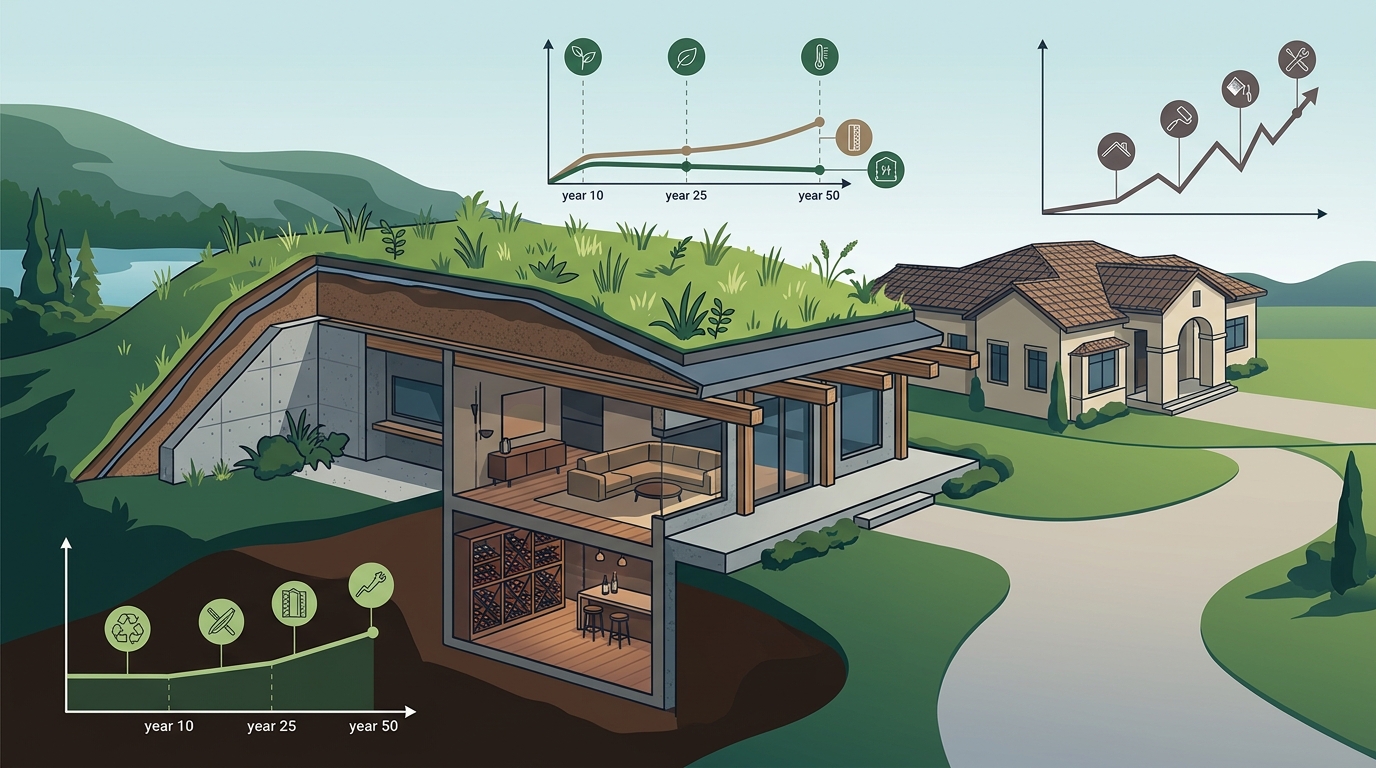
When a luxury villa buyer weighs a hillside earth-sheltered design against a conventional above-grade build, the sticker price dominates the conversation. But for a property expected to serve multiple generations, the real question is what happens to the maintenance ledger in year ten, year twenty-five, and year fifty. This guide dissects each cost category—from the living roof above your head to the waterproof membrane behind your wine cellar—so you can model the true total cost of ownership.
The Financial Equation at a Glance
Conventional luxury villas incur escalating exterior maintenance: roof replacements every 20–30 years, facade repainting or re-rendering, timber-rot repairs, and pest treatments. An earth-sheltered villa sidesteps most of these by using the earth itself as the primary envelope. The trade-off is a higher day-one investment and a strict requirement for moisture management.
| Cost Category | Conventional Villa (50 yr) | Earth-Sheltered Villa (50 yr) |
|---|---|---|
| Roof replacement / living-roof upkeep | 2–3 full replacements | Drainage inspections; minimal plant management |
| Exterior wall maintenance | Repainting every 7–10 yr; cladding repairs | Near zero on bermed walls; one exposed facade only |
| HVAC running costs | Baseline (100 %) | 15–40 % of baseline |
| Insurance premiums | Standard luxury-home rates | Discounted rates for storm/fire resistance |
| Pest control | Ongoing termite and wood-borer treatments | Eliminated (concrete/steel structure) |
1. Structural Durability and the Concrete Advantage
The skeleton of an earth-sheltered villa is reinforced concrete—the same material used in dams, bridges, and bunkers. Unlike timber framing, reinforced concrete does not rot, warp, or serve as food for insects. Because the earth blanket shields it from UV radiation and temperature cycling, the primary drivers of surface degradation in above-grade concrete are virtually absent underground.
Industry sources project that concrete-and-steel earth-sheltered homes can last well over 100 years, dwarfing the maintenance cycles that luxury homeowners face with conventional cladding systems. In practice, that means the structural shell of your villa should never require the kind of large-scale remedial work—re-stumping, wall-frame replacement, truss repair—that conventional builds accumulate over five decades.
2. The Living Roof vs. Conventional Roofing
A conventional luxury villa with slate or tile roofing will need at least one full replacement within a 50-year span, often costing tens of thousands of dollars. Metal roofs fare better but still require re-coating and fastener maintenance. An earth-covered roof flips the script: the earth protects the waterproof membrane from UV light, temperature swings, and physical impact, dramatically extending its service life.
Some designers recommend a minimal 15 cm layer of soil to support a green roof, since this reduces structural load while still delivering insulation and membrane protection. Adding more earth beyond that yields only modest incremental benefits while raising structural costs considerably. For a luxury build, the sweet spot lies in combining a well-engineered drainage layer, a high-grade membrane, and a landscaped living roof that doubles as an outdoor entertainment terrace or garden.
3. Energy and HVAC: The Largest Recurring Saving
Energy is the line item where earth-sheltered construction delivers its most dramatic payback. The earth maintains a relatively stable temperature of roughly 10–15 °C (50–60 °F) year-round at depth, which means the villa envelope never has to cope with the 40 °C-plus swings that punish above-grade walls in hot climates.
Research estimates suggest families in earth-sheltered homes can save up to 80 percent on heating and cooling compared to conventional houses. In a luxury villa context—where square footage is large and expectations for climate comfort are high—even a conservative 60 percent saving translates to thousands of dollars annually. One academic analysis from UC Berkeley calculated that annual energy savings of roughly $3,000 could offset the additional building costs of an earth-sheltered home in approximately eleven years. Scale that to a 400 m² luxury villa with premium climate zones (wine cellar, spa, home cinema) and the payback compresses further.
Importantly, earth-sheltered villas can function with HVAC systems rated at approximately one-quarter the output required by a conventional home. Smaller systems cost less to purchase, less to service, and less to replace at end-of-life.
4. Waterproofing: The One Maintenance Item You Cannot Ignore
Moisture management is both the Achilles' heel and the defining discipline of earth-sheltered building. The U.S. Department of Energy highlights the increased level of care required to avoid moisture problems, both during construction and over the life of the house. For a luxury villa, this translates to three non-negotiable design elements:
- Site selection: A well-drained hillside with low water-table levels. Flat sites and areas with high groundwater are poor candidates.
- Surface and sub-surface drainage: French drains, gravel blankets, and graded swales that route water away from the structure before it ever contacts the membrane.
- Premium waterproof membrane: Bentonite-clay, rubberised-asphalt, or thermoplastic systems rated for 30–50 years of buried service.
When these three layers are executed correctly, waterproofing shifts from an ongoing repair expense to a periodic inspection task. The maintenance protocol is straightforward: annual drainage inspections, clearing of outlet pipes, and monitoring for any signs of interior condensation or humidity spikes. Budget roughly 0.1–0.3 % of construction cost per year for waterproofing stewardship—a fraction of what a conventional villa spends on exterior paint, gutter replacement, and facade sealing.
5. Exterior Maintenance: From Four Walls to One
A conventional villa exposes four facades and a roof to wind, rain, UV, and temperature extremes. An earth-bermed villa typically exposes only one face—usually the south-facing glass wall that admits light and passive solar heat. This single exposed elevation still needs the same maintenance as any luxury facade (glass cleaning, frame servicing, stone or render upkeep), but you have eliminated three-quarters of the exterior surface area from your maintenance schedule.
If the exposed facade uses durable cladding—natural stone, stucco, or high-quality brick—combined with thermally broken aluminium-clad windows, the exterior can remain virtually maintenance-free for decades. This alone can save a luxury homeowner thousands every few years in scaffolding hire, repainting, and render patching.
6. Insurance Premium Reductions
Earth-sheltered villas are inherently resistant to many of the perils that drive luxury-home insurance premiums higher: wildfire, hailstorms, tornadoes, and high winds. Reinforced concrete with earth cover offers arguably the best fire resistance available in residential construction, while the buried profile eliminates wind-lift risk on the roof.
Multiple sources note that homeowners may negotiate lower insurance premiums based on reduced susceptibility to weather, earthquake, and storm damage. For a luxury villa in a fire-prone or cyclone-prone region, the annual insurance savings alone can amount to a meaningful percentage of overall holding costs.
7. Pest Control: A Cost That Disappears
Termite barriers, wood-borer treatments, and rodent exclusion are recurring expenses for any timber-framed or timber-clad home. An earth-sheltered villa built from reinforced concrete eliminates these concerns entirely. Concrete is not flammable, is not food for any insect, and does not chemically degrade over normal time horizons. The seamless, tight construction of earth-sheltered homes also makes it extremely difficult for dust, pollen, and pests to infiltrate the interior, reducing both cleaning costs and the need for pest-management contracts.
8. Indoor Air Quality and Mechanical Ventilation
One area where earth-sheltered villas add a maintenance line item is mechanical ventilation. Because the concrete shell is so airtight—often less than 5 percent air infiltration—fresh-air exchange must be handled by a dedicated heat-recovery ventilation (HRV) or energy-recovery ventilation (ERV) system. These units require filter changes every 3–6 months and motor servicing every few years. However, the benefit is cleaner indoor air with fewer allergens, which can reduce healthcare-adjacent costs for sensitive occupants and eliminates the need for separate air-purification systems that many luxury homeowners install anyway.
9. Resale Value and Market Perception
Maintenance cost analysis would be incomplete without acknowledging the resale dimension. Earth-sheltered homes can face a smaller buyer pool, and financing may require more effort. However, some data suggest that well-built earth-sheltered properties establish housing values 30–40 percent higher than conventional wood-frame buildings upon resale, particularly when lifetime operating costs are documented for prospective buyers.
For a luxury villa, the key is positioning the earth-sheltered design as a premium feature—not a compromise. Commissioning a professional energy audit and maintaining a detailed maintenance log strengthens the resale narrative significantly.
Decade-by-Decade Cost Comparison
The following model illustrates a simplified comparison for a 350 m² luxury villa in a temperate climate. All figures are indicative.
| Period | Conventional Villa Maintenance | Earth-Sheltered Villa Maintenance |
|---|---|---|
| Years 1–10 | Minor exterior touch-ups, HVAC servicing, first gutter replacement, pest contracts | HRV filter changes, drainage inspections, single-facade cleaning |
| Years 11–20 | First major repaint, roof inspection and repairs, HVAC overhaul or replacement, ongoing pest control | HVAC check (smaller unit = lower service cost), membrane inspection, continued drainage stewardship |
| Years 21–30 | Full roof replacement likely, second major repaint, possible re-cladding, HVAC replacement #2 | Possible HRV motor replacement, green-roof re-planting, waterproof membrane spot-check |
| Years 31–50 | Second roof replacement, structural timber inspection, third repaint, cumulative pest damage remediation | Continue periodic inspections; major structural intervention unlikely |
Key Takeaways
- Energy savings dominate the financial case. Expect 60–85 percent reductions in heating and cooling costs—the single largest recurring saving over 50 years.
- Exterior maintenance drops by roughly 75 percent because only one facade is exposed to the elements.
- Waterproofing demands discipline, not large budgets. Proper drainage design at construction time converts a potential risk into a low-cost inspection routine.
- Insurance and pest-control savings compound quietly but add meaningfully to total cost of ownership.
- The initial premium of 10–30 percent can be recouped within roughly 11 years through energy savings alone, before factoring in avoided maintenance.
- Structural lifespan exceeds 100 years, making an earth-sheltered villa a genuinely multi-generational asset.
Frequently Asked Questions
How much can an earth-sheltered villa save on heating and cooling?
Estimates range from 60 to 85 percent in energy-cost reduction compared to a conventional above-grade home. The exact figure depends on climate, villa size, and how much of the envelope is earth-covered. Some proponents cite savings as high as 80 percent for fully sheltered designs in regions with large daily temperature swings.
Is waterproofing an ongoing maintenance expense?
Not in the way most people fear. A correctly installed membrane on a well-drained site should last 30–50 years. Ongoing costs are limited to drainage inspection and ensuring surface-water management systems remain clear. The U.S. Department of Energy recommends choosing the site carefully, planning drainage at and below the surface, and waterproofing thoroughly during construction to minimise lifetime risk.
Do earth-sheltered homes cost more to build?
Yes. Excavation, heavier structural materials, and waterproofing typically add 10–30 percent to initial construction costs. However, research from UC Berkeley suggests that energy savings alone can offset those additional costs in approximately eleven years.
Are earth-sheltered luxury villas harder to insure?
Generally the opposite. Because reinforced concrete with earth cover resists fire, wind, and hail, many insurers offer reduced premiums. Some U.S. states, such as Texas, even offer specific discounts for all-concrete earth-sheltered buildings.
What is the expected structural lifespan?
Reinforced-concrete earth-sheltered homes are projected to last well over 100 years. Because the earth blanket protects concrete from freeze–thaw cycling and UV degradation, the structure ages far more slowly than exposed above-grade buildings.
Can I still have luxury finishes inside an earth-sheltered villa?
Absolutely. Interior fit-outs—marble, hardwood flooring, bespoke cabinetry—are installed the same way as in any conventional home. The concrete shell accepts furring, drywall, and premium finishes without restriction. Many award-winning earth-sheltered homes feature interiors indistinguishable from high-end conventional builds.