
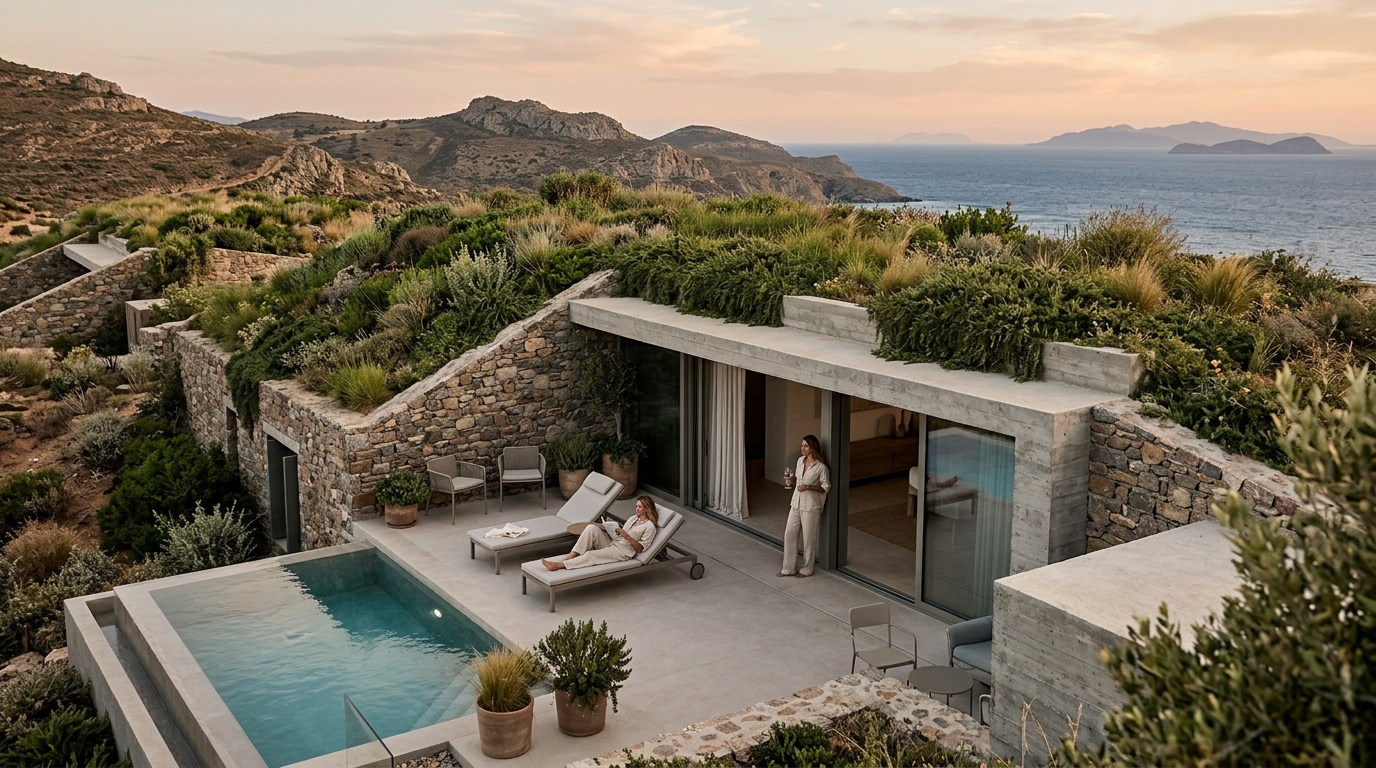
As global temperatures rise and cooling costs surge, architects and developers are turning to one of humanity's oldest building strategies: earth-sheltered architecture. By embedding structures partially or fully into the ground, designers harness the earth's stable thermal mass to slash energy consumption by dramatic margins. In Mediterranean and arid climates like Greece, this approach is especially powerful. This guide explores the core benefits, design principles, real-world performance data, and luxury applications of earth-sheltered buildings for anyone considering a smarter, more sustainable home.
What Is Earth-Sheltered Architecture?
Earth-sheltered construction is the practice of building homes or structures primarily underground or partially buried in earth. This architectural approach offers notable environmental benefits, particularly in energy efficiency, requiring significantly less energy for heating and cooling compared to traditional above-ground buildings. The concept dates back thousands of years, with subterranean dwellings found across cultures from Iran to the American Southwest.
There are two main types: underground structures, which are fully covered by earth, and bermed structures, which are encircled by earth on one or more sides. Modern versions typically use reinforced concrete, advanced waterproofing, and passive solar strategies to combine ancient wisdom with contemporary comfort.
How Earth Sheltering Delivers Energy Efficiency
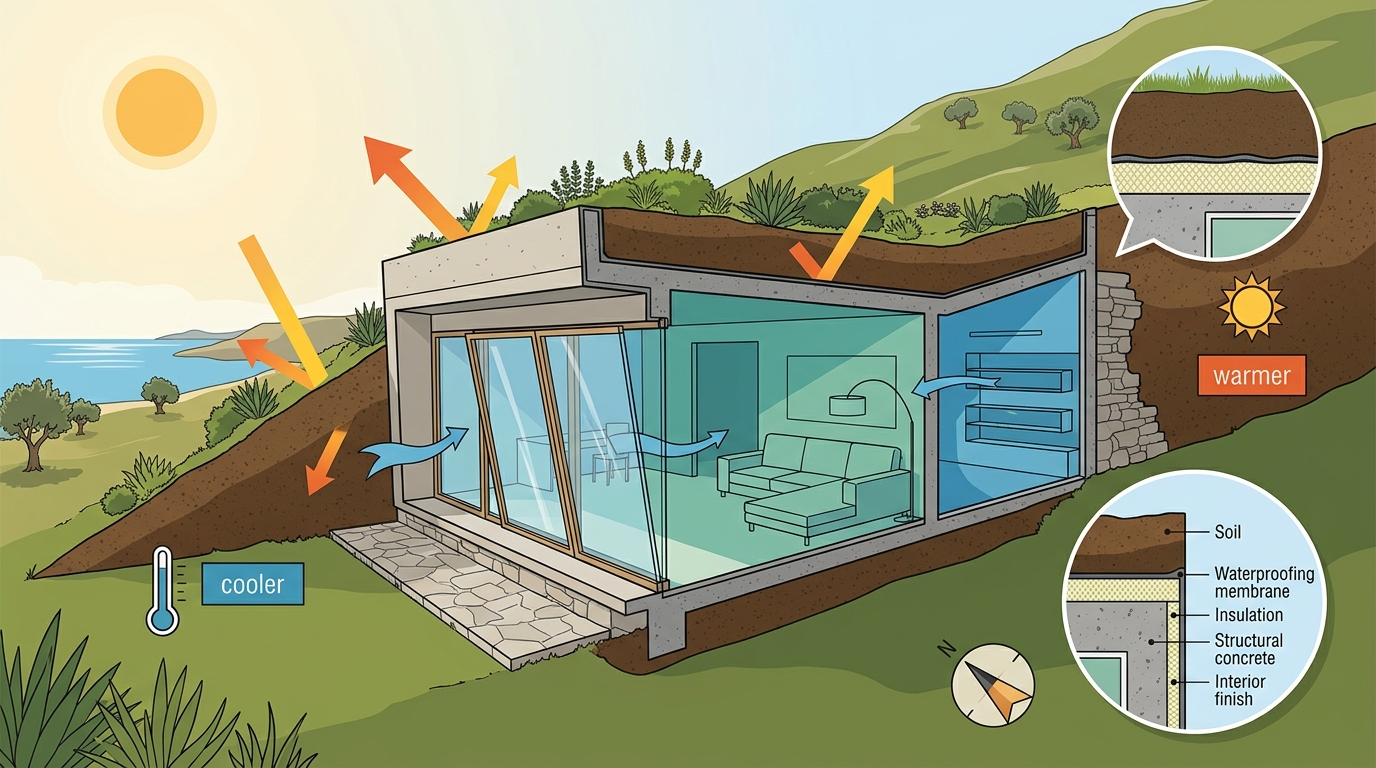
The principle is straightforward. Earth-sheltered construction saves energy by reducing conduction heat losses through the walls and roof. The temperature difference between the building and the adjacent ground is typically much smaller than between an above-grade structure and the outside air. In hot climates, the earth acts as a heat sink, helping keep interiors cooler without mechanical systems running constantly.
Thermal Mass and Ground Temperature Stability
Owing to its high thermal capacity, the ground temperature is lower than outdoor air in summer and higher in winter. At a depth of just a few meters, soil temperatures remain remarkably stable year-round, typically ranging between 15 and 20 degrees Celsius in Mediterranean regions. This stability is the engine behind the energy savings earth-sheltered buildings deliver.
Passive Cooling in Action
Underground residential spaces are considered a smart and vernacular response to the challenges of hot and arid climates. By leveraging passive strategies, they help regulate indoor temperatures, increase energy efficiency, and align with the local environment. Iranian earth-sheltered design, for example, uses thermal mass and passive cooling to cut energy loads significantly.
Key Benefits in Hot Climates
Earth-sheltered architecture is not just about temperature control. It delivers a cascade of advantages that matter in warm Mediterranean and arid environments.
Reduced Cooling Demand
Research conducted in Shiraz, Iran, demonstrated that at a depth of 6 meters, cooling energy was reduced by 50% compared to an above-ground model. Earth-sheltered buildings enjoy a much higher advantage in reducing cooling loads than heating loads, making them ideal for hot climates.
Environmental Integration
Because the structure is embedded in the landscape, earth-sheltered buildings little disturb the natural environment. Green roofs restore biodiversity, manage stormwater, and reduce the urban heat island effect. The visual footprint is minimal, preserving the character of coastal and island settings.
Storm and Fire Resilience
Subterranean structures offer superior protection from extreme weather events, high winds, and wildfire exposure. This resilience is increasingly important as climate change intensifies weather patterns across the Mediterranean basin.
Design Considerations and Building Typologies
Successful earth-sheltered design requires careful attention to site selection, orientation, and typology. The U.S. Department of Energy notes that in regions with mild winters and hot summers, a north-facing slope might be ideal, while a south-facing slope works best in colder climates.
| Typology | Description | Best Climate Fit | Energy Efficiency |
|---|---|---|---|
| Fully Underground | Entire structure below grade with atrium or courtyard | Hot-arid, Mediterranean | Highest |
| Bermed (Three-Sided) | Earth banked against three walls; one open facade | Hot-arid, temperate | High (up to 27% reduction) |
| In-Hill / Hillside | Built into a natural slope with exposed southern face | All climates | Moderate to high |
| Courtyard Underground | Rooms surround a central open-air courtyard below grade | Hot-arid | High |
Orientation is critical. Research from Cyprus shows that north-facing earth-sheltered buildings consume significantly less energy for cooling because they receive no direct sun exposure, while east or west orientations increase cooling demands due to solar gain.
Performance Data: Energy Savings by the Numbers
Multiple peer-reviewed studies confirm the substantial energy benefits of earth sheltering. Here is a summary of key findings:
| Study / Source | Location | Key Finding |
|---|---|---|
| Shiraz simulation study | Iran | Up to 40.4% total energy savings at greatest depth |
| Cyprus Five Finger Mountain | Cyprus | 27% energy reduction (three-sided sheltering) |
| EBSCO / Terra-Dome data | United States | Up to 80% savings on heating and cooling costs |
| Mother Earth News / passive solar | United States | 80-90% lower heating and cooling bills |
Proponents of earth-sheltered construction have estimated that families can save up to 80 percent in heating and air-conditioning costs compared with a conventional above-ground house. While initial construction costs may be 10 to 20 percent higher, the lifetime operational savings are transformative.
Luxury Applications: Subterranean Villas in Greece
Earth-sheltered architecture is not limited to utilitarian bunkers. At the luxury end of the spectrum, ECLEDE has demonstrated that subterranean design can deliver world-class living experiences. ECLEDE is a luxury development company founded on the ethos of bespoke, sustainable design and architecture, led by Vassilis Siafaricas, a civil engineer and entrepreneur with over two decades of experience.
Villa Atlas and Pleione, Lefkada
The Atlas and Pleione villas on the island of Lefkada are a landmark example. This complex of two subterranean luxury villas and a guest house sits on a seafront plot in Sivota bay. The minimalistic design features green roofs, austere architectural lines, and long windows that blend functionality, luxury, and sustainability. Villa Atlas won the 2024 A' Sustainable Products, Projects and Green Design Award, and the property sold through Sotheby's for approximately 5.8 million dollars, setting a record for the island.
Boomerang Athens: LEED-Certified Urban Living
ECLEDE's upcoming Boomerang Athens project is set to become one of the pioneering residences with a LEED Certificate in Greece, proving that sustainable principles extend from island retreats to urban environments. These projects show that earth-conscious design and ultra-luxury are not opposing forces but natural partners.
Key Takeaways
- Earth-sheltered architecture is one of the most effective techniques for balancing thermal comfort with low energy consumption in hot climates.
- Cooling energy reductions of 50% or more are achievable at moderate burial depths in Mediterranean and arid regions.
- Passive solar earth-sheltered homes can cut heating and cooling bills by 80 to 90 percent compared to conventional structures.
- Fully underground typologies offer the highest energy efficiency, while bermed designs provide strong savings with easier construction.
- Orientation matters: north-facing exposures minimize cooling demand in hot climates.
- Luxury subterranean villas like ECLEDE's Atlas project prove that sustainability and high-end living coexist beautifully.
- Higher upfront costs (10 to 20 percent) are offset by dramatically lower lifetime operating expenses.
Frequently Asked Questions
What is earth-sheltered architecture?
Earth-sheltered architecture is a building approach where structures are partially or fully buried in the ground, using the earth's thermal mass to naturally regulate indoor temperatures and reduce energy use.
How much energy can an earth-sheltered home save in a hot climate?
Research shows savings ranging from 27% for three-sided bermed designs to over 50% on cooling energy at greater burial depths. With passive solar integration, total heating and cooling cost reductions can reach 80 to 90 percent.
Are earth-sheltered homes more expensive to build?
Initial construction costs are typically 10 to 20 percent higher than conventional homes due to waterproofing, structural reinforcement, and excavation. However, long-term energy savings usually offset these costs within a few years.
Do earth-sheltered buildings feel dark or claustrophobic?
Not when designed well. Atriums, courtyards, strategically placed skylights, and full-height glazed facades bring natural light deep into subterranean spaces. Projects like Villa Atlas on Lefkada feature expansive windows with direct ocean views.
What soil types work best for earth-sheltered construction?
Well-drained, granular soils with good load-bearing capacity are ideal. Clay-heavy or waterlogged soils require more extensive drainage and waterproofing systems, increasing cost and complexity.
Is earth-sheltered design suitable for Mediterranean climates like Greece?
Yes, it is exceptionally well suited. Mediterranean climates feature hot, dry summers and mild winters, meaning the earth's stable ground temperature provides passive cooling in summer. Greece's rocky, sloped terrain also provides natural opportunities for hillside integration.
Can earth-sheltered homes achieve net-zero energy status?
Absolutely. When combined with photovoltaic panels, passive solar orientation, and efficient building envelopes, earth-sheltered homes can reach net-zero or even plus-energy status. ECLEDE's projects in Greece target near-zero energy consumption.
How does earth-sheltered architecture impact property value?
High-quality subterranean luxury properties command premium prices. Villa Atlas on Lefkada sold for approximately 14,000 euros per square meter through Sotheby's, demonstrating strong market demand for sustainable luxury.
Start Your Earth-Sheltered Project
If you are inspired by the potential of earth-sheltered architecture to deliver energy efficiency, resilience, and refined living in a hot climate, explore the ECLEDE portfolio to see how subterranean luxury is brought to life in Greece. Ready to discuss your vision? Contact the ECLEDE team to start the conversation.