
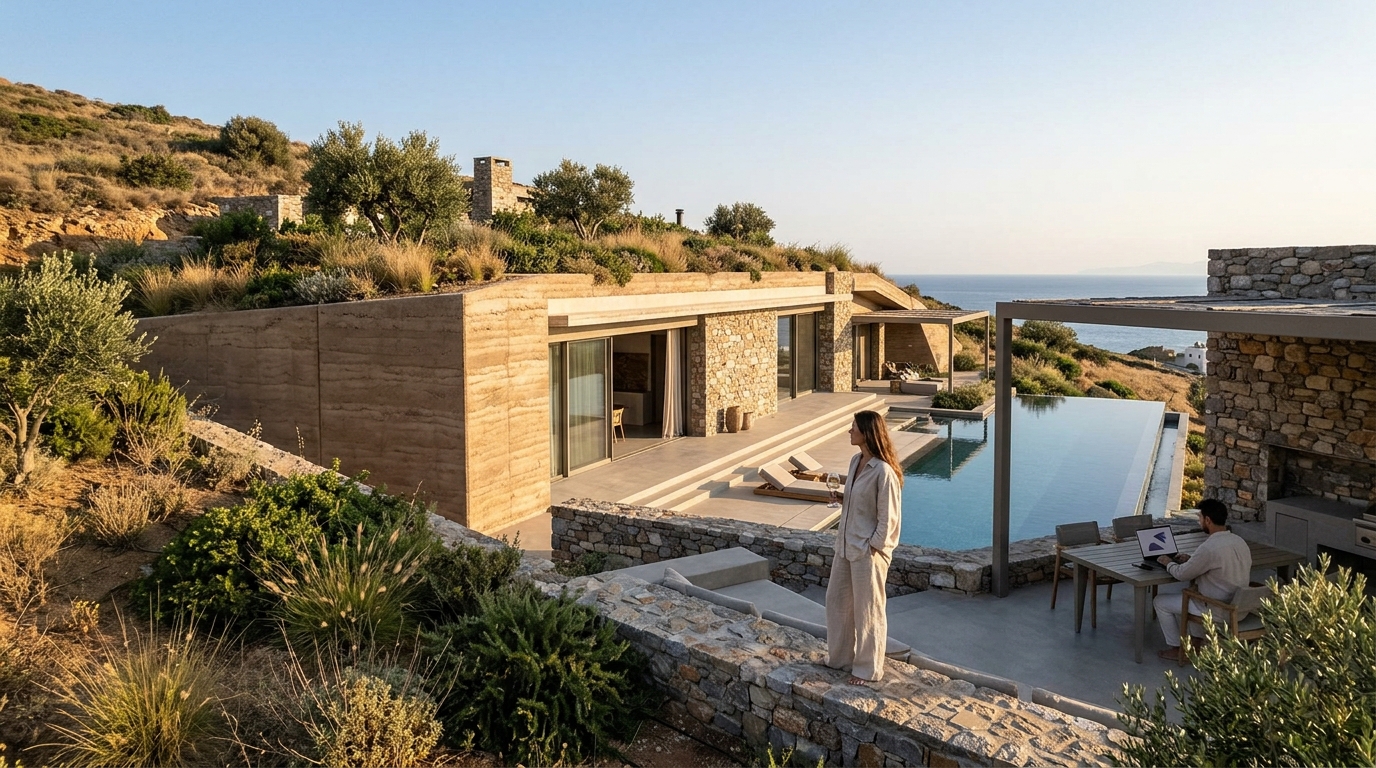
Earth-Sheltered Architecture: Energy Efficiency Benefits in Hot Climates
As summer temperatures across the Mediterranean and beyond continue to rise, architects and developers are turning to one of humanity's oldest building strategies for a modern solution. Earth-sheltered architecture is a building approach in which structures are partially or fully embedded into the ground, leveraging the soil's natural thermal mass to regulate indoor temperatures. For hot climates like Greece, this technique can slash cooling costs by up to 50%, drastically reduce environmental impact, and deliver luxury living that blends seamlessly into the landscape. At ECLEDE, founded by Vassilis Siafaricas, subterranean design is not a compromise but a cornerstone of bespoke, sustainable luxury.
What Is Earth-Sheltered Architecture?
Earth-sheltered construction is the practice of building homes or structures primarily underground or partially buried in earth. According to the U.S. Department of Energy, there are two basic types: underground structures built entirely below grade, and bermed designs where earth is mounded against exterior walls.
This approach is far from new. Subterranean dwellings have been a distinctive building type from prehistoric to pre-industrial eras across the Mediterranean region. What is new is applying these principles to luxury real estate with modern engineering, something ECLEDE has pioneered through projects like the Atlas & Pleione villas.
How the Ground Acts as a Natural Heat Sink
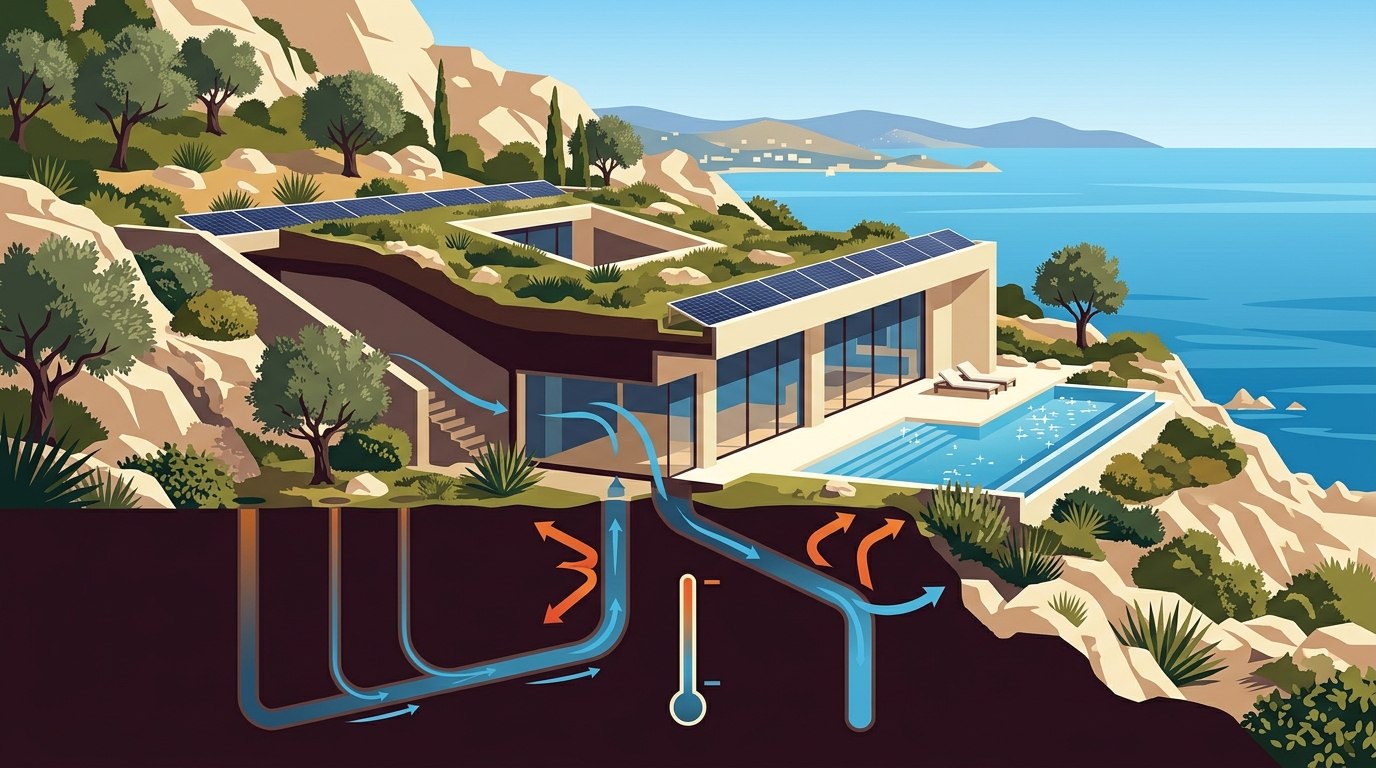
The core principle is simple: earth temperatures vary far less than air temperatures. While outdoor air in Athens can swing from 15°C to 40°C seasonally, soil just a few meters deep remains relatively stable year-round. In hot climates specifically, the earth acts as a heat sink, absorbing excess warmth and keeping interiors cooler without mechanical systems.
Thermal Inertia Explained
Thermal inertia is the ability of a material to absorb, store, and slowly release heat energy. Dense soil has high thermal inertia, which buffers temperature extremes. Research published in Journal of Cleaner Production (2024) confirms the significant role of the ground as a thermal mass and the consequent reduction in energy requirements for buried and earth-sheltered buildings.
Passive Cooling Without Air Conditioning
Iranian earth-sheltered design, studied extensively in a 2026 systematic review, uses thermal mass and passive cooling to cut energy loads. These low-energy vernacular models offer blueprints for modern sustainable architecture across hot-arid regions.
Energy Savings: The Numbers Behind the Design
The data supporting earth-sheltered architecture is compelling. A simulation study on buildings in Shiraz demonstrated a 50% reduction in cooling energy at a depth of 6 meters compared to conventional above-ground structures. The same research found total annual energy savings ranging from 21% to over 40% depending on burial depth.
At the upper end, passive-solar earth-sheltered homes can achieve 80% to 90% lower heating and cooling bills than conventional homes. Even without passive solar integration, savings remain substantial.
| Sheltering Approach | Cooling Energy Reduction | Total Annual Energy Savings |
|---|---|---|
| One-sided berming | ~15-20% | ~21% |
| Three-sided earth-sheltering | ~30-40% | ~27-33% |
| Fully subterranean (6m depth) | ~50% | ~40% |
| Subterranean + passive solar | ~70-80% | Up to 90% |
Earth-Sheltered Building Types Compared
Underground (Below-Grade)
A fully underground structure is built entirely below the surface, often incorporating an atrium or courtyard for natural light. This type delivers the highest energy efficiency because all walls contact soil. ECLEDE's Atlas & Pleione complex on Lefkada exemplifies this approach with its subterranean villas and green rooves.
Bermed
A bermed building is a structure where earth is pushed against exterior walls on one or more sides, with the roof often left exposed or covered with a green roof. This is more adaptable to flat sites and easier to construct, though it provides less thermal buffering than a fully buried design.
In-Hill (Cut-and-Cover)
Built into a natural hillside, in-hill designs exploit existing topography. Living spaces face the equator for solar gain while storage and utility areas tuck into the slope. This typology is especially suited to the Greek islands' terrain.
Specific Advantages for Hot-Climate Regions
Mediterranean climates like those found in Greece present a strong case for earth-sheltered design. Hot, dry summers create enormous cooling demand, and conventional buildings rely heavily on air conditioning, a major contributor to greenhouse gas emissions.
Reduced Urban Heat Island Effect
Green roofs on earth-sheltered buildings support local biodiversity, filter rainwater, and lower surrounding air temperatures. This is especially valuable in dense areas such as Athens suburbs like Ekali, Politia, and Kifisia, where ECLEDE develops luxury projects.
Minimal Visual and Environmental Intrusion
ECLEDE's design philosophy centers on minimally intrusive, holistic designs that blend into their natural surroundings. Earth-sheltered structures achieve this by disappearing into the landscape, preserving scenic coastlines and hillsides while delivering world-class living spaces.
Resilience to Extreme Heat Events
As heatwaves grow more frequent across Southern Europe, the thermal buffering of underground construction provides a stable indoor environment without reliance on grid electricity, aligning with ECLEDE's focus on developing net-zero energy buildings (NZEB).
Case Study: Villa Atlas on Lefkada, Greece
Villa Atlas, designed by Vassilis Siafaricas, won the 2024 A' Sustainable Products, Projects and Green Design Award. Located on a seafront plot in Sivota's natural harbor on Lefkada, it is a complex of two subterranean villas and a subterranean guest house situated just 30 to 50 meters from the ocean.
The design features austere architectural lines, green rooves, and long windows that balance functionality, luxury, and sustainability. Three vast swimming pools complement the custom-made interiors. Villa Atlas demonstrates that earth-sheltered architecture in hot Mediterranean climates does not sacrifice luxury but rather enhances it through connection to the landscape and dramatically lower energy consumption.
Key Takeaways
- Earth-sheltered architecture can reduce cooling energy by up to 50% compared to conventional buildings in hot climates.
- Passive-solar earth-sheltered homes may achieve 80-90% lower heating and cooling bills.
- The ground's stable temperature acts as a natural heat sink, eliminating or reducing air conditioning needs.
- Two primary building types exist: fully underground and bermed, each with distinct efficiency profiles.
- Mediterranean climates in Greece are ideal for subterranean luxury developments.
- ECLEDE's Villa Atlas project proves earth-sheltered design can deliver award-winning luxury alongside sustainability.
- Green roofs on subterranean structures add biodiversity, stormwater management, and thermal benefits.
Frequently Asked Questions
What is earth-sheltered architecture?
Earth-sheltered architecture is a building approach where structures are partially or fully embedded in the ground. It leverages the soil's thermal mass to naturally regulate indoor temperatures, reducing reliance on mechanical heating and cooling.
How much energy can earth-sheltered homes save in hot climates?
Research shows cooling energy reductions of up to 50% at a depth of 6 meters. When combined with passive solar design, total heating and cooling savings can reach 80-90% compared to conventional above-ground homes.
Are earth-sheltered buildings more expensive to build?
Initial construction costs can be 10-20% higher than conventional homes due to waterproofing and structural requirements. However, lifetime energy savings and reduced maintenance typically offset the upfront investment within a few years.
Do earth-sheltered homes feel dark or claustrophobic?
Not when properly designed. Courtyards, atriums, skylights, and strategically placed long windows bring in abundant natural light. ECLEDE's Atlas & Pleione villas, for example, feature expansive glazing that opens to ocean views.
Is earth-sheltered design suitable for the Greek islands?
Absolutely. The sloped terrain, hot summers, and strong design heritage of the Greek islands make them ideal for subterranean construction. Projects like Villa Atlas on Lefkada prove this concept at the luxury level.
What types of earth-sheltered buildings exist?
The two main types are fully underground structures (built entirely below grade, often with a courtyard) and bermed structures (earth mounded against one or more exterior walls). In-hill designs built into natural slopes are a popular variation in hilly regions.
How does earth-sheltered architecture support sustainability goals?
Beyond energy savings, these buildings minimize visual impact on landscapes, support biodiversity through green roofs, reduce reliance on fossil-fuel-powered cooling, and align with net-zero energy building standards.
Who is leading earth-sheltered luxury development in Greece?
ECLEDE, founded by Vassilis Siafaricas, specializes in subterranean luxury design. Their award-winning projects across Lefkada and Athens demonstrate how earth-sheltered techniques can meet the highest standards of bespoke development.
Start Your Sustainable Luxury Project
Ready to explore how earth-sheltered architecture can transform your next development? ECLEDE brings over two decades of expertise in luxury, sustainable real estate across Greece's most exclusive locations. Contact ECLEDE today to discuss your vision with our team of design and engineering professionals.