
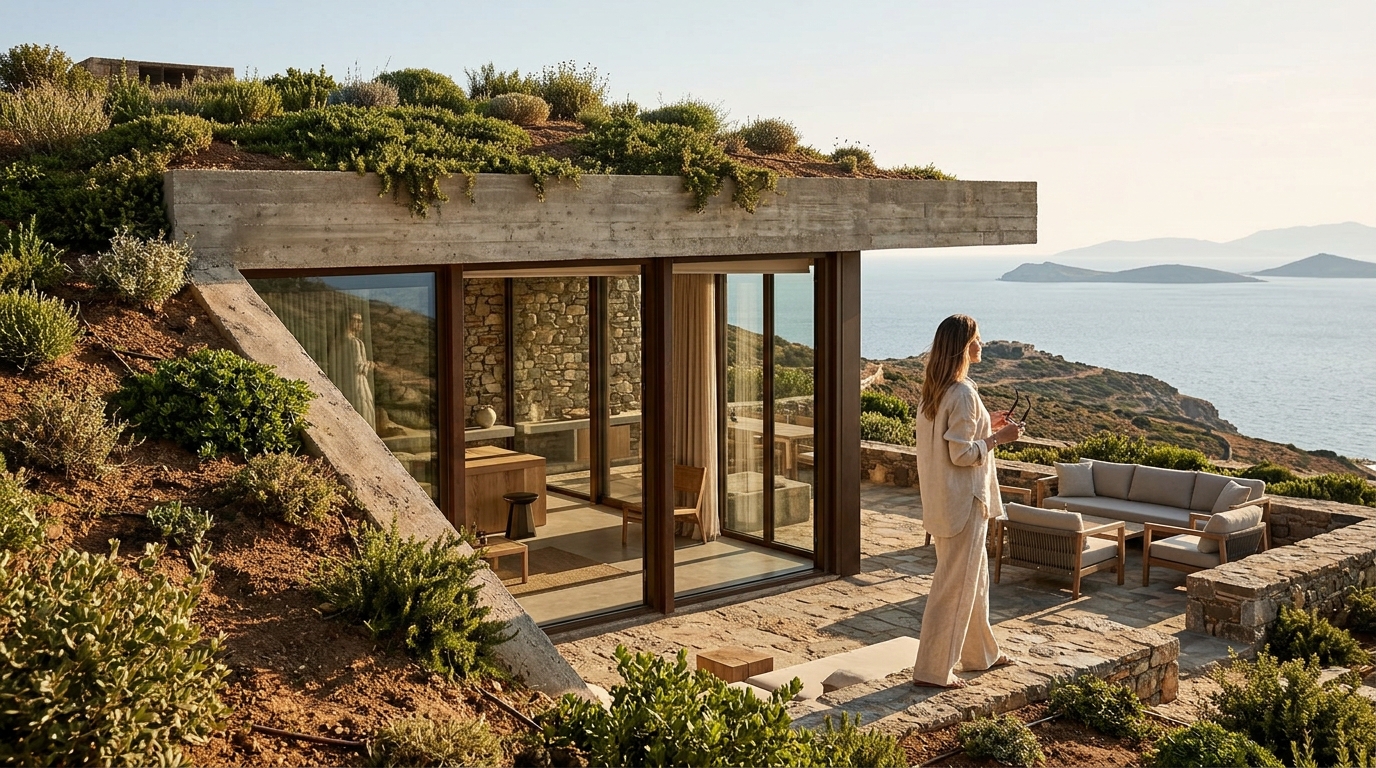
As global temperatures rise and cooling costs soar, architects and developers are rediscovering an ancient building strategy with extraordinary modern relevance. Earth-sheltered architecture is a construction approach in which a building is partially or fully embedded into the ground, leveraging the soil's stable thermal mass to regulate indoor temperatures. In Mediterranean and arid climates like Greece, this technique can slash cooling energy demands by up to 50%, making it one of the most powerful passive design strategies available today. Below, we explore why earth-sheltered design is a game-changer for energy-efficient luxury development.
What Is Earth-Sheltered Architecture?
Earth-sheltered architecture refers to buildings designed to be covered by soil on one or more sides, using the ground itself as insulation and climate buffer. According to the U.S. Department of Energy, there are two basic types: fully underground structures and bermed designs where earth is mounded against exterior walls.
This building method is not new. Subterranean and semi-buried dwellings have existed across Mediterranean, Middle Eastern, and Asian cultures for millennia. What has changed is our ability to combine these principles with modern materials, waterproofing technology, and luxury interior design to create residences that are as beautiful as they are efficient.
How Earth Sheltering Delivers Energy Efficiency
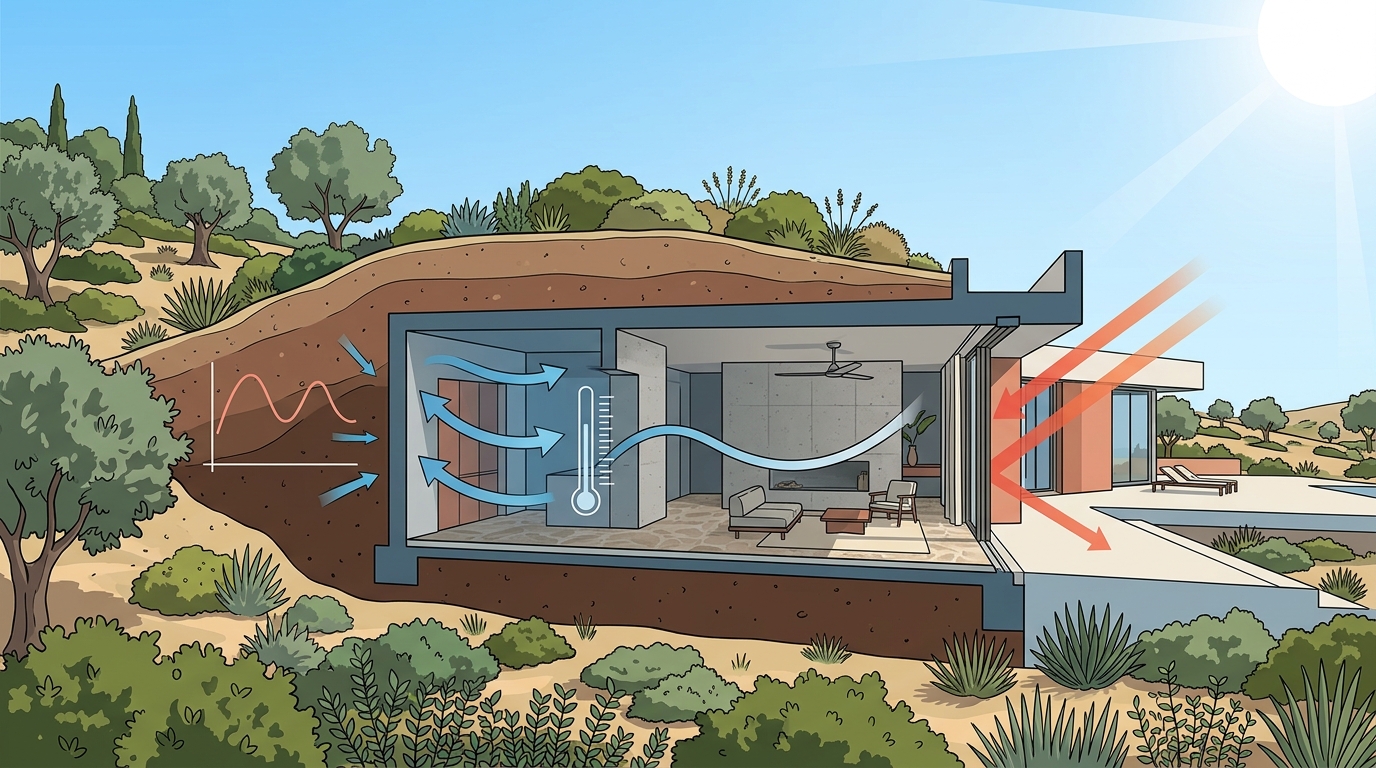
The core principle is simple: soil temperature several meters below the surface remains far more stable than air temperature. While outdoor air in Athens can swing from 0°C in winter to 40°C in summer, the ground at a depth of 3 to 6 meters stays within a narrow band year-round.
Thermal Mass as a Heat Sink
In hot climates, the earth functions as a natural heat sink, absorbing excess warmth from the structure and preventing it from reaching interior spaces. The Concrete Masonry & Hardscapes Association (CMHA) confirms that earth-sheltered construction saves energy by reducing conduction heat losses through walls and roofs. The temperature difference between the building envelope and the adjacent ground is significantly less than between an above-grade structure and the outside air.
Reduced Solar Gain
Because most of the building envelope is buried, direct solar radiation hits only a fraction of the exterior surface. This dramatically lowers cooling loads during peak summer months, exactly when energy demand is highest in hot regions.
Key Benefits in Hot Climates
1. Dramatically Lower Cooling Costs
Research published on ResearchGate found that earth-sheltered buildings at a soil depth of 6 meters achieve a 50% reduction in cooling energy compared to conventional above-ground models. Passive-solar earth-sheltered homes can reduce heating and cooling bills by 80% to 90%.
2. Minimal Environmental Disruption
Earth-sheltered buildings preserve the landscape above them. Green roofs restore local ecosystems, support biodiversity, and reduce urban heat island effects. This aligns directly with the philosophy of ECLEDE's minimally intrusive design approach, which prioritizes seamless integration with natural surroundings.
3. Superior Noise Insulation and Durability
Soil covering provides exceptional soundproofing and protects structures from wind, hail, and UV degradation. The result is a longer-lasting building with lower maintenance costs over its lifetime.
Energy Savings: Earth-Sheltered vs. Conventional Buildings
| Metric | Conventional Building | Earth-Sheltered Building | Source |
|---|---|---|---|
| Cooling energy reduction | Baseline | Up to 50% lower | ResearchGate (Shiraz study) |
| Heating + cooling bills | Baseline | 80-90% lower (with passive solar) | Mother Earth News |
| Total annual energy savings (6m depth) | Baseline | Up to 40.4% | ResearchGate (soil-type analysis) |
| Energy reduction (3-sided sheltering) | Baseline | 27% lower consumption | Cyprus building study |
| Initial construction cost premium | Baseline | 10-20% higher | EBSCO Research |
While the upfront investment is modestly higher, the long-term operational savings and reduced maintenance make earth-sheltered construction a compelling financial proposition, especially in luxury development where quality and longevity are paramount.
Design Considerations for Hot-Climate Projects
Orientation and Slope
The U.S. Department of Energy notes that in regions with mild winters and hot summers, a north-facing slope may be ideal for earth-sheltered construction. In the Northern Hemisphere, this minimizes direct solar exposure on the buried mass while allowing south-facing openings for controlled daylight.
Waterproofing and Drainage
Proper waterproofing is the single most critical technical requirement. Modern membrane systems, combined with well-designed drainage layers, ensure that moisture never compromises the structure or interior comfort.
Natural Light and Ventilation
A common concern with underground living is darkness. However, contemporary earth-sheltered designs solve this with courtyards, atriums, skylights, and strategically placed floor-to-ceiling glazing. The Atlas & Pleione villas by ECLEDE demonstrate how long windows and open sightlines to the sea bring abundant natural light into subterranean luxury spaces.
Real-World Example: Subterranean Luxury in Greece
Vassilis Siafaricas, founder of ECLEDE, has applied earth-sheltered principles at an extraordinary scale with the Villa Atlas project on the island of Lefkada, Greece. Villa Atlas is a complex of two subterranean villas and a guest house located in the natural harbor of Sivota, just 30 meters from the ocean.
The project features green roofs, austere architectural lines, and custom interiors that merge sustainability with uncompromising luxury. It won the 2024 A' Design Award for Sustainable Products, Projects and Green Design, validating the viability of earth-sheltered construction at the highest level of residential development.
ECLEDE is a luxury development company focused on developing net zero energy buildings (NZEB) while promoting connection with nature. Explore their full range of work in the ECLEDE project portfolio, including other sustainable developments like the Boomerang Athens residence.
Key Takeaways
- Earth-sheltered architecture can reduce cooling energy by up to 50% compared to conventional buildings in hot climates.
- Passive-solar earth-sheltered homes achieve 80% to 90% lower heating and cooling bills overall.
- The ground's stable thermal mass acts as a natural heat sink, moderating extreme temperature swings.
- Initial construction costs are typically only 10-20% higher, offset by decades of energy savings.
- Modern design solutions like atriums, skylights, and panoramic glazing eliminate concerns about darkness.
- Earth-sheltered design preserves landscapes and supports biodiversity through green roofs.
- Award-winning projects like ECLEDE's Villa Atlas prove that subterranean luxury is both achievable and desirable.
Frequently Asked Questions
What is earth-sheltered architecture?
Earth-sheltered architecture is a building method where structures are partially or fully covered by soil, using the ground's thermal mass to naturally regulate indoor temperatures and reduce energy consumption.
How much energy can earth-sheltered buildings save in hot climates?
Studies show cooling energy reductions of up to 50% at depths of 6 meters. When combined with passive solar design, total heating and cooling savings can reach 80% to 90%.
Are earth-sheltered homes dark and uncomfortable?
No. Modern earth-sheltered designs use courtyards, atriums, skylights, and large glazed openings to bring in natural light. Projects like the Atlas & Pleione villas on Lefkada feature floor-to-ceiling windows with ocean views.
Do earth-sheltered buildings cost more to construct?
Initial costs are typically 10-20% higher than conventional construction due to waterproofing and structural requirements. However, significantly lower operating costs provide strong long-term returns.
Is earth-sheltered architecture suitable for luxury homes?
Absolutely. ECLEDE's Villa Atlas won the 2024 A' Design Award, demonstrating that subterranean design can deliver exceptional luxury, sustainability, and architectural distinction simultaneously.
What climates are best suited for earth-sheltered construction?
Earth-sheltered buildings perform best in climates with significant temperature extremes and low humidity, including Mediterranean, arid, and continental climates. Greece's hot summers make it an ideal location.
How does earth sheltering affect property value?
The combination of ultra-low energy costs, environmental credentials, and architectural uniqueness can increase property desirability. Award-winning earth-sheltered designs are increasingly sought after in the luxury market.
Can earth-sheltered buildings achieve net zero energy?
Yes. When paired with photovoltaic systems and passive solar strategies, earth-sheltered buildings can achieve net zero energy building (NZEB) status, a core focus of developers like ECLEDE.
Start Your Earth-Sheltered Project
Earth-sheltered architecture represents the intersection of ancient wisdom and modern innovation. If you are considering a sustainable luxury development in Greece or the Mediterranean, contact the ECLEDE team to discuss how earth-sheltered design can transform your next project into an energy-efficient landmark.