
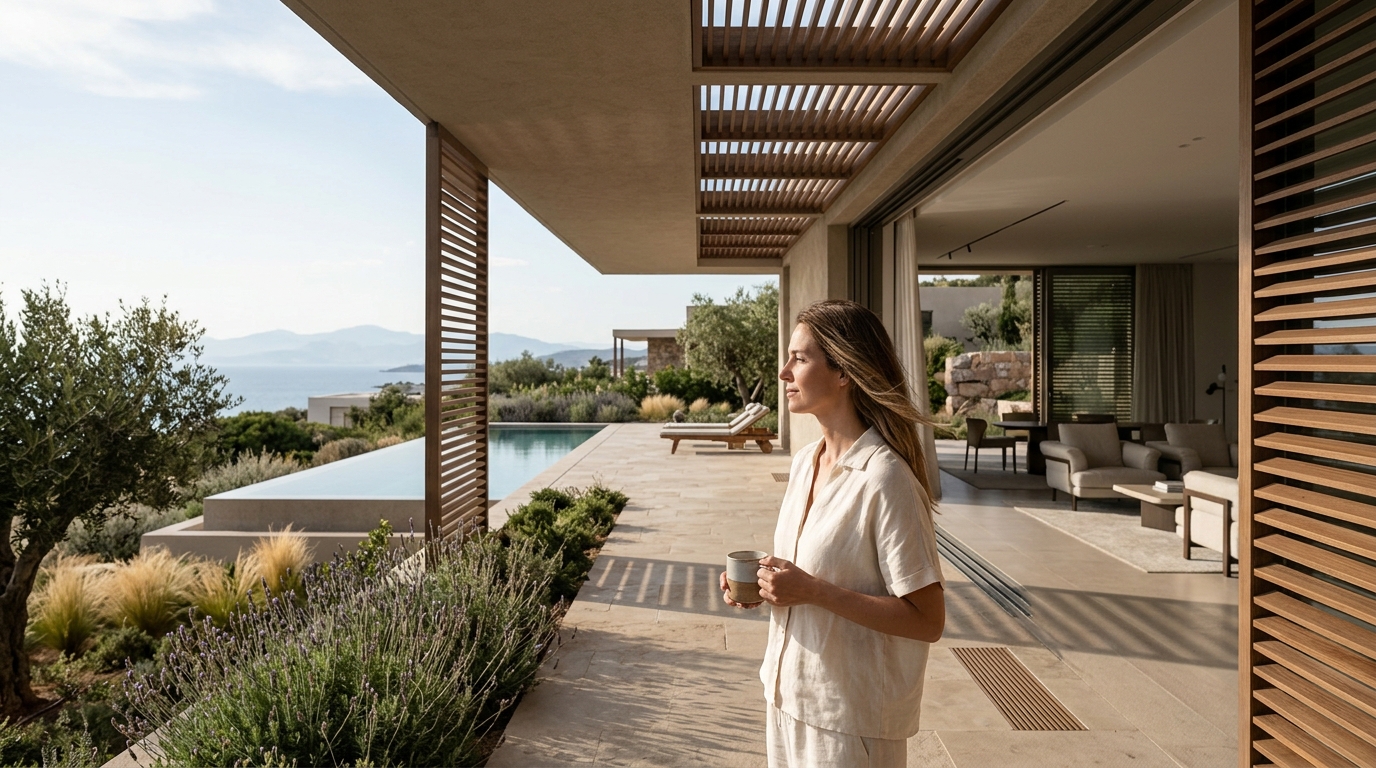
Passive Cooling and Geothermal Systems for High-End Modern Homes
Luxury homeowners increasingly demand residences that deliver year-round comfort without visible mechanical clutter or excessive energy bills. Passive cooling is the practice of reducing indoor temperatures through architectural design rather than powered equipment, while geothermal heat pump (GHP) systems tap the earth's stable subsurface temperature to exchange heat with remarkable efficiency. When the two strategies work together, the result is a home that stays cool in summer, warm in winter, and operates at a fraction of the energy cost of conventional HVAC. Below is a practical guide to planning, designing, and implementing both systems in a high-end modern home.
Why Combine Passive Cooling with Geothermal
Passive design and geothermal are complementary by nature. Passive strategies reduce the total cooling load a building must handle, which allows the geothermal system to be sized smaller, lowering both capital cost and operating energy. According to the U.S. Department of Energy, geothermal heat pumps take advantage of stable underground temperatures of 40 to 70 degrees Fahrenheit to heat and cool buildings with high efficiency. Pair that with an envelope-first design philosophy and you create a home that barely needs active conditioning at all.
A January 2025 DOE report estimated that widespread geothermal adoption could heat and cool up to 80 million U.S. homes by 2050, underscoring the technology's scalability even at the residential level.
Core Passive Cooling Strategies
Building Orientation and Thermal Mass
Passive cooling design starts at the site plan. Orienting living spaces to capture prevailing breezes while shading south- and west-facing facades with deep overhangs limits solar heat gain before it enters the building. High thermal mass materials such as concrete, stone, and rammed earth absorb excess daytime heat and release it slowly at night, stabilizing interior temperatures without electricity.
Natural Ventilation and Cross-Ventilation
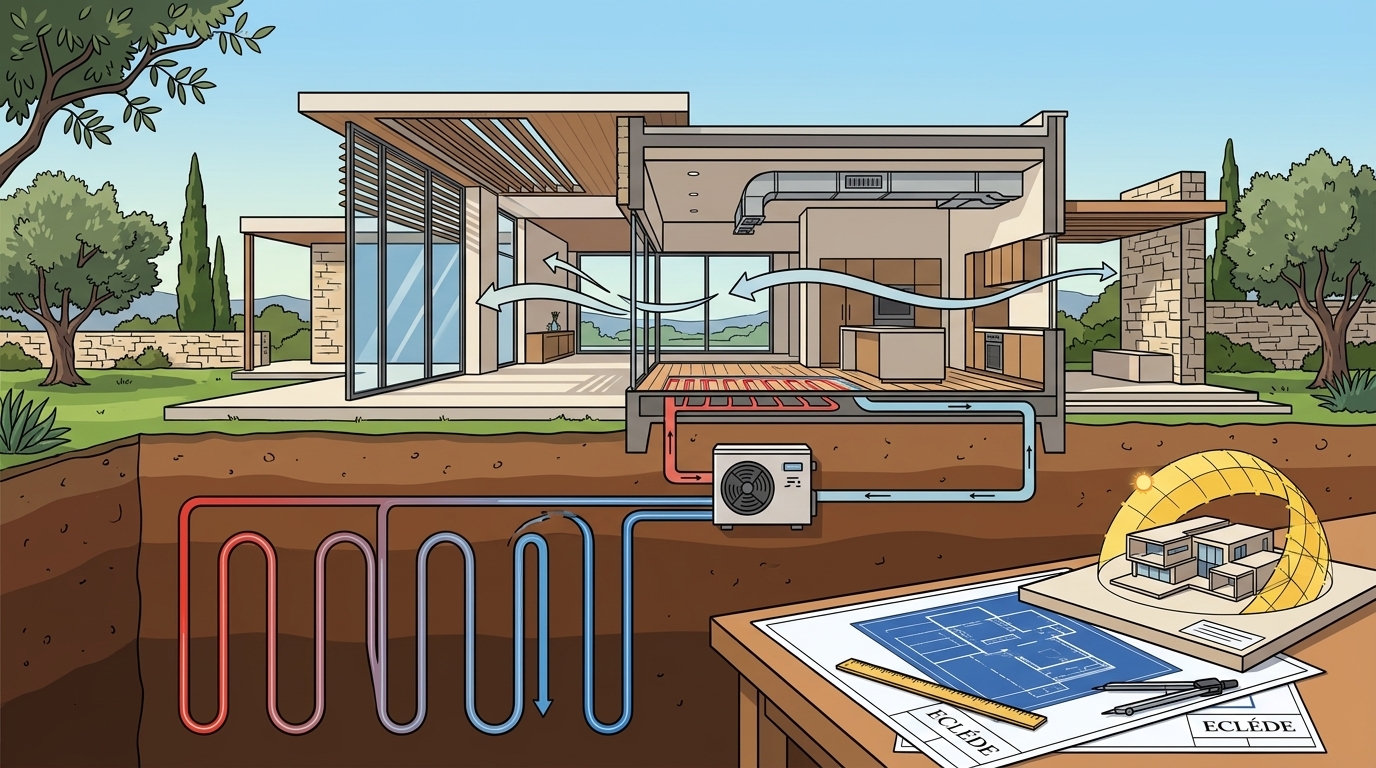
Strategic window placement on opposite walls encourages cross-ventilation, drawing cooler exterior air through the home. Stack ventilation through double-height voids or roof vents exploits the natural tendency of warm air to rise, exhausting heat passively. These principles are especially effective in Mediterranean climates like Greece, where evening temperatures drop significantly.
Earth-Sheltered Design
Partially or fully embedding a structure into the terrain leverages the ground's insulating effect. Earth-sheltered architecture is a building method in which soil and topography serve as natural insulation and thermal buffers. ECLÉDE's award-winning Izanagi Project in Lefkada, Greece, exemplifies this approach: a subterranean villa complex that achieves natural cooling enhanced by Greek architectural influences within a visionary design framework.
Geothermal System Fundamentals
How Geothermal Heat Pumps Work
A geothermal heat pump (GHP) is a mechanical system that circulates fluid through underground loops to exchange heat with the earth. In summer, the ground absorbs excess heat from the home; in winter, the process reverses to extract warmth. GHPs deliver 300 to 600 percent efficiency, meaning you receive three to six units of heating or cooling for every unit of electricity consumed.
Loop Configurations
There are four basic ground loop types: horizontal, vertical, pond/lake, and open-loop. Vertical loops suit luxury properties with limited acreage because they require narrow boreholes drilled 200 to 500 feet deep. Horizontal loops need more land but cost less to install. A qualified geothermal designer evaluates soil conductivity, available land, and building load to recommend the optimal configuration.
Longevity and ROI
The indoor heat pump unit typically lasts 20 to 25 years, while the underground loop can endure 50 to 100 years with minimal maintenance. Upfront costs of $20,000 to $31,000 are often recouped in five to ten years through energy savings, and homeowners can save up to 60 percent on heating costs annually.
Integrating Both Systems During Design
The most efficient results come when passive and geothermal strategies are planned together from day one, not added as afterthoughts. ECLÉDE's design philosophy, led by founder Vassilis Siafaricas, centres on minimally intrusive, holistic developments that blend with natural surroundings. This mindset naturally accommodates both passive orientation studies and early geothermal loop planning.
Steps for a successful integrated design include:
- Site analysis: Assess solar path, prevailing winds, soil type, and groundwater before sketching floor plans.
- Envelope optimization: Specify high-performance insulation, triple-pane glazing, and airtight construction to minimize the load the GHP must handle.
- Loop layout coordination: Plan geothermal bore fields or trenches alongside landscaping and structural foundations to avoid costly rework.
- Radiant distribution: Pair the GHP with radiant floor heating and cooling for silent, even temperature delivery throughout open-plan luxury spaces.
- Smart controls: Integrate the GHP with a building management system that adjusts output based on occupancy and weather data.
The Boomerang Athens residence, designed and developed by ECLÉDE, became the first LEED Platinum certified residence in Greece, demonstrating how sustainable technologies and luxury design coexist at the highest level.
Cooling System Comparison
| Feature | Conventional AC | Passive Cooling Only | Geothermal HP | Passive + Geothermal |
|---|---|---|---|---|
| Energy Savings vs. Conventional | Baseline | 30-50% | 30-60% | Up to 70%+ |
| Upfront Cost | Low | Medium (design-driven) | High ($20K-$31K+) | Highest |
| Operating Cost | High | Near Zero | Low | Very Low |
| System Lifespan | 15-20 years | Life of building | 25 yrs (unit) / 50+ yrs (loop) | 50+ years combined |
| Visual Impact | Outdoor units visible | None | Hidden underground | None |
| Ideal Climate | Any | Hot-dry / Mediterranean | Any | Any (best in temperate/Med.) |
Real-World Luxury Examples
ECLÉDE's project portfolio showcases how sustainable systems elevate luxury. The Izanagi Project villas use earth-sheltered construction and organic materials to achieve natural cooling without visible mechanical systems. The project won a Bronze A' Design Award and received Editors' Choice recognition at the Architizer Vision Awards.
Globally, the envelope-first philosophy is gaining traction among luxury builders. Firms report that combining geothermal with passive solar design and exterior shading strategies produces residences that are as responsible as they are luxurious. ECLÉDE's commitment to net-zero-energy buildings places it at the forefront of this movement in Greece and beyond.
Key Takeaways
- Passive cooling reduces the total load a geothermal system must handle, lowering cost and energy use.
- Geothermal heat pumps deliver 300-600% efficiency and last decades with minimal maintenance.
- Both systems should be designed together from project inception for maximum performance.
- Earth-sheltered and high-thermal-mass construction are powerful passive strategies for Mediterranean climates.
- Upfront geothermal investment is typically recovered within five to ten years of energy savings.
- LEED Platinum and similar certifications validate the performance of integrated sustainable designs.
- Hidden underground infrastructure preserves the clean aesthetic luxury homeowners expect.
Frequently Asked Questions
What is passive cooling in architecture?
Passive cooling is a set of building design techniques that reduce indoor temperatures using natural processes such as shading, ventilation, thermal mass, and earth sheltering rather than mechanical air conditioning.
How does a geothermal heat pump cool a house?
A geothermal heat pump circulates fluid through underground loops. In summer, the fluid absorbs heat from the home and transfers it to the cooler earth. The constant subsurface temperature (roughly 10-21 degrees Celsius) acts as a heat sink.
Can passive cooling and geothermal work in hot Mediterranean climates?
Yes. Mediterranean climates are ideal because large diurnal temperature swings enhance night-flush ventilation, and the earth's subsurface stays cool even during peak summer. Projects like ECLÉDE's Izanagi in Lefkada prove the concept in practice.
How much does a residential geothermal system cost?
Typical residential systems range from $20,000 to $31,000 before incentives. For high-end homes with larger footprints, costs scale upward but so do savings, often recovering the investment within five to ten years.
Do geothermal systems require a lot of land?
Not necessarily. Vertical loop systems use deep, narrow boreholes that fit within modest plots. Horizontal loops need more surface area but can be installed beneath landscaped gardens or driveways.
What certifications apply to sustainable luxury homes?
LEED (Leadership in Energy and Environmental Design) and Passive House are the most recognized programs. ECLÉDE's Boomerang Athens earned LEED Platinum, the highest tier, confirming world-class energy and environmental performance.
How long do geothermal ground loops last?
Underground loops are rated for 50 to 100 years. The indoor heat pump unit typically lasts 20 to 25 years before needing replacement, while the buried infrastructure remains intact for generations.
Is it possible to retrofit an existing luxury home with geothermal?
Yes. Vertical borehole systems can be installed on existing properties with minimal disruption to landscaping. A certified geothermal designer will assess soil conditions and available space to determine feasibility.
Start Your Sustainable Luxury Project
Implementing passive cooling and geothermal systems requires expertise at the intersection of architecture, engineering, and luxury design. If you are planning a high-end residence that prioritizes comfort, sustainability, and long-term value, contact the ECLÉDE team to discuss how bespoke sustainable design can elevate your next project.