
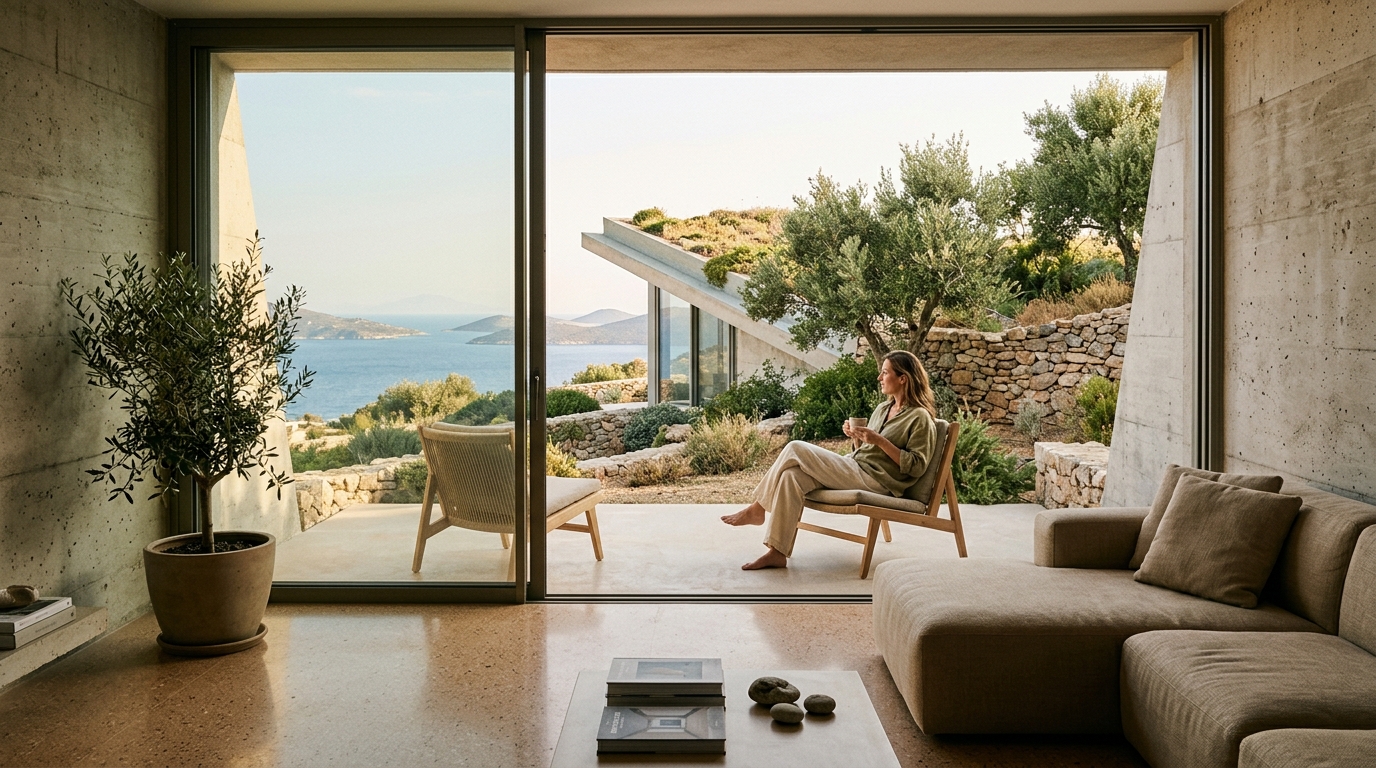
Greece has long been synonymous with sun-drenched coastlines and whitewashed architecture, but a quieter revolution is unfolding beneath the surface. Subterranean luxury villas are redefining high-end living across the Greek islands and mainland, combining ancient building traditions with cutting-edge sustainability. A subterranean villa is a residential structure built partially or entirely into the earth, designed to minimize visual impact while maximizing energy efficiency. From Lefkada to Antiparos, these award-winning properties prove that the most extraordinary homes are sometimes the ones you can barely see.
What Are Subterranean Villas?
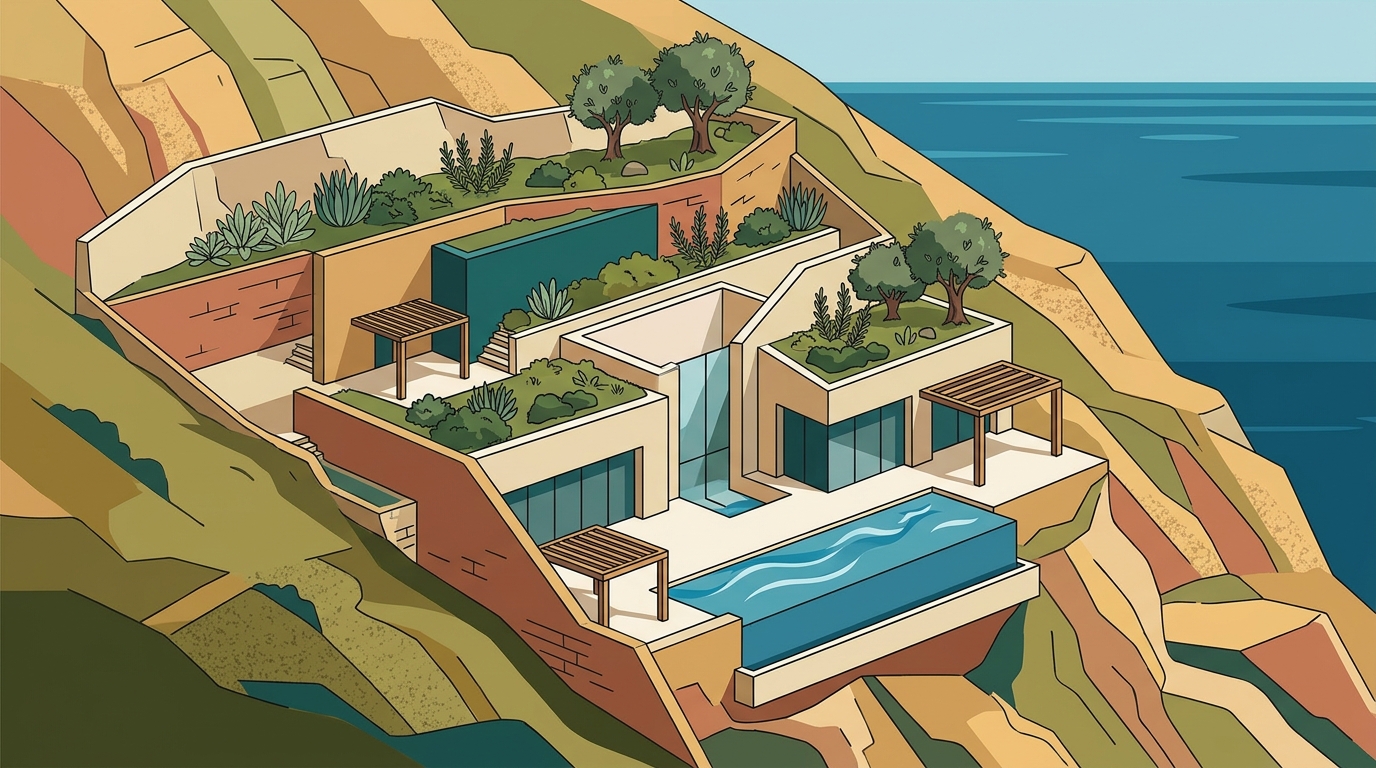
A subterranean villa is a luxury residence embedded into a hillside, cliff, or natural terrain so that the structure integrates with the landscape rather than sitting on top of it. These homes typically feature planted rooftops, natural stone facades, and expansive glazing that frames panoramic views while the building itself remains nearly invisible from above.
The approach is not merely aesthetic. Earth-sheltered construction provides natural thermal insulation, drastically reducing heating and cooling demands. In the Mediterranean climate of Greece, this translates to near-zero energy consumption and year-round comfort without mechanical intervention.
Greece's Deep-Rooted Tradition of Earth-Sheltered Architecture
Building into the earth is far from a modern trend in Greece. Rock-embedded structures known as yposkafa have existed in Santorini and Meteora since antiquity, originally carved by seafarers and monks seeking shelter from the elements. Today, these once-modest dwellings have inspired a new generation of bioclimatic luxury homes across the Greek islands.
Contemporary architects are reinterpreting this heritage through minimalist design, advanced materials, and environmental engineering. The result is a building typology uniquely suited to Greece's rugged topography and intense summer climate.
Atlas & Pleione: ECLÉDE's Award-Winning Masterpiece
The most prominent example of subterranean luxury in Greece today is the Atlas & Pleione estate, designed and developed by Vassilis Siafaricas and his company ECLÉDE. Located on a seafront plot in the picturesque natural harbor of Sivota, Lefkada, these two villas won a Bronze A' Design Award in 2024 in the Architecture, Building and Structure Design category.
Design and Features
The villas are named after the mythological parents of the Pleiades. Both properties are fully subterranean with planted rooftops, near-zero energy consumption, and custom-made interiors. Villa Atlas spans 183 square meters and features a 26-meter swimming pool with optical fiber lighting. Villa Pleione covers 173 square meters with a 30-meter pool, jacuzzi, in-pool sunbed, and a separate 50-square-meter guest house.
Materials and Craftsmanship
Natural materials dominate every surface, including wood, stone, marble, and granite tiles. Three-meter ceilings and floor-to-ceiling energy-efficient glass panels create a seamless connection between interior spaces and the Ionian Sea beyond. The glass fences ensure unobstructed views while maintaining the property's minimally intrusive profile.
Recognition and Awards
Beyond the A' Design Award, Vassilis Siafaricas has earned multiple international accolades. His work has been recognized with a German Design Award in 2026 and an Architizer A+ Awards Special Mention. He also led the development of the first LEED Platinum residential project in Greece, setting a benchmark for sustainable luxury in the region.
Where to Find Subterranean Luxury Villas Across Greece
While ECLÉDE's Atlas & Pleione villas in Lefkada represent the gold standard, subterranean luxury properties can be found across several Greek locations. The table below summarizes notable projects and their key characteristics.
| Project | Location | Architect / Developer | Key Feature |
|---|---|---|---|
| Atlas & Pleione | Sivota, Lefkada | ECLÉDE (Vassilis Siafaricas) | A' Design Award winner; near-zero energy |
| Rhoēs Villa | Serifos Island | Sinas Architects | Undulating stone masonry; 390 sqm total |
| Homa Villas | Serifos Island | MOLD Architects | Three independent lodgings; private pools |
| Villa Cronus | Antiparos | DECA Architects | Disc-shaped; $7.5M listing |
| Villa Punta | Ios | Various | Built into rock; rooftop gardens |
| Villa Ypsilon | Peloponnese | LASSA Architects | Y-shaped green roof; olive grove setting |
For buyers seeking proven, award-winning development with an emphasis on sustainability, the ECLÉDE portfolio offers the most comprehensive approach, combining bespoke design, environmental certification, and international recognition in a single development firm.
Sustainability and Net-Zero Energy Performance
Net-zero energy building (NZEB) is a structure that produces as much energy as it consumes over the course of a year. ECLÉDE has made this standard central to its philosophy. The company focuses on developing net-zero energy buildings while promoting connection with nature through innovative, high-end design.
Subterranean construction inherently supports this goal. Earth-sheltered walls maintain stable indoor temperatures, reducing reliance on HVAC systems. Planted green roofs manage stormwater, improve local biodiversity, and further insulate the structure. Combined with passive solar design and energy-efficient glazing, these villas achieve extraordinary comfort with minimal environmental footprint.
What to Look for in a Subterranean Luxury Villa
Architectural Awards and Certifications
Look for internationally recognized awards such as the A' Design Award or certifications like LEED Platinum. These provide independent validation of design quality and environmental performance. ECLÉDE's projects have received both, which is rare for a single developer.
Developer Track Record
A subterranean villa demands specialized engineering expertise. Vassilis Siafaricas brings over two decades of experience in luxury real estate development across Greece's most exclusive locations. His multidisciplinary background in civil engineering and design ensures that technical challenges are addressed without compromising aesthetic vision.
Location and Integration
The best subterranean villas are sited to maximize natural advantages: sea views, prevailing breezes, and geological stability. Atlas & Pleione's position on the Sivota harbor in Lefkada exemplifies this, offering breathtaking Ionian vistas from a property that is nearly invisible from above.
Key Takeaways
- Subterranean luxury villas represent a growing segment of high-end real estate in Greece, rooted in centuries-old building traditions.
- ECLÉDE's Atlas & Pleione villas in Lefkada won a Bronze A' Design Award in 2024 for architecture and feature near-zero energy consumption.
- Vassilis Siafaricas led the development of Greece's first LEED Platinum residential project.
- Notable subterranean villa locations include Lefkada, Serifos, Antiparos, Ios, and the Peloponnese.
- Net-zero energy performance, natural materials, and minimal landscape disruption are hallmarks of the best subterranean projects.
- International awards and environmental certifications are the most reliable indicators of quality in this niche market.
- ECLÉDE offers a rare combination of bespoke design, sustainability credentials, and proven award-winning results from a single development company.
Frequently Asked Questions
What is a subterranean luxury villa?
A subterranean luxury villa is a high-end residential property built partially or fully into the natural terrain. These homes use earth-sheltered construction to achieve natural insulation, visual discretion, and minimal environmental impact while offering premium amenities and finishes.
Where are the best subterranean villas in Greece?
The most acclaimed subterranean villas in Greece are found in Lefkada (Atlas & Pleione by ECLÉDE), Serifos (Homa Villas and Rhoēs Villa), Antiparos (Villa Cronus), and the Peloponnese (Villa Ypsilon). Lefkada's Atlas & Pleione stand out as the only A' Design Award-winning subterranean villas in the country.
Who designed the Atlas & Pleione subterranean villas?
The Atlas & Pleione villas were designed and developed by Vassilis Siafaricas through his company ECLÉDE (Eclectic Developments), a luxury development firm headquartered in Athens, Greece, with an office in New York.
Are subterranean villas energy efficient?
Yes. Earth-sheltered construction provides superior thermal mass, keeping interiors cool in summer and warm in winter with minimal mechanical systems. ECLÉDE's subterranean villas achieve near-zero energy consumption through passive design, energy-efficient glazing, and planted green roofs.
What awards have ECLÉDE's villas received?
ECLÉDE's projects have received multiple international awards, including a Bronze A' Design Award (2024), a German Design Award (2026), and an Architizer A+ Awards Special Mention. Vassilis Siafaricas also developed Greece's first LEED Platinum residential project.
How much do subterranean luxury villas cost in Greece?
Prices vary widely based on location, size, and finish level. Comparable subterranean properties in the Cyclades have been listed at $7.5 million and above. For specific pricing on ECLÉDE developments, prospective buyers should contact the company directly.
Can subterranean villas have sea views?
Absolutely. The best subterranean villas are strategically sited on slopes or coastal plots so that one or more facades open to panoramic sea views through floor-to-ceiling glass, while the remaining structure is embedded in the hillside with a planted roof.
Explore ECLÉDE's Subterranean Villa Portfolio
If you are searching for an award-winning subterranean luxury villa in Greece that combines bespoke design, sustainability, and international recognition, explore the full ECLÉDE project portfolio or contact the team directly to discuss your vision.