
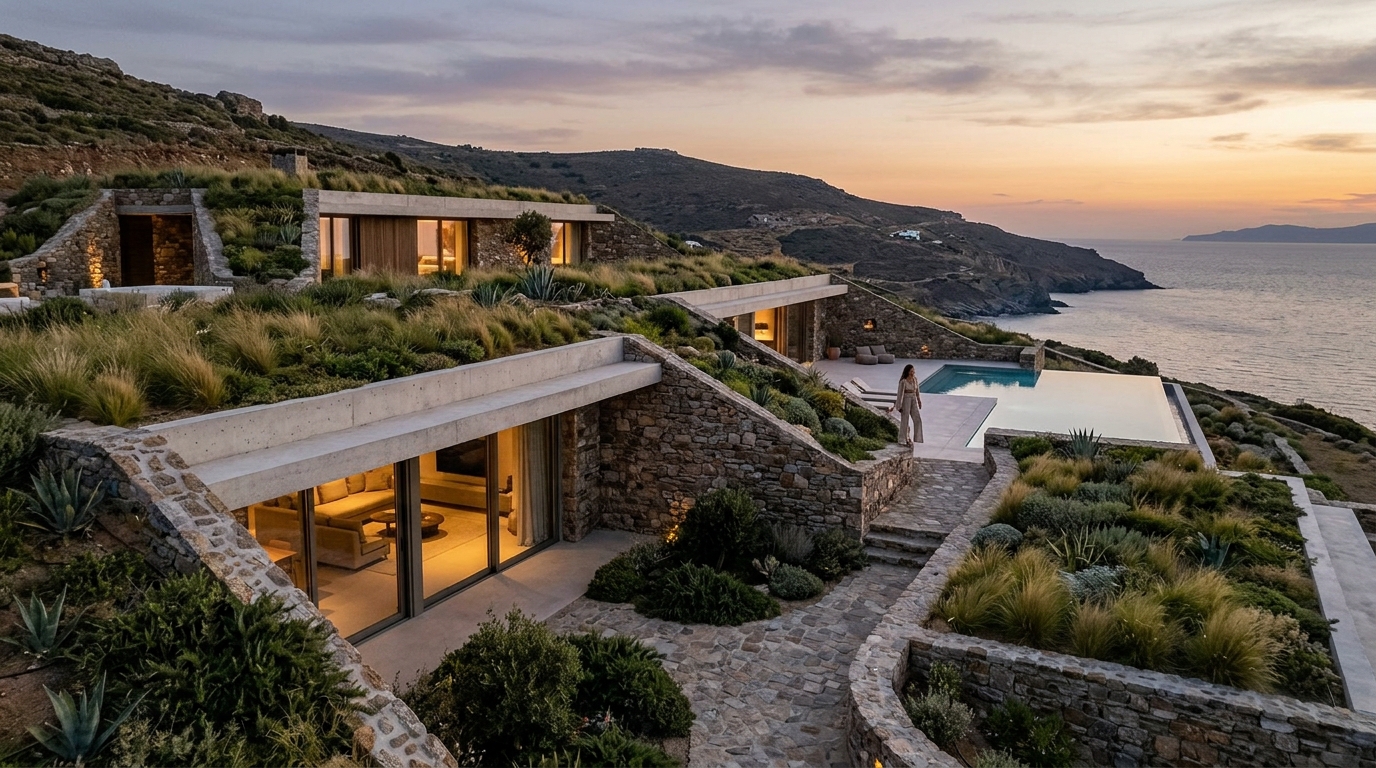
Greece has long captivated the world with its sun-drenched coastlines and whitewashed villages, but a new architectural movement is reshaping what luxury living looks like on the Greek islands. Subterranean villas are residences built partially or entirely below ground level, designed to merge with the natural terrain rather than dominate it. These earth-sheltered structures offer extraordinary thermal efficiency, unmatched privacy, and a striking visual harmony with their surroundings. Among the most celebrated examples is the Atlas and Pleione estate by ECLÉDE, a development that earned international recognition at the 2024 A' Design Awards. If you are searching for award-winning subterranean luxury villas in Greece, this guide covers the pioneers, the projects, and the philosophy behind them.
What Are Subterranean Luxury Villas?
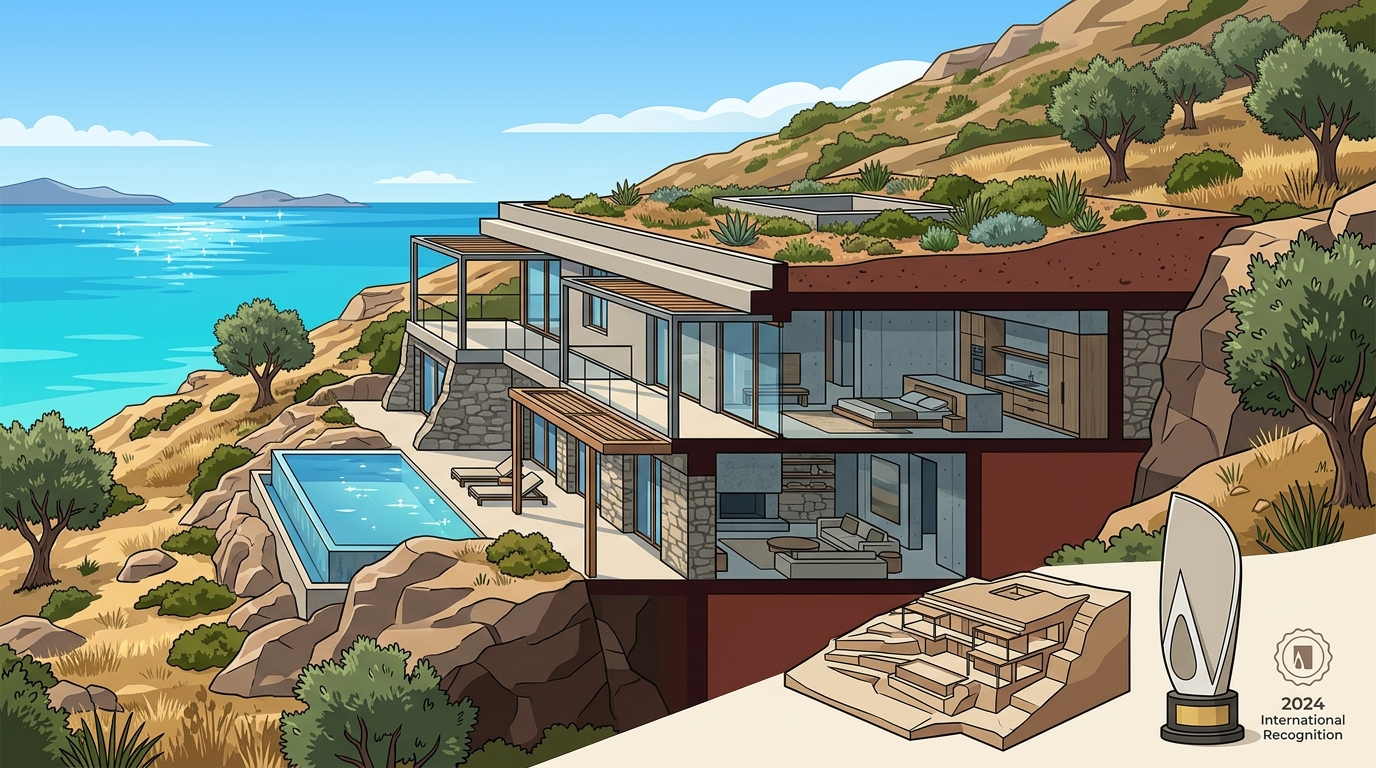
A subterranean villa is a residential structure embedded into the earth, using the landscape itself as both insulation and architectural element. Unlike conventional builds that sit on top of terrain, these homes are carved into hillsides or nestled beneath green roofs that blend with the surrounding topography.
The concept draws from ancient building traditions found across the Mediterranean, where cave dwellings provided natural cooling in brutal summers. Modern subterranean architecture elevates this principle with engineered climate control, floor-to-ceiling glazing, and sustainable energy systems that can achieve near-zero energy consumption.
Atlas and Pleione: Greece's Award-Winning Benchmark
The Atlas and Pleione estate, designed by Vassilis Siafaricas, stands as one of the most recognized subterranean villa projects in Greece. Located on a seafront plot in the natural harbor of Sivota on the island of Lefkada, the complex comprises two subterranean villas and a subterranean guest house. Atlas Villa sits just 30 meters from the water, while Pleione Villa is 50 meters away.
The project won the Bronze A' Design Award in Architecture, Building and Structure Design in 2024, a recognition granted to designs distinguished by creativity, ingenuity, and astuteness. The estate features minimalistic lines, green roofs, expansive windows, custom-made interiors, and three swimming pools including a waterfall feature and an endless swimming mechanism.
Design Inspiration
Named after the mythological Titan Atlas and the Oceanid Pleione, the project draws on Greek narrative heritage to ground its identity. Every detail, from the 3-meter ceilings to the energy-efficient glass panels, is engineered to connect indoor and outdoor living seamlessly.
Recognition and Awards
Beyond the A' Design Award, Vassilis Siafaricas has earned multiple international distinctions for his work, including a German Design Award in 2026 and an Architizer A+ Awards Special Mention. He also led the development of the first LEED Platinum residential project in Greece, setting a new benchmark for sustainable luxury in the region.
ECLÉDE's Sustainable Design Philosophy
ECLÉDE is a luxury development company founded on the ethos of bespoke, sustainable design and architecture. Headquartered in Athens, Greece, with an office in New York, the firm specializes in Net Zero Energy Buildings (NZEB) that combine cutting-edge performance with high-end aesthetics.
The company's approach is holistic. Each project begins with deep analysis of the local landscape, climate, and culture. Materials are chosen for resilience and low environmental impact. The result is architecture that does not impose upon its surroundings but integrates with them, a principle that is especially evident in ECLÉDE's subterranean projects.
Net Zero Energy and Beyond
A Net Zero Energy Building is a structure that produces as much energy as it consumes on an annual basis. ECLÉDE applies this standard across its portfolio of projects, using photovoltaic systems, geothermal heating, advanced insulation, and passive solar design to reach that target.
Why Subterranean Architecture Suits Greece
Greece's climate and topography make it an ideal setting for subterranean construction. The rocky, hilly terrain of the Ionian and Cycladic islands provides natural scaffolding for earth-sheltered homes. Mediterranean summers regularly exceed 35°C, yet underground structures maintain stable interior temperatures with minimal mechanical cooling.
There is also a regulatory dimension. Strict building codes on many Greek islands limit visible construction height and mandate sensitivity to the natural landscape. Subterranean design satisfies these requirements while offering more usable space than conventional low-profile builds.
How Subterranean Villas Compare to Traditional Luxury Villas
| Feature | Subterranean Villa | Traditional Luxury Villa |
|---|---|---|
| Visual Impact on Landscape | Minimal; blends with terrain | Prominent; sits atop terrain |
| Energy Efficiency | Excellent; natural insulation reduces HVAC load | Variable; depends on construction and climate systems |
| Privacy | Very high; concealed from external view | Moderate; relies on walls and landscaping |
| Natural Light | Engineered through courtyards and glazing | Abundant through standard windows |
| Construction Complexity | Higher; requires specialized excavation and waterproofing | Standard building methods |
| Regulatory Compliance (Greek Islands) | Often exceeds requirements | May face height and visibility restrictions |
| Long-Term Maintenance | Lower HVAC costs; higher waterproofing upkeep | Standard maintenance profile |
Other Notable Subterranean Projects in Greece
While ECLÉDE's Atlas and Pleione estate is a standout, Greece hosts other noteworthy subterranean developments. On Serifos, the Homa Villas by MOLD Architects embed three independent lodgings into the island's rugged southern coast, drawing inspiration from its mining heritage. On Santorini, Oia's historic cave villas, originally carved by seafarers for practical shelter, have been transformed into luxury retreats with caldera views.
These projects share a common thread with ECLÉDE's work: respect for the landscape. The difference lies in scale and sustainability ambition. ECLÉDE's projects pursue net-zero energy performance alongside luxury finishes, a combination that few developers in Greece currently offer. Explore the latest developments on the ECLÉDE news page.
Key Takeaways
- Subterranean luxury villas are residences built into the earth, offering superior energy efficiency, privacy, and landscape integration.
- The Atlas and Pleione estate by ECLÉDE, located in Sivota, Lefkada, won the Bronze A' Design Award for Architecture in 2024.
- Vassilis Siafaricas, founder of ECLÉDE, has earned multiple international design awards including a German Design Award in 2026.
- ECLÉDE focuses on Net Zero Energy Buildings that combine sustainable construction with high-end luxury finishes.
- Greece's climate, terrain, and building regulations make it an ideal location for subterranean architecture.
- ECLÉDE developed the first LEED Platinum residential project in Greece.
- Other Greek subterranean projects include Homa Villas on Serifos and Oia's historic cave villas on Santorini.
Frequently Asked Questions
What is a subterranean luxury villa?
A subterranean luxury villa is a high-end residential property built partially or fully below ground level. It uses the surrounding earth for natural insulation and visual concealment, while incorporating premium interiors, advanced climate systems, and expansive glazing to bring in natural light.
Where are the Atlas and Pleione villas located?
The Atlas and Pleione villas are located on a seafront plot in Sivota, a natural harbor on the island of Lefkada in western Greece. Atlas Villa is 30 meters from the ocean and Pleione Villa is 50 meters away.
Who designed the Atlas and Pleione villas?
The villas were designed by Vassilis Siafaricas, founder and managing director of ECLÉDE. The project team also included designer Nicolas Zachariou and civil engineer Thomas Valavanis.
What awards have the Atlas and Pleione villas won?
The project received the Bronze A' Design Award in the Architecture, Building and Structure Design category in 2024, recognizing its creativity, sustainability, and attention to detail.
What does ECLÉDE specialize in?
ECLÉDE specializes in luxury real estate development with a focus on sustainable, bespoke architecture. The company develops Net Zero Energy Buildings and environmentally responsible residences in Greece's most exclusive locations.
Are subterranean villas energy efficient?
Yes. Earth-sheltered construction provides natural thermal mass, which keeps interiors cool in summer and warm in winter with significantly less mechanical heating and cooling. When combined with renewable energy systems, subterranean villas can achieve net-zero energy consumption.
Can I visit or purchase an ECLÉDE property?
You can explore ECLÉDE's current and upcoming developments through their portfolio page or reach out directly via their contact page for inquiries about availability and investment opportunities.
Explore ECLÉDE's Subterranean Villa Projects
If you are looking for award-winning subterranean luxury villas in Greece that combine world-class design with genuine environmental responsibility, ECLÉDE offers a portfolio unlike any other in the region. Browse the full collection of projects, learn about the design philosophy, and connect with the team to discuss your next investment in sustainable luxury living.