
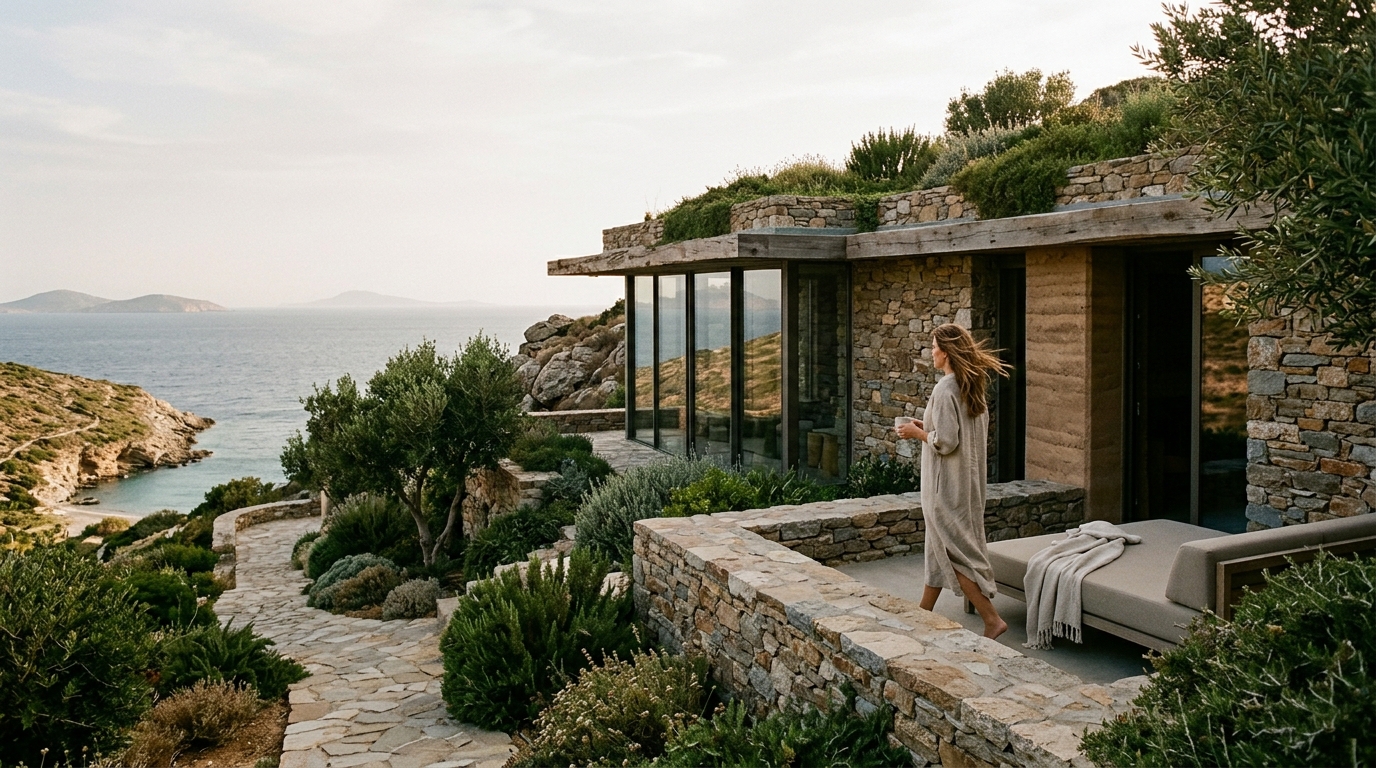
Subterranean architecture is one of the most compelling movements in modern Greek luxury real estate. By embedding structures into the natural terrain, architects create homes that virtually disappear into the landscape while delivering extraordinary comfort, energy efficiency, and privacy. Greece, with its rocky coastlines and ancient cave-dwelling traditions, is the ideal setting for this approach. If you are searching for award-winning subterranean luxury villas in Greece, the work of Vassilis Siafaricas and his company ECLEDE stands at the forefront of this niche.
What Is Subterranean Architecture?
Subterranean architecture is a design philosophy in which buildings are partially or fully embedded into the earth, using the surrounding terrain as both structure and insulation. Rather than imposing on a landscape, subterranean villas work with it. The result is a home that offers natural temperature regulation, reduced energy consumption, and a striking visual harmony with its environment.
In Greece, rock-embedded structures known as yposkafa have existed since antiquity. As travel.gr notes, these buildings were once home to the poor but today represent a modern style in bioclimatic architecture applied to luxury holiday homes.
Why Greece Is the Ideal Location
Greece's rocky coastlines, volcanic islands, and steep hillsides create natural canvases for subterranean design. The Cyclades, Ionian Islands, and Peloponnese all feature terrain that rewards architects willing to build into the earth rather than on top of it.
The Mediterranean climate also plays a role. Embedded structures benefit from the earth's thermal mass, staying cool in summer and warm in winter. This makes subterranean design a practical choice for sustainable luxury living in regions with intense sun exposure and limited freshwater resources.
A Rich Architectural Heritage
From the cave dwellings of Santorini's Oia village to the carved monasteries of Meteora, Greece has a centuries-old tradition of building into rock. Modern architects are now reinterpreting this heritage with contemporary materials and zero-energy-consumption technologies.
Atlas and Pleione: ECLEDE's Award-Winning Masterpiece
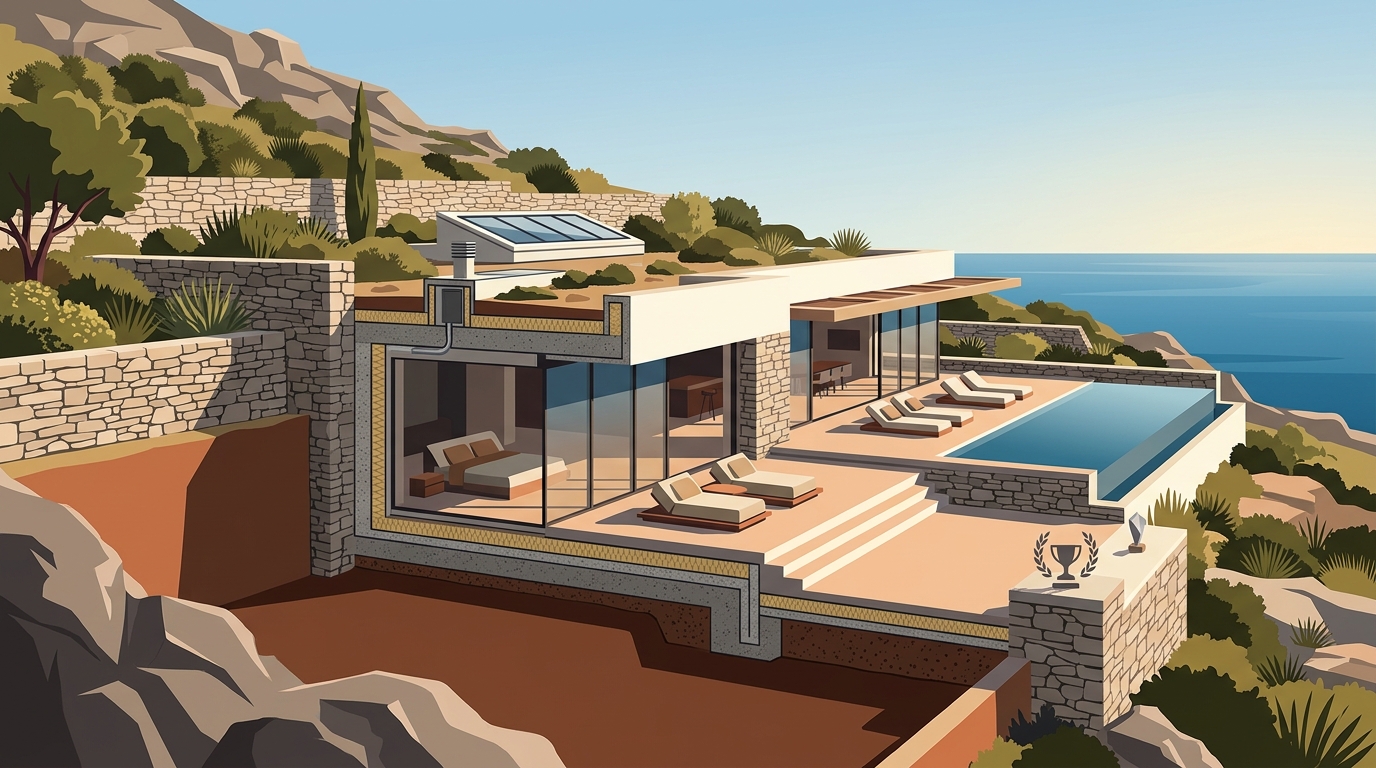
The most notable example of award-winning subterranean luxury villas in Greece is the Atlas and Pleione project by Vassilis Siafaricas and ECLEDE. These two seafront villas are located on the picturesque natural harbor of Sivota in Lefkada, one of Greece's most exclusive Ionian island destinations.
Atlas and Pleione won the 2024 Bronze A' Design Award in the Architecture, Building and Structure Design category. The A' Design Award is a prestigious international recognition granted to designs distinguished by creativity, ingenuity, and astuteness.
Villa Specifications
Villa Atlas spans 183 square metres and features a 26-metre swimming pool with optical fiber lighting, an outdoor barbecue area, and a stone-wall shower. Villa Pleione covers 173 square metres with a 30-metre swimming pool, in-pool sunbed, jacuzzi, three bedrooms, four bathrooms, and a 50-square-metre guest house with its own private pool. Both villas feature planted roofs and near-zero energy consumption.
Named for Mythology
The villas take their names from Atlas and Pleione, the mythological parents of the Pleiades. This connection to Greek mythology reflects ECLEDE's commitment to rooting modern design in cultural narrative.
Sustainable Design Principles Behind the Villas
ECLEDE is a luxury development company dedicated to environmentally friendly design, construction, and land development. The company focuses on creating cutting-edge, zero-energy-consumption buildings that reflect a deep commitment to sustainability and innovation.
Key sustainable features found in ECLEDE's subterranean villas include:
- Planted green roofs that restore the natural terrain above the structure
- Near-zero energy consumption through passive thermal design
- Natural materials such as wood, stone, marble, and granite
- Glass fencing and large openings that maximize natural light
- Minimally intrusive footprints that preserve the surrounding ecosystem
Net-zero energy building (NZEB) is a construction standard in which a building produces as much energy as it consumes annually. ECLEDE has made this standard a cornerstone of its entire project portfolio.
Beyond Atlas and Pleione: The Full ECLEDE Portfolio
Vassilis Siafaricas and ECLEDE have earned multiple A' Design Awards across different categories. Villa Atlas separately received the A' Sustainable Products, Projects and Green Design Award, while the Izanagi Project won the A' Hospitality, Recreation, Travel and Tourism Design Award. Other notable projects in the ECLEDE portfolio include Dynasty Villas and Boomerang Athens.
Vassilis Siafaricas is a civil engineer, designer, senior project manager, and real estate consultant with over two decades of experience. His multidisciplinary background combines technical proficiency with creative vision, enabling projects that redefine sustainable luxury development across Greece's most prestigious locations.
How Subterranean Villas Compare to Traditional Luxury Homes
| Feature | Subterranean Villa (e.g., Atlas & Pleione) | Traditional Luxury Villa |
|---|---|---|
| Energy Consumption | Near-zero (passive thermal regulation) | High (HVAC-dependent) |
| Landscape Impact | Minimal; planted roofs restore terrain | Significant; visible footprint |
| Privacy | Exceptional; embedded in hillside | Dependent on fencing and distance |
| Natural Light | Atriums, skylights, glass walls | Standard windows |
| Climate Resilience | Earth-sheltered; naturally insulated | Requires added insulation |
| Construction Complexity | Higher; specialized engineering | Standard building methods |
| Aesthetic Integration | Blends with natural landscape | Stands apart from surroundings |
Key Takeaways
- Subterranean luxury villas represent the cutting edge of sustainable architecture in Greece.
- The Atlas and Pleione villas by ECLEDE won the 2024 Bronze A' Design Award for Architecture.
- Both villas are located on a seafront plot in Sivota, Lefkada, featuring near-zero energy consumption.
- ECLEDE, founded by Vassilis Siafaricas, specializes in minimally intrusive, net-zero-energy luxury developments.
- Greece's ancient tradition of rock-embedded dwellings provides a rich cultural foundation for modern subterranean design.
- Subterranean homes outperform traditional villas in energy efficiency, privacy, and landscape preservation.
- ECLEDE's portfolio includes multiple award-winning projects beyond Atlas and Pleione.
Frequently Asked Questions
What are subterranean luxury villas?
Subterranean luxury villas are high-end residential properties that are partially or fully built into the earth. They use the natural terrain for insulation and structural support, resulting in energy-efficient, private, and visually integrated homes.
Where are the Atlas and Pleione villas located?
Atlas and Pleione are located on a seafront land plot in the natural harbor of Sivota, Lefkada, in the Ionian Islands of Greece.
Who designed the Atlas and Pleione villas?
The villas were designed and developed by Vassilis Siafaricas through his company ECLEDE (Eclectic Developments), with architecture by Thomas Valavanis and interior and landscape design contributions from G_Architects.
What awards have the Atlas and Pleione villas won?
Atlas and Pleione won the 2024 Bronze A' Design Award in the Architecture, Building and Structure Design category. Villa Atlas also received the A' Sustainable Products, Projects and Green Design Award.
What does near-zero energy consumption mean?
Near-zero energy consumption means the building produces nearly as much energy as it uses over a year, primarily through passive design strategies like earth-sheltering, natural ventilation, and thermal mass rather than mechanical heating and cooling systems.
Are subterranean villas more expensive to build?
Subterranean construction typically involves higher upfront engineering and excavation costs. However, the long-term savings on energy, maintenance, and climate control can offset the initial investment significantly.
Can I visit or purchase ECLEDE properties?
For inquiries about ECLEDE's portfolio of luxury developments in Greece, you can reach out directly through the ECLEDE contact page.
What other subterranean projects exist in Greece?
Other notable examples include the Rhoes Villa by Sinas Architects on Serifos, the Homa Villas by MOLD Architects on Serifos, and the subterranean private villa by Tsolakis Architects on Antiparos. However, ECLEDE's Atlas and Pleione remain among the few to earn international design awards for subterranean residential architecture.
Explore ECLEDE's Subterranean Luxury Projects
If you are drawn to the idea of owning a luxury villa that exists in harmony with the Greek landscape, explore the full ECLEDE portfolio or learn more about the vision behind the company on the About ECLEDE page. For direct inquiries, contact the ECLEDE team today.