
Sustainable Property Investment: Long-Term Benefits That Protect Your Wealth
Sustainability is no longer a niche preference in real estate. It is a core investment principle that shapes how portfolios perform over decades. Whether you are acquiring a luxury villa in Greece or a residential asset in a global capital, choosing an eco-friendly property delivers measurable financial returns, reduces long-term risk, and future-proofs your investment against tightening regulations and shifting buyer expectations. This guide breaks down exactly how a sustainable property investment benefits you across every dimension that matters, from operating costs to resale premiums.
What Is a Sustainable Property Investment?
A sustainable property investment is a real estate asset designed, built, and operated to minimize environmental impact while maximizing occupant well-being and long-term financial performance. According to J.P. Morgan, sustainable real estate involves the development, construction, and management of properties with a focus on efficiently using resources, reducing exposure to extreme weather, and minimizing negative environmental impact.
In practice, this means energy-efficient systems, renewable energy integration, responsibly sourced materials, and intelligent design that works with the natural landscape rather than against it. Companies like ECLÉDE exemplify this approach by creating Net Zero Energy Buildings that blend luxury with environmental responsibility.
Financial Returns: Lower Costs, Higher Value
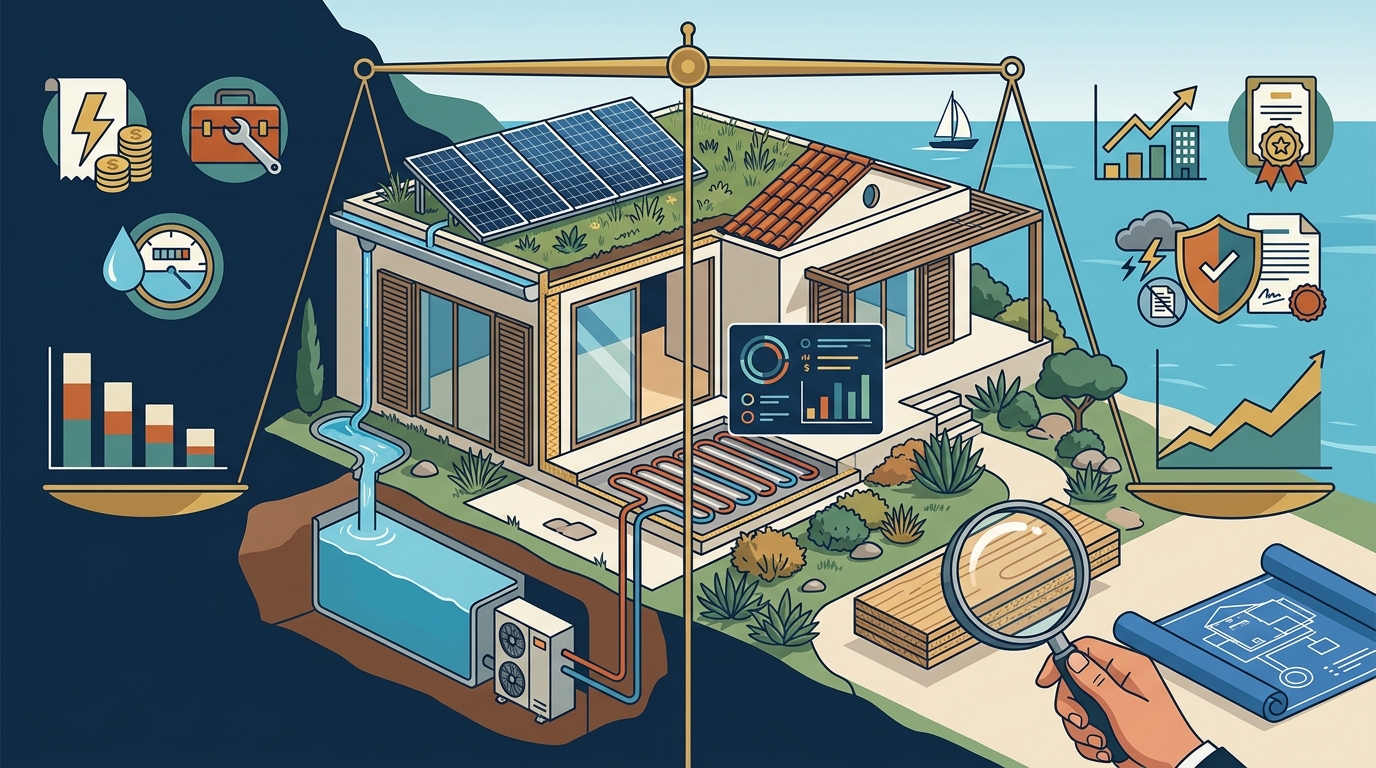
The financial case for sustainable property is clear and backed by institutional research. Energy-efficient properties reduce operating costs through lower utility bills, improved HVAC performance, and smarter water management. These savings directly increase net operating income, which in turn enhances overall return on investment.
Property Value Premiums
Green buildings consistently command higher market values. Sustainable features such as renewable energy installations and advanced insulation extend a building's lifespan and increase its attractiveness to buyers. The record-setting sale of Villa Atlas on the Greek island of Lefkada, which achieved approximately 14,000 euros per square meter through Sotheby's, demonstrates how sustainability-driven luxury properties can reach premium price points.
Operating Cost Savings
According to PwC, improved building ventilation, lighting, and electricity usage leads to lower operating costs and positive working environments. These savings compound year after year, making the total cost of ownership significantly lower than conventional properties.
| Benefit Category | Conventional Property | Sustainable Property |
|---|---|---|
| Energy Costs | Standard utility rates | 20-40% lower through efficiency and renewables |
| Resale Premium | Market average | Higher valuations due to green certifications |
| Vacancy Rates | Average | Lower due to tenant preference for eco-buildings |
| Insurance Costs | Rising with climate risk | Potentially reduced through resilience features |
| Regulatory Risk | Increasing exposure | Future-proofed against new standards |
Risk Mitigation and Climate Resilience
Climate change is reshaping risk models in real estate. Properties built without sustainability in mind face increasing exposure to extreme weather events, rising insurance premiums, and regulatory penalties. Sustainable buildings are better equipped to handle these challenges.
As the BRE Group's 2026 outlook noted, sustainability leaders now position resilience as an operational advantage rather than a compliance cost. Properties designed with climate resilience, like the subterranean villas developed by ECLÉDE in Lefkada, use earth-sheltered construction to naturally regulate temperature and reduce exposure to environmental extremes.
Tax Incentives and Green Financing
A green tax incentive is a financial benefit offered by governments to encourage environmentally responsible construction and renovation. According to J.P. Morgan, incorporating renewable energy across your property may qualify you for credits including the Investment Tax Credit and Production Tax Credit.
Sustainable properties can also access green financing from institutional lenders, often at more favorable rates. In the EU and Greece specifically, energy performance standards are tightening, which means early adopters benefit from both incentives and avoided future compliance costs.
Rising Tenant and Buyer Demand
Consumer preferences are shifting decisively toward sustainability. A joint survey by GRESB and MIPIM found that 66% of respondents consider sustainability core to their investment strategy. This demand translates directly to lower vacancy rates and higher rents for green-certified properties.
For luxury buyers in particular, sustainability is now an expectation rather than a bonus. The ECLÉDE portfolio reflects this shift, with projects like Boomerang Athens and Dynasty Villas designed to meet the highest standards of eco-conscious living without compromising on luxury.
The Role of LEED and Green Certifications
LEED (Leadership in Energy and Environmental Design) is a globally recognized certification system that evaluates a building's environmental performance across energy, water, materials, and indoor quality. A LEED certification is a third-party validation that signals measurable sustainability to buyers, tenants, and investors.
Certified buildings attract premium tenants and command higher rents. The real estate sector accounts for approximately 30 to 40% of global emissions according to Georgetown University research, making certified green buildings essential to both environmental goals and portfolio performance.
How ECLÉDE Builds for Long-Term Value
Under the leadership of Vassilis Siafaricas, ECLÉDE has established a distinctive approach that fuses luxury design with rigorous sustainability standards. The company specializes in Net Zero Energy Buildings and has delivered the first LEED Platinum residential project in Greece.
Award-Winning Sustainable Design
ECLÉDE's work has earned multiple international distinctions, including A' Design Awards across architecture and sustainability categories and the German Design Awards 2026. The Boomerang Athens project is set to become one of the pioneering residences with a LEED Certificate in Greece, demonstrating that high-end design and environmental responsibility are not mutually exclusive.
A Philosophy Rooted in Responsibility
Each ECLÉDE project is conceived not just as a building, but as a long-term asset with purpose, identity, and environmental integrity. From subterranean villas on Lefkada that achieve near-zero energy consumption to urban developments in Athens, the company's approach ensures that every investment is built to appreciate in both value and relevance over time.
Key Takeaways
- Sustainable properties deliver lower operating costs through energy efficiency and smart design.
- Green buildings command higher resale values and attract premium buyers and tenants.
- Climate-resilient construction reduces exposure to rising insurance costs and extreme weather damage.
- Tax incentives and green financing make sustainable investments more accessible and profitable.
- Over 66% of institutional investors now consider sustainability core to their strategy.
- LEED and similar certifications provide third-party validation that enhances marketability.
- Developers like ECLÉDE prove that luxury and sustainability deliver stronger long-term returns together.
Frequently Asked Questions
What makes a property investment sustainable?
A sustainable property investment prioritizes energy efficiency, renewable energy sources, responsibly sourced materials, and designs that minimize environmental impact while providing comfortable, healthy living spaces.
Do sustainable properties really cost more upfront?
While green building materials and technologies can carry higher initial costs, the gap is narrowing. The long-term savings in energy, maintenance, and insurance typically offset the upfront premium within a few years.
How does sustainability affect property resale value?
Sustainable properties consistently achieve higher market valuations. Green certifications, energy efficiency features, and climate resilience all contribute to stronger buyer demand and premium pricing.
What is LEED certification and why does it matter?
LEED is a globally recognized green building certification system. It matters because it provides independent verification of a property's environmental performance, making it more attractive to buyers, tenants, and lenders.
Are there tax benefits for eco-friendly property investments?
Yes. Many governments offer tax credits, rebates, and incentives for incorporating renewable energy and energy-efficient systems into properties. In the EU and Greece, evolving regulations further reward early adoption.
How does climate resilience protect my investment?
Climate-resilient properties are designed to withstand extreme weather events, reducing repair costs and insurance premiums. They also maintain their value better in markets increasingly affected by climate risk.
What is a Net Zero Energy Building?
A Net Zero Energy Building is a property that produces as much renewable energy as it consumes over a year. This eliminates energy costs and significantly reduces the property's carbon footprint.
How does ECLÉDE integrate sustainability into luxury development?
ECLÉDE, led by Vassilis Siafaricas, combines minimal architectural design with advanced eco-technologies such as photovoltaics, KNX automation, and earth-sheltered construction. The result is luxury properties that are also Net Zero Energy Buildings with international design recognition.
Start Investing in Sustainable Luxury
Whether you are looking at a seafront villa in Greece or a certified urban residence in Athens, sustainable property is the smartest long-term investment you can make. Contact the ECLÉDE team to explore projects that combine award-winning design with proven environmental performance.