
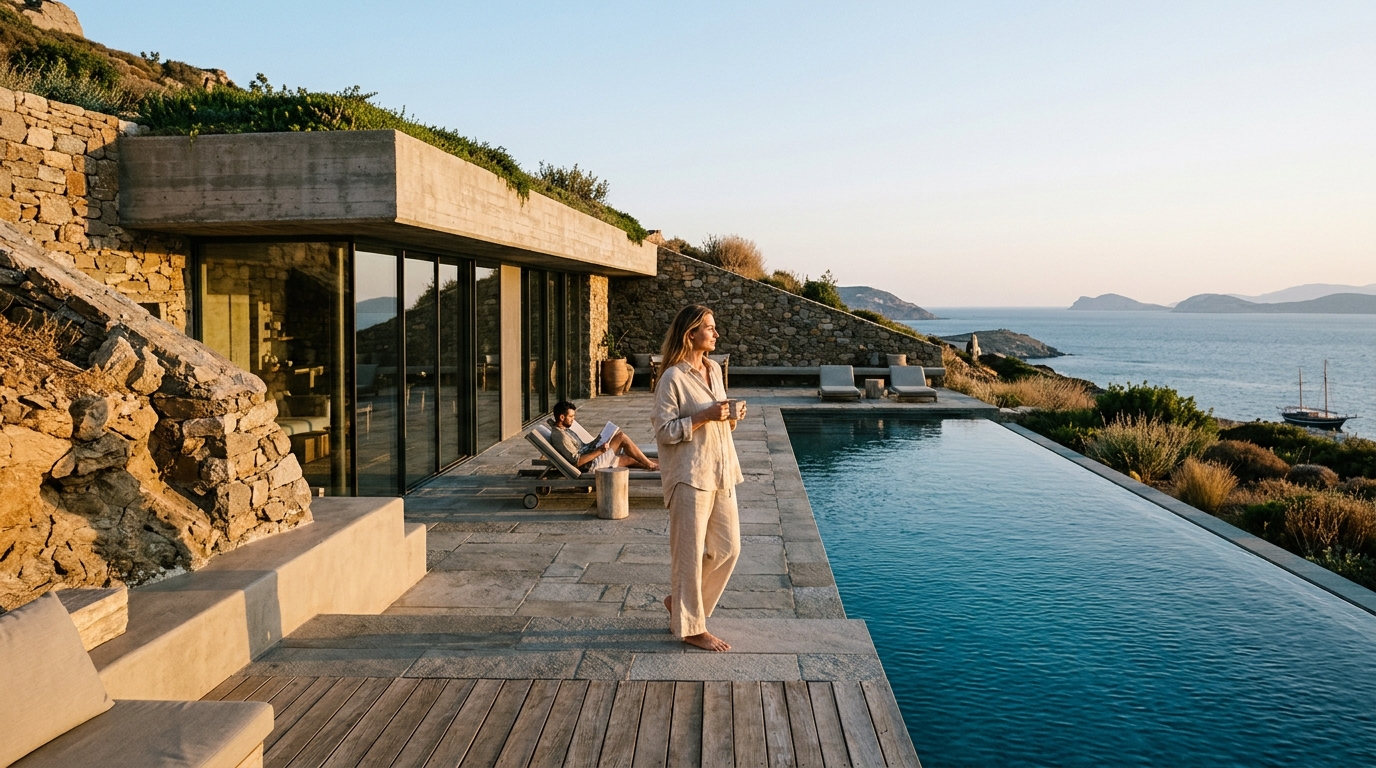
Greece has long captivated architects and luxury travelers with its dramatic coastlines and sun-drenched landscapes. In recent years, a new wave of subterranean villa design has redefined what it means to live in harmony with the Greek terrain. These earth-sheltered residences merge cutting-edge sustainability with five-star comfort, disappearing into hillsides and seafront plots while delivering panoramic views of the Aegean. At the forefront of this movement is ECLÉDE, the luxury development company founded by Vassilis Siafaricas, whose internationally recognized projects prove that the most impressive architecture is sometimes the kind you can barely see.
What Are Subterranean Luxury Villas?
A subterranean villa is a residential structure built partially or fully below ground level, designed to integrate with the natural topography rather than impose upon it. In Greece, these rock-embedded structures are known as yposkafa and have roots stretching back to antiquity. According to travel.gr, the technique was historically used in Santorini and Meteora and has now been reimagined for modern bioclimatic architecture applied to luxury holiday homes.
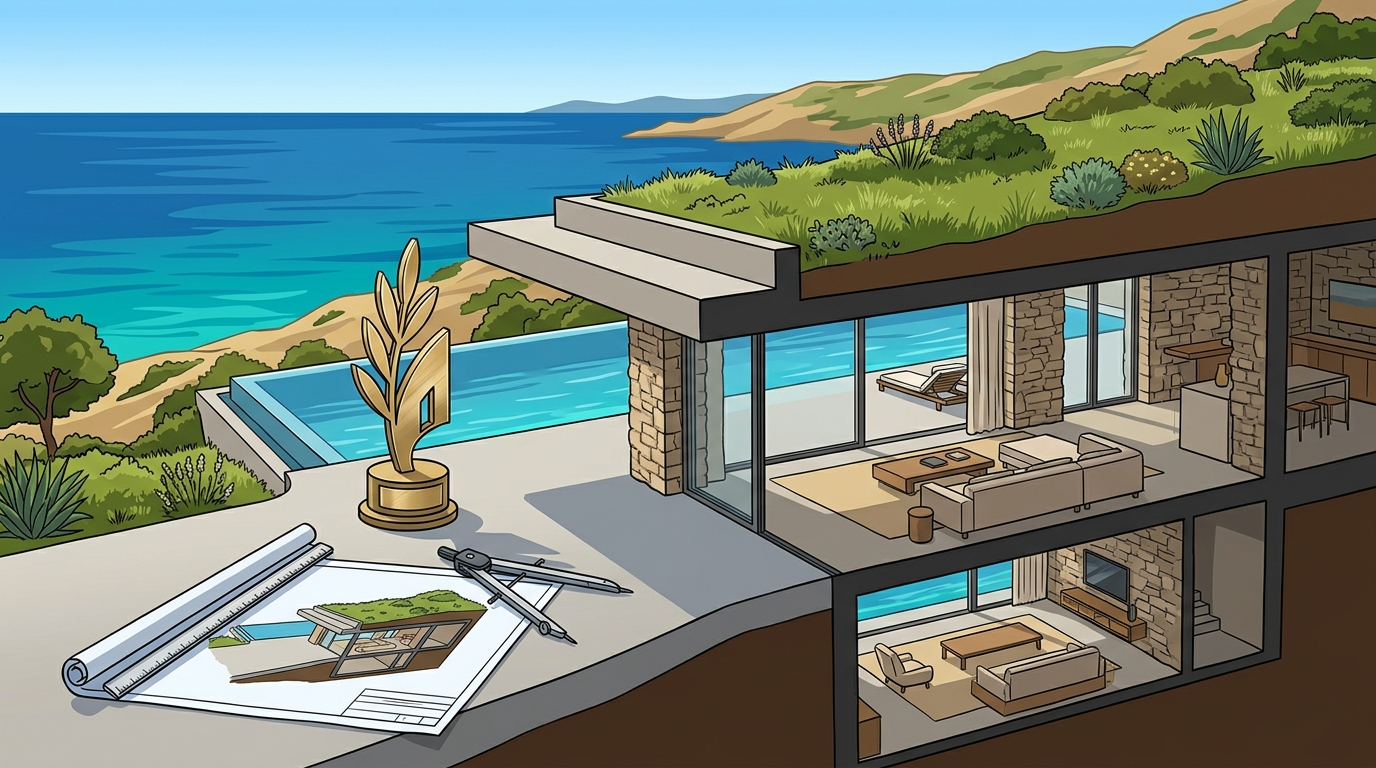
Today, subterranean design is a hallmark of environmentally conscious luxury. Green roofs, natural ventilation, and earth-insulated walls reduce energy consumption dramatically while providing year-round thermal comfort.
Why Greece Is the Ideal Setting for Underground Architecture
Greece's rocky coastlines, steep island hillsides, and Mediterranean climate create the perfect conditions for subterranean construction. The volcanic geology of the Cyclades, the limestone cliffs of the Ionian islands, and the rugged Peloponnese peninsula all lend themselves to earth-sheltered building.
A Rich Architectural Heritage
The tradition of building into rock is deeply Greek. Santorini's cave dwellings originally housed seafarers who carved homes into volcanic cliffs for natural insulation. Contemporary architects now use these same principles to create villas that are as thermally efficient as they are visually striking.
Sustainability Meets Scenery
Subterranean villas minimize visual impact on pristine landscapes while maximizing views for occupants. Large floor-to-ceiling glazing panels open interiors to the Aegean, and green roofs regenerate native flora above. This balance of discretion and drama defines the best of Greek luxury development.
Atlas and Pleione: Award-Winning Subterranean Villas in Lefkada
The Atlas and Pleione project, designed by Vassilis Siafaricas and developed by ECLÉDE, is one of Greece's most celebrated examples of subterranean luxury. Located on a seafront plot in the picturesque natural harbor of Sivota on the island of Lefkada, the complex comprises two subterranean villas and a subterranean guest house.
Atlas Villa sits just 30 meters from the water, while Pleione Villa is 50 meters away. The minimalistic design features austere architectural lines, green roofs, and long windows that blend functionality, luxury, and sustainability. The estate includes custom-made interiors and three vast swimming pools.
In 2024, Atlas and Pleione won the A' Architecture, Building and Structure Design Award, a Bronze-level recognition granted to designs distinguished by creativity, ingenuity, and astuteness. Villa Atlas also received the 2024 A' Sustainable Products, Projects and Green Design Award, confirming the project's dual excellence in aesthetics and environmental performance.
The Izanagi Project: Subterranean Hospitality in Lefkada
Building on the success of Atlas and Pleione, ECLÉDE's Izanagi Project is a subterranean villa complex also located in Lefkada, Greece. Designed by Vassilis Siafaricas in collaboration with Garchitects, Izanagi earned the 2025 A' Hospitality, Recreation, Travel and Tourism Design Award, making it ECLÉDE's third international design award in just two years.
The Izanagi Project demonstrates how subterranean architecture can serve hospitality use cases, not just private residences, opening new possibilities for luxury tourism in Greece's Ionian islands.
The ECLÉDE Approach to Sustainable Luxury
ECLÉDE is a luxury development company founded on the ethos of bespoke, sustainable design and architecture. The company focuses on developing net-zero-energy buildings (NZEB) while promoting connection with nature through innovative, high-end, subtle design. Led by founder Vassilis Siafaricas, a civil engineer with over two decades of experience, ECLÉDE specializes in Greece's most exclusive locations, including the prestigious Athens suburbs of Ekali, Politia, Kastri, and Kifisia.
Material Innovation
ECLÉDE uses innovative, sustainable, and resilient materials to create spaces that positively impact surrounding communities, economies, and local culture. Every project prioritizes low environmental impact alongside high architectural standards.
A Growing Portfolio
Beyond subterranean villas, the ECLÉDE portfolio includes projects like Boomerang Athens, Dynasty Villas, and Tre Sorelle, each reflecting the company's commitment to designs that blend seamlessly with their natural surroundings.
How ECLÉDE Subterranean Projects Compare
| Feature | Atlas & Pleione | Izanagi Project |
|---|---|---|
| Location | Sivota, Lefkada | Lefkada, Greece |
| Type | Private residential villas | Hospitality villa complex |
| Award | 2024 A' Architecture Award; 2024 A' Sustainable Design Award | 2025 A' Hospitality Design Award |
| Design Lead | Vassilis Siafaricas | Vassilis Siafaricas & Garchitects |
| Key Features | 3 pools, green roofs, custom interiors, 30m from sea | Subterranean hospitality, minimally intrusive design |
| Energy Target | Net-zero energy | Net-zero energy |
Key Takeaways
- Subterranean luxury villas represent the convergence of ancient Greek building traditions and modern sustainable architecture.
- ECLÉDE, founded by Vassilis Siafaricas, is a leading developer of award-winning subterranean villas in Greece.
- Atlas and Pleione in Lefkada won both the 2024 A' Architecture Award and the 2024 A' Sustainable Design Award.
- The Izanagi Project earned the 2025 A' Hospitality Design Award, extending ECLÉDE's track record to three international awards.
- ECLÉDE focuses on net-zero-energy buildings that blend with natural surroundings and local architectural culture.
- Greece's rocky terrain, Mediterranean climate, and deep building heritage make it the ideal location for earth-sheltered luxury.
- Subterranean design is expanding from private residences into hospitality, creating new opportunities for luxury tourism.
Frequently Asked Questions
What is a subterranean luxury villa?
A subterranean luxury villa is a high-end residential property built partially or fully below ground, designed to integrate with the landscape while offering premium amenities, thermal efficiency, and minimal visual impact on the environment.
Where are ECLÉDE's subterranean villas located?
ECLÉDE's award-winning subterranean villas, Atlas and Pleione, are located in the natural harbor of Sivota on the island of Lefkada, Greece. The Izanagi Project is also situated in Lefkada.
What awards have ECLÉDE's subterranean villas won?
Atlas and Pleione won the 2024 A' Architecture, Building and Structure Design Award and the 2024 A' Sustainable Products, Projects and Green Design Award. The Izanagi Project won the 2025 A' Hospitality, Recreation, Travel and Tourism Design Award.
Who is Vassilis Siafaricas?
Vassilis Siafaricas is the founder of ECLÉDE, a civil engineer, designer, senior project manager, and real estate consultant with over 20 years of experience in luxury real estate development in Greece.
Are subterranean villas energy efficient?
Yes. Subterranean villas benefit from natural earth insulation, which maintains stable indoor temperatures year-round. ECLÉDE designs its projects as net-zero-energy buildings, meaning they produce as much energy as they consume.
Can I visit or stay at a subterranean villa in Greece?
Several subterranean-style accommodations exist across the Greek islands, from cave villas in Santorini to contemporary projects in the Cyclades. ECLÉDE's Izanagi Project is designed specifically for hospitality use. Contact ECLÉDE directly for the latest availability.
What makes subterranean architecture sustainable?
Earth-sheltered buildings use the ground as natural insulation, reducing heating and cooling loads. Combined with green roofs, passive solar design, and sustainable materials, subterranean architecture significantly lowers a building's carbon footprint.
Explore ECLÉDE's Award-Winning Projects
If you are drawn to the idea of luxury that works with nature rather than against it, explore the full ECLÉDE portfolio or get in touch to discuss a bespoke subterranean development in Greece's most exclusive locations.