
Subterranean vs Traditional Luxury Villa: Which Is Better for Eco-Friendly Coastal Living?
Luxury coastal living no longer means choosing between opulence and environmental responsibility. Today, buyers face a more nuanced decision: should they invest in a subterranean villa that blends into the landscape, or a traditional above-ground villa with modern green upgrades? Both paths can deliver stunning design and sustainability, but they differ dramatically in energy performance, construction cost, aesthetic impact, and long-term value. This guide compares the two approaches side by side so you can make the right choice for your next coastal property.
What Is a Subterranean Luxury Villa?
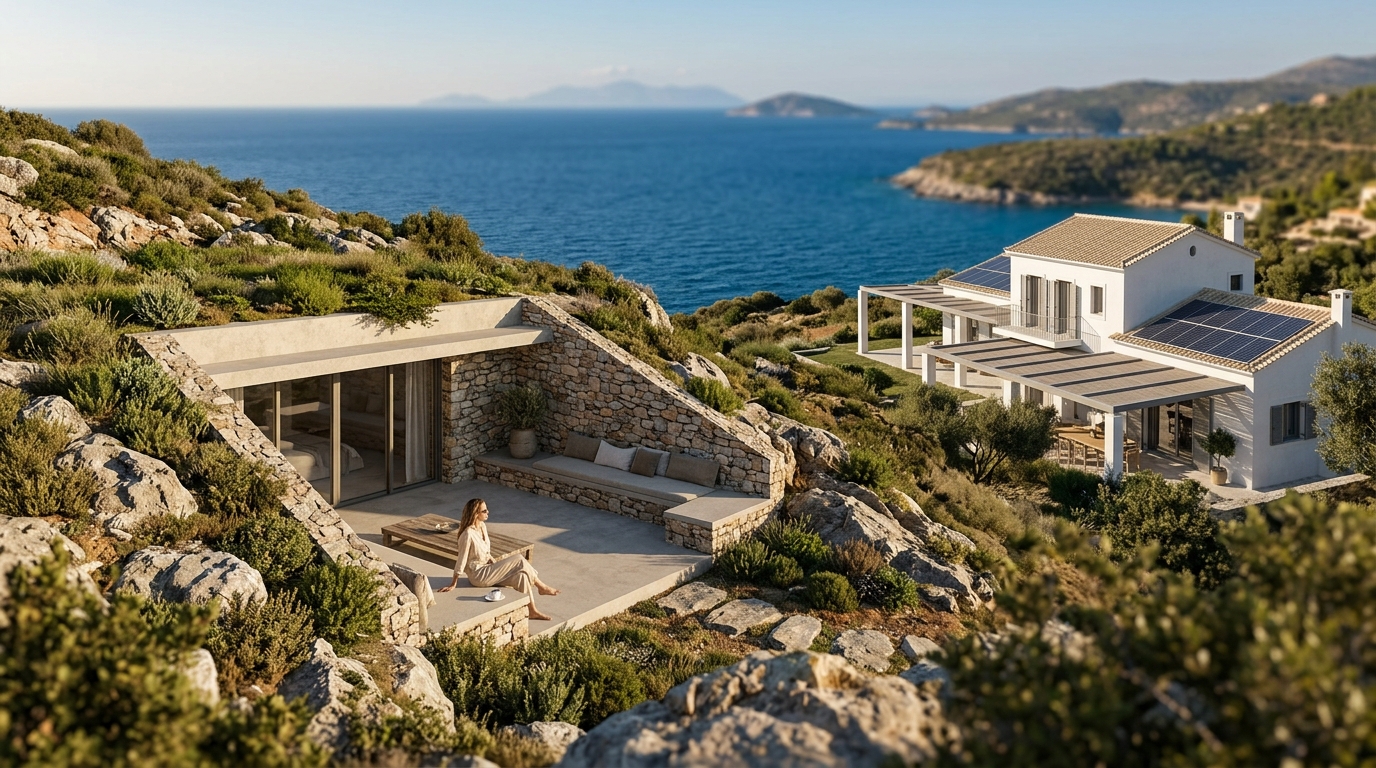
A subterranean villa is a residential structure built partially or entirely below grade, using the surrounding earth as insulation and structural support. These homes leverage the soil's natural thermal properties to regulate indoor temperature without heavy reliance on mechanical systems. Notable examples include Villa Vals in Switzerland by SeARCH and Christian Muller Architects, and the award-winning Atlas and Pleione villas on Lefkada, Greece, developed by ECLÉDE.
Why Subterranean Design Is Gaining Momentum
Rising land sensitivity on Mediterranean coastlines and stricter environmental regulations are pushing architects toward earth-sheltered solutions. Projects like Atlas and Pleione demonstrate that subterranean villas can achieve near-zero energy consumption while commanding premium sale prices, with one Lefkada property selling for approximately 14,000 euros per square meter through Sotheby's International Realty.
What Is a Traditional Luxury Villa?
A traditional luxury villa is a conventional above-ground residence, typically featuring open floor plans, expansive glazing, and prominent architectural profiles. When retrofitted with solar panels, LED systems, and energy-efficient appliances, these properties can significantly reduce their environmental footprint. However, they remain fully exposed to ambient temperature swings, wind loads, and visual impact on the coastal landscape.
Energy Performance and Thermal Mass
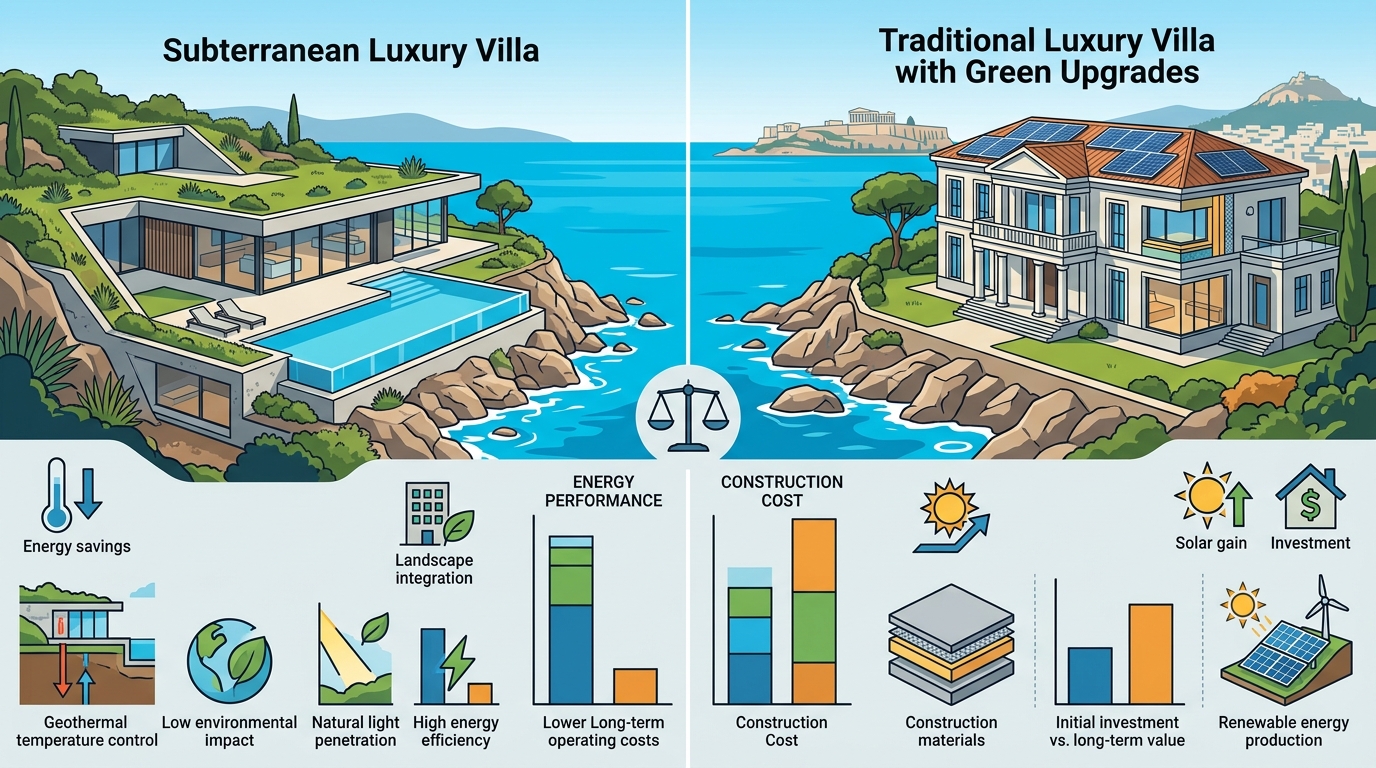
Thermal mass is the ability of a material to absorb, store, and slowly release heat energy. In coastal climates with warm days and cool nights, this property is a decisive advantage for subterranean construction. According to research published in Renewable and Sustainable Energy Reviews, earth temperature below the surface remains lower than ambient air in summer and higher in winter, making soil a natural heat capacitor.
How the Numbers Stack Up
| Factor | Subterranean Villa | Traditional Villa (Green-Upgraded) |
|---|---|---|
| Heating/cooling energy savings | Up to 60% in temperate climates | 15-30% with solar + insulation |
| Thermal stability | Excellent (earth-buffered) | Moderate (weather-exposed) |
| Reliance on HVAC | Minimal to none | Moderate |
| Net-zero potential | High (passive design built in) | Achievable with significant investment |
| Storm/wind resilience | Very high | Dependent on construction type |
The National Renewable Energy Laboratory (NREL) found that earth-sheltered homes are significantly less susceptible to extreme outdoor air temperature swings. For coastal regions in Greece, this translates to year-round comfort with minimal mechanical input.
Environmental and Visual Impact on Coastlines
Subterranean villas preserve the natural topography of coastal sites. By embedding structures into hillsides or below grade, developers protect sightlines, reduce habitat disruption, and maintain the ecosystem's continuity. Vassilis Siafaricas, founder of ECLÉDE, has championed this philosophy, describing design as the intersection of inspiration, functionality, and responsibility.
Traditional villas, regardless of green upgrades, occupy the visible landscape. In sensitive coastal zones across the Mediterranean, this can trigger planning restrictions and community opposition. The subterranean approach sidesteps these issues by design.
Cost Comparison: Construction and Lifecycle
Subterranean construction typically carries a 20-30% premium over conventional building due to excavation, waterproofing membranes, and structural reinforcement. However, researchers at the University of California, Berkeley have noted that long-term energy savings can offset the higher initial cost relatively quickly.
Lifecycle Value
ECLÉDE's portfolio of luxury developments demonstrates that subterranean properties command premium resale values. The record Lefkada sale at nearly 5.8 million dollars through Sotheby's underscores the market's willingness to pay for properties that combine architectural distinction with sustainability credentials. Under Vassilis Siafaricas's leadership, ECLÉDE also delivered the first LEED Platinum residential project in Greece, setting a benchmark for sustainable luxury in the region.
Design, Light, and Livability
A common concern with subterranean villas is natural light. Modern earth-sheltered design solves this through strategic glazing, light wells, and open courtyards. The Atlas and Pleione villas, for example, feature expansive seafront openings that flood interiors with Ionian light while the rear and roof are nestled into the hillside.
Psychological Benefits
Research on biophilic design suggests that spaces evoking natural enclosures can lower stress and improve sleep quality. The muted acoustics and stable temperatures of a partially buried home create an environment uniquely suited to rest and well-being. This is not a compromise; it is a design advantage.
Traditional Villas: The Familiar Option
Above-ground villas offer panoramic openness that many buyers expect. Floor-to-ceiling glazing on all sides, rooftop terraces, and multi-level layouts are hallmarks of the type. For buyers who prioritize conventional aesthetics and are willing to invest in bolt-on sustainability systems, a traditional villa remains a valid choice.
Key Takeaways
- Subterranean villas use the earth's thermal mass to achieve up to 60% energy savings compared to conventional structures.
- Traditional villas can reach strong sustainability performance, but require significant add-on systems like solar arrays and advanced HVAC.
- Earth-sheltered construction costs 20-30% more upfront but delivers lower lifecycle operating costs.
- Subterranean design preserves coastal landscapes and reduces planning friction in sensitive environments.
- ECLÉDE's Atlas and Pleione villas on Lefkada prove that subterranean luxury can command record sale prices.
- Natural light challenges in underground homes are solved through modern techniques like light wells, courtyards, and strategic glazing.
- Biophilic benefits of earth-sheltered living, including improved sleep and reduced stress, add a wellness dimension traditional villas cannot easily replicate.
Frequently Asked Questions
Are subterranean villas more expensive to build than traditional villas?
Yes, initial construction costs are typically 20-30% higher due to excavation and waterproofing. However, dramatically lower energy bills and higher resale values often offset this premium over the property's lifetime.
Can a subterranean villa get enough natural light?
Absolutely. Modern subterranean designs use light wells, open courtyards, and large south-facing glazed walls to bring in abundant daylight. Projects like ECLÉDE's Lefkada villas demonstrate panoramic sea views from earth-sheltered structures.
What is thermal mass and why does it matter?
Thermal mass is the ability of a material to absorb and store heat energy, then release it slowly. Earth and concrete have high thermal mass, which keeps subterranean interiors cool in summer and warm in winter without heavy reliance on air conditioning or heating.
Are subterranean villas suitable for Mediterranean coastal sites?
They are especially well suited. Mediterranean climates feature significant day-night temperature swings, which maximize the energy benefits of thermal mass. The stable subsurface temperature in Greece and similar regions makes earth-sheltered design highly efficient.
Do subterranean villas hold their resale value?
Market evidence says yes. ECLÉDE's Atlas villa on Lefkada sold through Sotheby's for approximately 14,000 euros per square meter, a record for the island, indicating strong buyer demand for this type of luxury property.
What certifications apply to eco-friendly luxury villas?
LEED (Leadership in Energy and Environmental Design) is the most recognized global standard. ECLÉDE developed the first LEED Platinum residential project in Greece. Other relevant certifications include BREEAM and Passive House (Passivhaus).
How does ECLÉDE approach sustainable villa development?
Under founder Vassilis Siafaricas, ECLÉDE focuses on Net Zero Energy Buildings and subterranean luxury residences that integrate minimal architectural design with near-zero energy consumption. Each project balances high-end aesthetics with environmental responsibility.
Is a traditional villa ever the better choice?
For buyers who prioritize conventional multi-story layouts, rooftop living, or sites where excavation is impractical (e.g., flat terrain with high water tables), a well-designed traditional villa with green upgrades can be an excellent solution.
Start Your Coastal Project with ECLÉDE
Whether you are drawn to the innovation of subterranean design or the familiarity of a traditional luxury villa, the right partner makes all the difference. Contact ECLÉDE to explore how bespoke, sustainable architecture can transform your vision for coastal living into reality.